
Ryan Dahl first released a basic version of Node.js back in 2009. Since then, Node.js has emerged as the most reliable technology for building the back end of most apps. In this blog, we explore the different types of applications you can build with Node.js. In addition to that, we will also talk about the most famous apps built with Node.js.
What is Node.js?
Node.js is a JavaScript runtime environment with a formidable ecosystem and is built on Chrome’s V8 JavaScript engine. It is a fast, lightweight, scalable, and efficient environment. Node.js is the world’s largest ecosystem of open source libraries with outstanding features such as an event-driven model, serverless architecture, and many more.
Node.js development trends in 2020 maximize the value you get out of this framework. Therefore, Node.js is currently the first choice of 98% of the Fortune 500 companies. Not just that, it also tops the list of the most used frameworks and libraries.
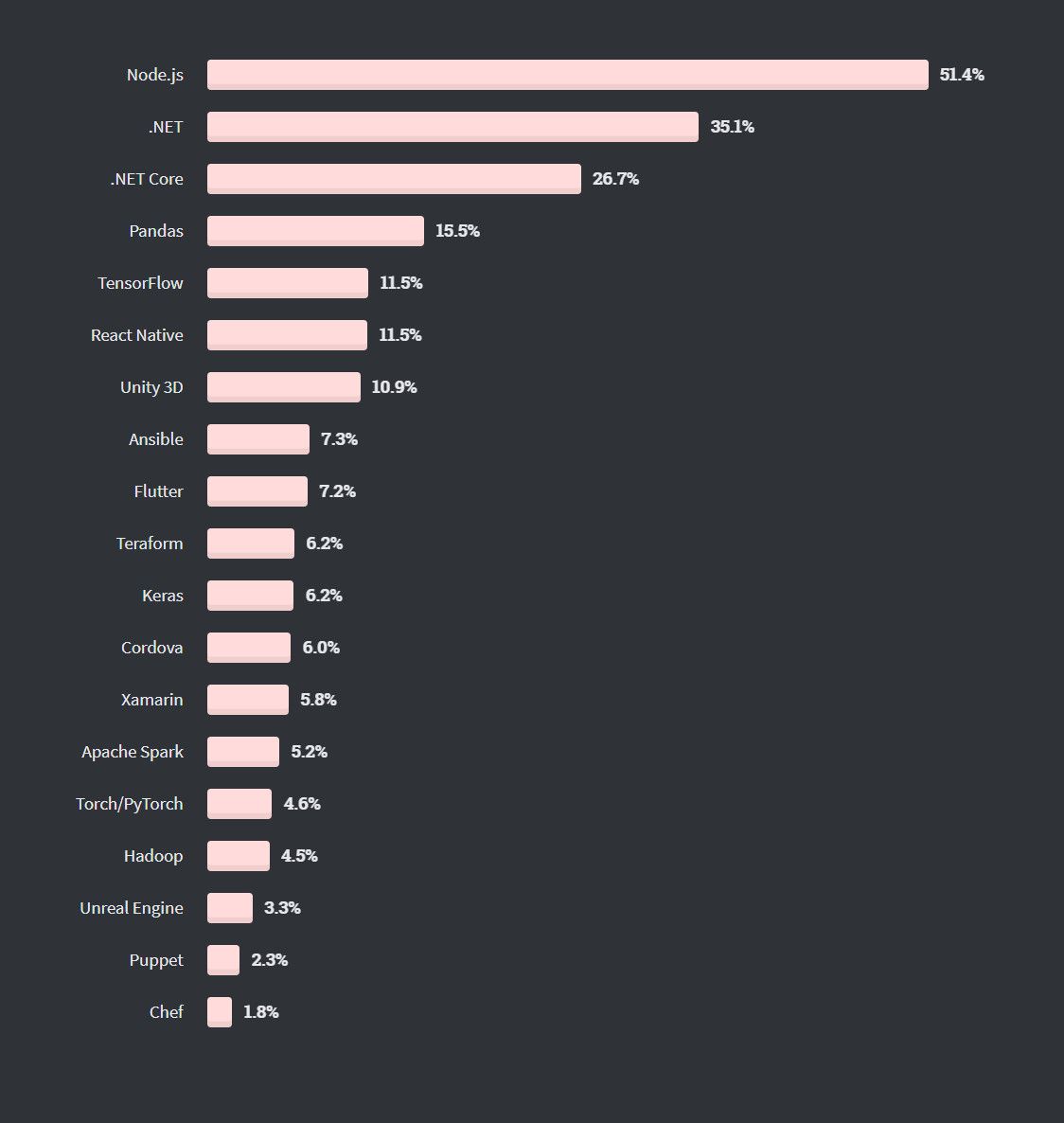
Source: Stack Overflow Insights
Types of applications you can build with Node.js
Node.js offers great advantages for a wide range of applications. Following are the top 6 kinds of applications you can build using Node.js:
1. Internet of Things (IoT)

Internet of Things (IoT) refers to a network of physical devices such as sensors and beacons that share and exchange data through the internet. The data is normally transferred from devices to servers and from servers to the application that displays the data.
Many a time, a single IoT system may consist of a great number of devices. Hence, the task of managing requests and data streams in the IoT system becomes very complex.
Node.js serves as the most optimal solution for developing private and/or public IoT systems.
Why use Node.js for IoT
The biggest reason to choose Node.js for such networks is its remarkable ability to process multiple concurrent requests. Node.js has an event-driven architecture and facilitates asynchronous data processing. As a result, the servers of Node.js do not get blocked and the data requests are processed conveniently.
Secondly, Node.js serves as a smooth and efficient application layer between the IoT devices and the databases that store the information emitted by these devices.
Moreover, Node.js has minimal memory requirements. As a result, node.js developers can easily integrate it with single-board controllers like Arduino. These are commonly used in the creation of digital devices that constitute an IoT system.
2. Real-Time Chat Apps

A real-time chat is an online communication tool that enables live transmission of text, audio, or video messages. These are based on Instant Messaging (IM) or Internet Relay Chat (IRC) technologies. Of course, they can facilitate both one-to-one and one-to-many group chats.
Real-time chat apps are one of the most common types of applications you can build with Node.js.– be it social networking apps or an interactive commercial website.
Why build real-time chat apps with Node.js
Node.js has an Event API that allows developers to work in an event-driven approach with any data. This functionality greatly helps in implementing server-side events and push notifications. Both of these features are frequently used in real-time communication applications.
The event-driven structure of Node.js also allows it to establish and maintain collaboration with WebSockets. A web socket is crucial for a quick exchange of messages between the client and server via one open connection. Thus, Node.js plays a hugely beneficial role in real-time chat apps.
Node.js is capable of carrying out real-time messaging with lower latency and faster data transfer if you choose to install the WebSockets on the server-side as well as on the client-side.
3. Single-Page Applications (SPAs)

A single-page application is a web application that fits on a single page on the browser. Instead of loading the entire new page, the app dynamically rewrites the current web page. This gives users an experience similar to that of a desktop app.
Today, SPAs are widely used to create social networking apps, project management tools, and much more. Gmail is the most practical example of an SPA. It resorts to AJAX for seamless updates of recent messages.
Why build SPA with Node.js
Node.js is a robust runtime environment that can handle asynchronous calls and heavy I/O workloads with great efficiency. This makes it well-suited for complex SPAs.
The event loop characteristic of Node.js authorizes it to delay multiple concurrent requests from the client. Thus, it ensures a subtle and consistent transition accompanied by seamless data updates.
Lastly, Node.js is written in the same language (JavaScript) as used to build SPAs. This makes the work of developers quite simple because they can use the same language and data structure on the server and the client-side. In turn, the development process speeds up and enhances the maintainability of the SPAs.
4. Real-Time Collaboration Tools

Real-time collaboration tools are the ones that enable multiple users to work on the same app simultaneously. There is a wide range of collaboration tools that offer us a bunch of software solutions.
Some of the prominent use cases are project management (Trello) and collaborative editing of documents (Google Docs).
Why build real-time apps with Node.js
Real-time collaboration apps present a case similar to that of real-time chats. Node.js asynchronous and event-based architecture provides a great edge in building these apps.
Collaboration apps generate multiple events and I/O requests simultaneously. For example, a group of students can edit the same document or even the same paragraph of that document. In this scenario, Node.js utilizes the WebSockets and Event API to make sure that the requests and data submitted by multiple users do not hang the server and that all the server-side data is delivered to the client without any delay.
The push notifications given by Node.js promptly update the collaboration environment. This is to ensure that all the users have a single and coherent view of the application.
5. Streaming Apps

Application streaming is a type of on-demand software distribution. They differ from remote server app in nature. Application streaming requires you to download only certain parts of the application on-demand on the device, while the other parts can be downloaded later as and when they are needed. This prevents the overloading of the server and the local computer.
You can also run the application perfectly without any connection at all after it is completely downloaded. Streaming apps like Netflix are certainly one of the best types of applications you can build with Node.js.
Why build streaming apps with Node.js
An inherent feature of Node.js, Stream API, makes it an excellent choice for designing such streaming apps.
Moreover, Node.js possesses a comprehensive interface of readable and writable streams that can be controlled and processed effectively.
6. Apps with microservices architecture
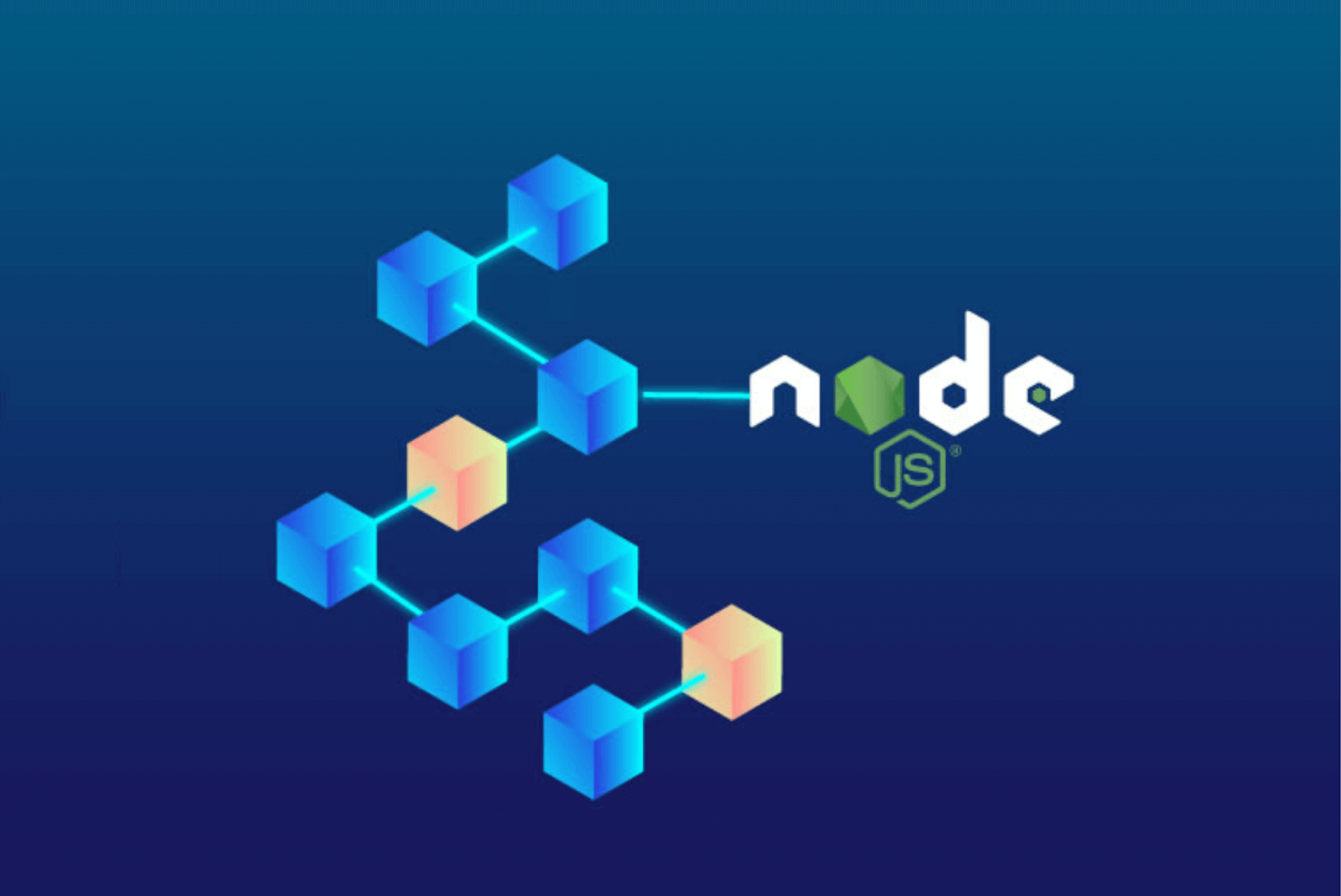
When you build an application with a microservices architecture, you build it as a collection of separate modules. Each module plays a specific role in the app functionality and is developed and tested constantly. When the team has built all the modules, they integrate them to form the complete application.
Large enterprise applications greatly benefit from this architecture type. This is because their development teams are vast and distributed geographically. This approach helps the entire team stay on track.
Why use Node.js for microservices architecture
Native Node.js frameworks like Koa and Express which enable you to create some highly flexible microservices modules.
When integrated with Docker, Node.js contains microservices in their respective containers in a clean, well-differentiated manner. As a result, there is little chance of microservices hampering one another’s functionalities.
Node.js is extremely lightweight and has minimal resource requirements. So building microservices with Node.js makes applications efficient and quickly deployable.
Top Famous Apps Built With Node.js
Because of its advanced features and limited resource requirements, a large number of corporate giants have adopted Node.js application development. So here is a list of 5 Node.js applications built by famous companies.
1. Node.js in PayPal
PayPal, the world’s most popular online payment platform, decided to use Node.js in its application in 2013. Having to write the front end and the back end codes with different languages was the main challenge PayPal’s engineering team was facing.
Node.js was the only way for them to solve this problem. Jeff Harrell, Director of Engineering at Paypal, explains,
“Node.js helps us solve this by enabling both the browser and server applications to be written in JavaScript. It unifies our engineering specialties into one team which allows us to understand and react to our users’ needs at any level in the technology stack.”
2. Node.js in LinkedIn
The world-famous professional networking platform LinkedIn used to run its back-end on Ruby on Rails. However, the company decided to use Node.js for its mobile-app backend in 2011.
As a result, the LinkedIn app became 20% faster with the help of Node.js. Kiran Prasad, VP of Product at LinkedIn, elaborated,
“One reason was the scale. The second is, if you look at Node, the thing it’s best at doing is talking to other services. The mobile app has to talk to our platform API and database. We’re not doing massive data analytics. Node showed us huge performance gains compared to what we were using before, which was Ruby on Rails.”
3. Node.js in Netflix
The global favorite video streaming app Netflix chose to build their entire user interface using Node.js. It sped up the development process manifolds. Moreover, Node.js also reduced the app startup time by over 70%.
Kristofer Baxter, the then UI engineering manager at Netflix, wrote in a blog,
“Three large pain points shaped our new Node.js architecture:
Context switching between languages was not ideal.
Enhancement of markup required too much direct coupling between server-only code generating markup and the client-only code enhancing it.
We’d rather generate all our markup using the same API.”
4. Node.js in Uber
Uber, one of the largest on-demand apps, needed a feasible solution for handling millions of data requests daily. Node.js, with its exceptional data processing features, was chosen by Uber as one of the app’s leading technologies.
Matt Ranney, a senior staff engineer at Uber, had shared,
“One of the things that make Node.js uniquely suited to running in production is that you can inspect and change a program without restarting it. So very few other languages offer that capability. Not a lot of people seem to know that ability exists, but indeed you can inspect and even change your program while it’s running without restarting it.”
5. Node.js in GoDaddy
A leading web hosting and domain registrar company, GoDaddy migrated the back end of its app to a full-fledged Node.js infrastructure. With the help of Node.js, GoDaddy app was able to reduce its dependence on hardware to a great extent.
Antonio Silveira, the then VP of engineering at GoDaddy, had written in a statement,
“We are now using about 10x fewer servers to host our customer websites and we reduced the Time To First Byte (TTFB) considerably from ~60ms to something around ~12ms. Performance is a key differentiator when we talk about web applications, including a better position in Google’s search results.”
The Bottom Line
Node.js is efficient, runs on JavaScript, and speeds up the development process. So from SPA to IoT, there are many different kinds of applications you can build with Node.js. Its serverless architecture, microservices, and event emitters have made it a favorite amongst startups and enterprises alike.
Third Rock Techkno is a leading node.js development company in India and the USA. From our pool of world-class developers, you can hire dedicated Node.js developers for your next project. If you want to build a Node.js app, we’d love to discuss the possibilities of your app ideas. Contact us for a free consultation call with our veteran IT consultants.