
The financial industry is undergoing a significant transformation driven by artificial intelligence (AI). From automating complex financial operations to detecting fraudulent transactions, AI-powered agents are reshaping how financial institutions operate.
A report by PwC estimates that AI will contribute up to $15.7 trillion to the global economy by 2030, with a significant portion coming from the financial sector. AI agents, powered by machine learning (ML) and natural language processing (NLP), are enhancing efficiency, security, and customer experience in banking, investment, and financial management.
Financial institutions are increasingly adopting AI-driven solutions to stay competitive. According to Deloitte, 86% of banks are already using AI in some form, with fraud detection, risk assessment, and customer support being the most common applications.
This blog explores how AI agents are revolutionizing the finance industry, detailing their use cases, benefits, and impact on financial institutions.
Quick answer
AI agents in finance automate reconciliation, fraud detection, reporting, forecasting and customer queries by acting on data, not just analyzing it. In 2026 finance teams use them to close books faster, cut manual errors and monitor transactions in real time — with a human kept in the loop for high-stakes decisions.
What is an AI Agent?
An Artificial Intelligence (AI) agent is an autonomous entity designed to perceive its environment, make decisions, and execute actions to achieve specific goals. Unlike traditional software that operates on predefined instructions, AI agents possess the capability to learn and adapt based on interactions and data. They can function independently, making them invaluable in dynamic environments where real-time decision-making is crucial.
Key Characteristics of AI Agents
- Autonomy: AI agents operate without continuous human oversight, enabling them to perform tasks independently
- Adaptability: They learn from experiences, allowing them to improve performance over time.
- Interactivity: AI agents can communicate with other systems, users, or agents to gather information or coordinate actions.
- Goal-Oriented Behavior: They are programmed to achieve specific objectives, optimizing their actions to meet desired outcomes.
How AI Agents Differ from Traditional Financial Software
Traditional financial software operates on static, rule-based frameworks, meaning it follows predefined logic and requires manual updates to adapt to new conditions. Fraud detection, risk assessment, and financial modeling in these systems rely on fixed algorithms that lack the ability to learn from new data in real time. This makes them reactive rather than proactive, requiring human intervention for optimization and decision-making.
| Feature | AI Agents | Traditional Financial Software |
|---|---|---|
| Decision-Making | Autonomous and adaptive | Rule-based and static |
| Fraud Detection | Predictive and real-time | Reactive and manual review |
| Scalability | Scales with data growth | Limited by fixed algorithms |
| User Interaction | Conversational AI (chatbots) | Form-based inputs |
In contrast, AI financial agents are autonomous, adaptive, and predictive. They analyze large volumes of financial data in real time, detect anomalies, and make data-driven decisions without manual input. Unlike traditional software, AI agents can learn from historical data, continuously improve risk models, and adjust financial strategies dynamically. Their ability to integrate with APIs, external tools, and multiple data sources enables them to provide more accurate, efficient, and scalable financial solutions than traditional systems.
AI Agents for Smarter Finance
Discover how AI agents can optimize risk assessment, fraud detection, and investment strategies.

Insights into AI Agents and the Finance Industry
The adoption of AI agents in finance is driven by the industry's need for efficiency, security, and data-driven decision-making. As financial transactions become more complex and cybersecurity threats rise, AI-driven automation has become a necessity rather than an option.
Market Trends and Statistics
- The global AI in finance market is expected to grow at a CAGR of 37.3%, reaching $3,636 billion by 2030 (Allied Market Research).
- AI-powered fraud detection systems have reduced financial fraud by 50% in leading banks (Statista).
Challenges in Financial Services AI Adoption
Despite its potential, AI implementation in finance faces challenges
- Regulatory Compliance – AI systems must comply with financial regulations like GDPR, PSD2, and the Fair Credit Reporting Act.
- Data Security Concerns – Protecting sensitive financial data is a top priority.
- Integration with Legacy Systems – Many banks operate on outdated IT infrastructure.
- Bias and Transparency Issues – AI models must be explainable to regulators and stakeholders.
Leading financial institutions are overcoming these challenges by investing in AI governance frameworks, ensuring transparency, compliance, and ethical AI usage.
Read More : Exploring the Potential of AI Integration in Flutter-Based Fintech Apps
Different Types of AI Agent Use Cases in Finance
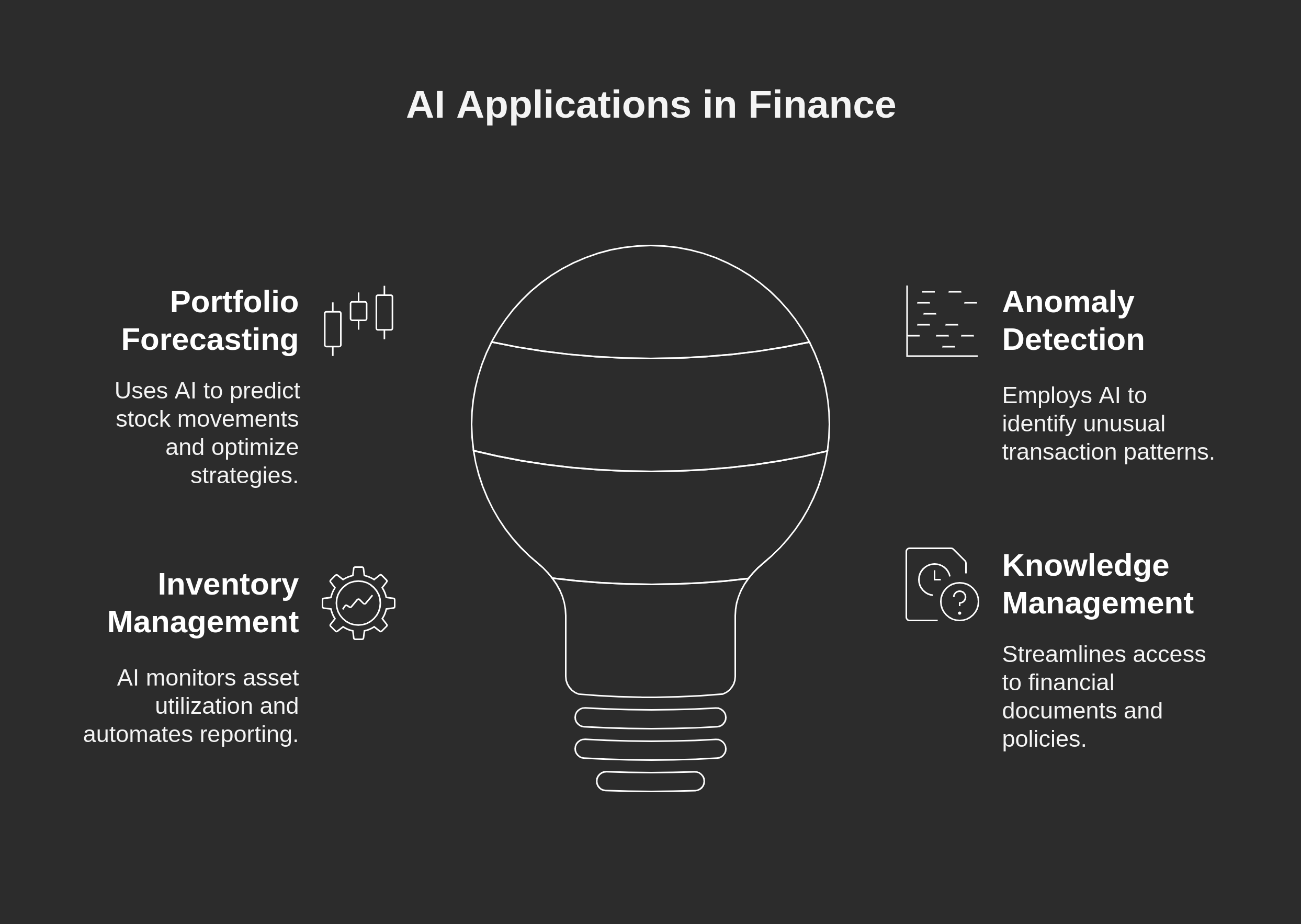
AI agents are transforming various aspects of the finance industry. Here are five key AI applications
1. AI Agent for Trading Portfolio Forecasting
Problem: Investors struggle to make informed decisions due to market volatility.
Solution: AI-driven portfolio forecasting agents analyze historical data, market trends, and news sentiment to predict stock price movements and optimize trading strategies.
Impact
- Increases investment accuracy by 35% (Harvard Business Review).
- Reduces portfolio risks by identifying market fluctuations in advance.
- Provides real-time insights for algorithmic trading.
2. AI Agent for Anomaly Detection in Financial Data
Problem: Financial institutions process millions of transactions daily, making manual anomaly detection inefficient.
Solution: AI agents use unsupervised learning algorithms to detect unusual patterns, ensuring financial integrity.
Impact
- Identifies irregular transactions before they escalate into financial risks.
- Improves regulatory compliance by ensuring accurate financial reporting.
3. AI Agent for Smart Inventory Management
Problem: Financial firms and insurance companies struggle with asset tracking and optimization.
Solution: AI-powered inventory agents monitor asset utilization, predict future needs, and automate financial reporting.
Impact
- Reduces operational costs by 25%.
- Enhances financial planning and budgeting accuracy.
4. AI Agent for IT Company Knowledge Management
Problem: IT finance teams waste time searching for financial data and policy documents.
Solution: AI-powered knowledge management agents, like Athena, streamline finance-related queries by providing instant access to financial policies, reports, and insights.
Impact
- Improves decision-making efficiency by 40%.
- Reduces time spent on searching financial documents by 50%.
A Detailed Look at AI Agent Architecture in Finance
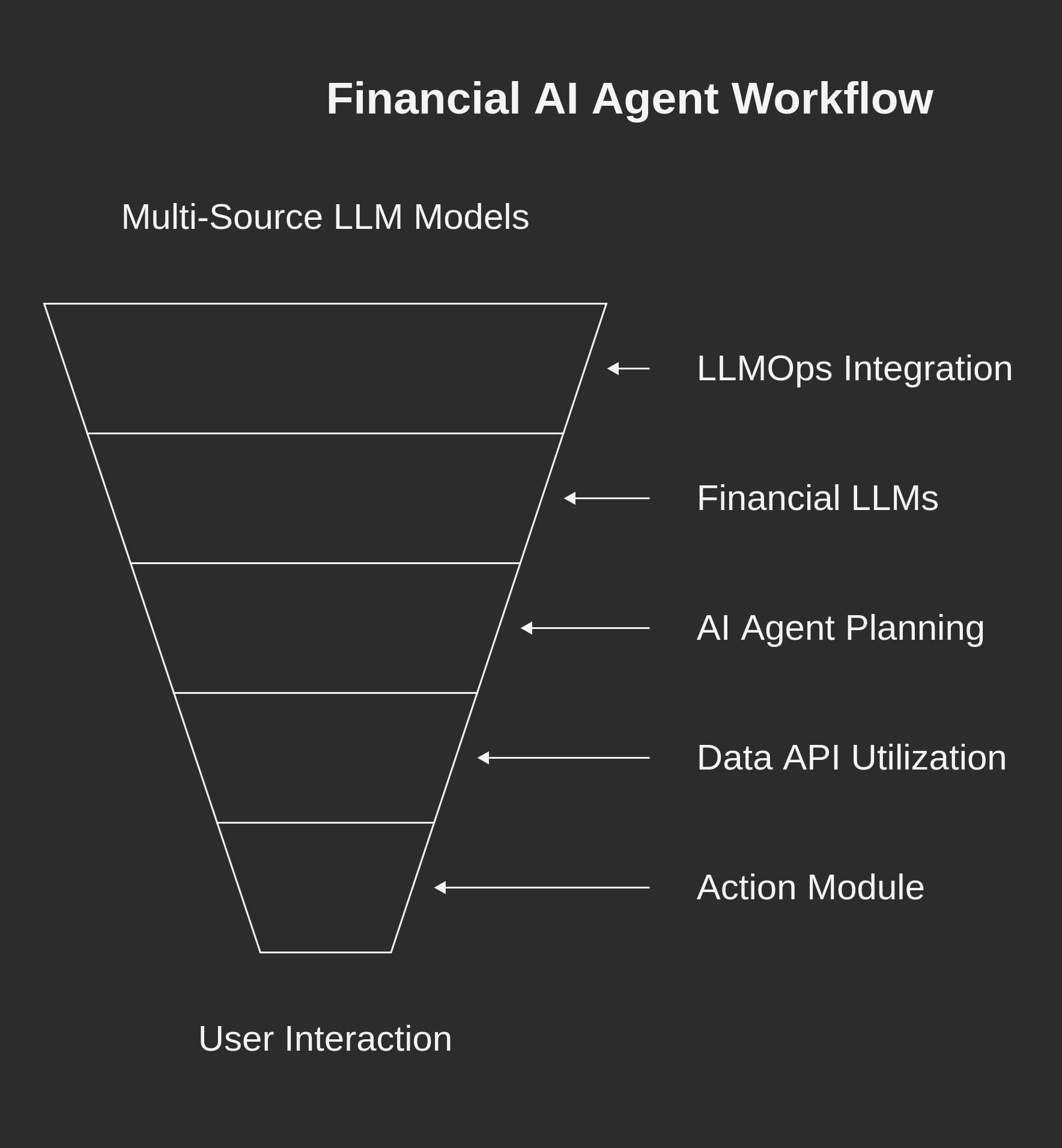
AI agents in finance rely on a well-structured architecture that integrates various AI technologies, data processing systems, and decision-making frameworks. Their core function is to process large volumes of financial data in real time, detect patterns, and make informed decisions with minimal human intervention.
Let’s break down the AI agent architecture in finance step by step.
1. Data Ingestion Layer
AI agents require vast amounts of data to function effectively. This layer collects, processes, and normalizes structured and unstructured financial data.
Data Sources:
- Banking transaction logs
- Credit card transactions
- Market data (stocks, forex, crypto)
- Customer support interactions
- Regulatory and compliance data
Data Processing Methods:
- Real-time streaming (Kafka, Apache Flink)
- Batch processing (Hadoop, Spark)
- API integrations with financial systems
2. Machine Learning & AI Models
Once the data is collected, it moves to the AI models that drive the financial agent’s decision-making.
Types of AI Models Used:
- Supervised Learning: Fraud detection, credit risk assessment
- Unsupervised Learning: Anomaly detection in transactions
- Reinforcement Learning: Algorithmic trading strategies
- Natural Language Processing (NLP): Chatbots and financial document analysis
Model Training & Optimization:
- Feature engineering to improve predictions
- Continuous learning with AI feedback loops
- Model fine-tuning for accuracy
3. Decision-Making & Automation Layer
This layer interprets AI model outputs and applies financial business logic.
Decision Engines:
- Risk scoring models to assess creditworthiness
- Fraud detection rules to block suspicious transactions
- Predictive analytics for investment forecasting
Automation Components:
- Robotic Process Automation (RPA) for handling routine financial operations
- AI-powered chatbots for customer support and financial advisory
4. Security & Compliance Layer
Financial institutions must comply with strict regulations and cybersecurity standards.
Security Measures:
- AI-driven fraud detection with behavioral biometrics
- End-to-end encryption for sensitive financial transactions
- AI-based cyber threat monitoring
Compliance Automation:
- AI models ensuring KYC (Know Your Customer) & AML (Anti-Money Laundering) compliance
- Automatic regulatory reporting and audit trails
5. User Interaction & Insights Layer
The final layer provides real-time insights, reports, and automated customer interactions.
- AI Chatbots & Virtual Assistants: Personalized financial guidance
- AI Dashboard & Reporting: Interactive visualization of key financial metrics
- Voice AI in Banking: Hands-free account management through smart assistants
How are AI financial agents different from standard LLMs?
AI financial agents and standard Large Language Models (LLMs) differ significantly in their design, functionality, and application within the fintech industry. Understanding these differences is crucial for financial institutions aiming to harness artificial intelligence effectively.
Comparison: AI Financial Agents vs. Standard LLMs
| Aspect | AI Financial Agents | Standard LLMs |
|---|---|---|
| Functionality | Designed for specific financial tasks like fraud detection and risk assessment. | Primarily focused on understanding and generating human-like text. |
| Integration | Connects with financial APIs, databases, and real-time transaction systems. | Requires additional frameworks to interact with external systems. |
| Decision-Making | Uses structured reasoning and memory for real-time financial decisions. | Generates responses based on learned patterns but lacks decision-making ability. |
| Autonomy | Operates independently, performing tasks without human intervention. | Requires user input and responds reactively. |
| Regulatory Compliance | Monitors transactions and ensures adherence to financial regulations. | Lacks built-in compliance mechanisms, requiring extra layers for regulatory checks. |
Impact of These Differences on the Fintech Industry
The distinctions between AI financial agents and standard LLMs have profound implications for the fintech sector:
- The distinctions between AI financial agents and standard LLMs have profound implications for the fintech sector:
- Enhanced Efficiency and Accuracy: AI financial agents can process vast amounts of financial data in real time, leading to more accurate risk assessments and fraud detection, thereby reducing operational costs and enhancing decision-making processes.
- Improved Customer Experience: By providing personalized financial advice and services autonomously, AI financial agents enhance customer satisfaction and engagement, offering tailored solutions that adapt to individual financial situations.
- Regulatory Compliance: The ability of AI financial agents to monitor transactions and generate compliance reports ensures that financial institutions adhere to regulatory standards, minimizing the risk of legal penalties and enhancing trustworthiness.
- Operational Autonomy: The autonomous nature of AI financial agents allows them to perform tasks without continuous human oversight, leading to increased productivity and allowing human professionals to focus on more strategic activities.
In contrast, while standard LLMs offer advanced text processing capabilities, their lack of integration and decision-making features limits their direct applicability in complex financial operations without substantial customization and additional frameworks.
By leveraging AI financial agents, fintech companies can achieve greater operational efficiency, compliance, and customer satisfaction, positioning themselves competitively in a rapidly evolving financial landscape.
Benefits of AI Agents in Fiance

AI agents are reshaping the financial landscape by enhancing efficiency, security, and decision-making. Below are the key benefits AI-driven agents bring to finance
1. Advanced Fraud Detection & Risk Mitigation
- AI models analyze transaction patterns to detect suspicious activities in real-time.
- Predictive analytics helps identify potential fraud risks before they escalate.
- AI agents use behavioral biometrics and anomaly detection to reduce fraud incidents.
Impact:- AI-based fraud detection reduces fraudulent transactions by 70% and improves regulatory compliance.
2. Improved Investment and Portfolio Management
- AI-powered trading algorithms analyze market trends for highly accurate stock predictions.
- AI agents optimize portfolio diversification, minimizing risk and maximizing returns.
- Automated market sentiment analysis enhances decision-making for investors.
Impact: AI-driven investment decisions improve portfolio performance by 35%.
3. Faster Loan & Credit Risk Assessment
- AI models assess borrower creditworthiness based on historical and alternative data.
- Machine learning reduces approval time for loans and credit applications.
- AI ensures fair lending practices by eliminating human bias.
Impact:- AI reduces loan processing time by 40% and improves credit approval accuracy.
4. Increased Operational Efficiency & Cost savings
- AI automates time-consuming back-office operations, reducing labor costs.
- AI-driven chatbots handle 80% of routine banking queries, improving customer experience.
- AI minimizes errors in financial reporting, ensuring regulatory compliance.
Impact:- AI-driven automation cuts financial operational costs by 25%
5. Personalized Customer Experience & AI-Driven Support
- AI-powered virtual financial advisors provide personalized investment recommendations.
- Chatbots offer 24/7 customer support for banking, credit card, and investment queries.
- AI customizes financial products based on user behavior and preferences.
Impact:- AI improves customer satisfaction by 60% through personalized services.
6. AI-Powered Regulatory Compliance & Security
- AI automates KYC and AML checks, reducing compliance risks.
- AI-powered regulatory agents generate real-time reports for audits.
- AI models detect security breaches, protecting customer financial data.
Impact:- AI-driven compliance reduces regulatory penalties by 30%.

Build Smart AI Solutions for Your Business
From AI-powered finance tools to intelligent automation, we help businesses integrate AI seamlessly.Conclusion
AI agents are revolutionizing the finance industry by improving security, efficiency, and decision-making. With fraud detection, trading forecasts, financial anomaly detection, and smart inventory management, AI-driven automation is helping financial institutions reduce risks, cut costs, and optimize operations.
As AI adoption in finance continues to grow, businesses that embrace AI-powered agents will gain a competitive advantage, ensuring better financial insights, enhanced security, and seamless automation.
Financial firms must invest in AI governance frameworks, ethical AI practices, and regulatory compliance to maximize AI’s potential in finance.