
E-learning has a completion problem.
Most self-paced online courses see completion rates between 10% and 15%. That's not a typo. For every 100 learners who start a course, only 10-15 actually finish it.
But here's what's interesting: courses with coaching and community support see completion rates above 70%. The content isn't dramatically different. The difference is in support, having someone to turn to when you're stuck.
That's the gap AI chatbots fill.
The chatbot market specifically hit $7.76 billion and is projected to reach $27.29 billion by 2030. This isn't speculative technology. It's the infrastructure that's reshaping how people learn online.
AI chatbots provide instant support, personalized guidance, and 24/7 availability, turning passive content consumption into interactive learning experiences. They answer questions at 11 pm when instructors are asleep. They adapt explanations when learners don't understand the first time. They keep learners engaged when motivation dips.
This guide covers what AI chatbots actually do in e-learning, seven ways they improve learning outcomes, real examples from platforms like Khan Academy and Duolingo, key features to consider, and practical implementation guidance.
What Are AI Chatbots in E-Learning?
AI chatbots in e-learning are conversational interfaces powered by artificial intelligence that interact with learners through text or voice. They use natural language processing and machine learning to understand questions, provide explanations, and guide learning, functioning as always-available teaching assistants.
Not all e-learning chatbots serve the same purpose. They fall into several categories based on their primary function.
AI Tutors explain concepts and guide problem-solving. Khan Academy's Khanmigo is the leading example, it helps students work through math problems, understand historical events, and develop writing skills by asking guiding questions rather than providing direct answers.
Support Bots handle administrative questions and platform navigation. University chatbots, such as Georgia State's "Pounce," answer questions about enrollment, deadlines, and campus resources.
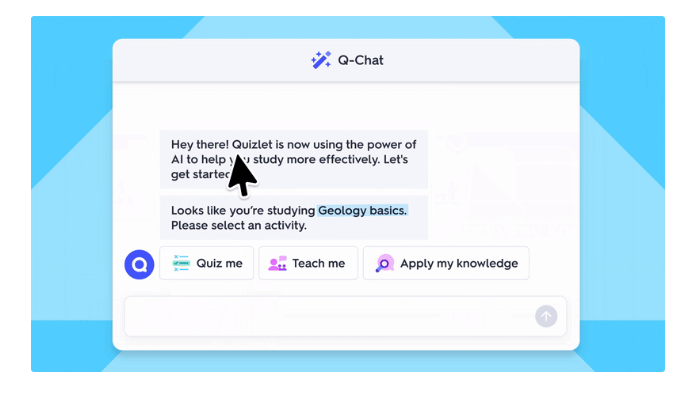
Assessment Bots quiz learners and provide feedback. Quizlet's Q-Chat creates adaptive quizzes and explains answers in real-time.
Language Practice Bots serve as conversation partners. Duolingo Max's Roleplay feature lets learners practice ordering coffee in Paris or discussing vacation plans with AI characters.
Onboarding Bots guide new learners through course setup and platform orientation, reducing the friction that causes early dropoff.
The key distinction is between rule-based bots and AI-powered bots. Rule-based bots follow decision trees with fixed responses. AI-powered bots understand context, generate dynamic responses, and handle questions they've never seen before by understanding intent rather than matching keywords.
The underlying technologies include natural language processing, large language models like GPT-4, machine learning for personalization, and APIs for LMS integration.
Why AI Chatbots Matter for E-Learning
The Completion Rate Problem
The numbers are stark. MOOCs average 10-15% completion rates. Self-paced corporate training often performs similarly. Yet courses with live coaching, community support, or cohort-based structures regularly achieve 70% or higher completion.
The difference isn't content quality. It's interaction and support.
When learners get stuck, they need help immediately. When they lose motivation, they need encouragement. When they don't understand an explanation, they need it rephrased. Traditional e-learning provides none of this at scale.
What Learners Actually Need
Learners need instant answers when they hit obstacles. A question that goes unanswered for 24 hours often means a learner who never comes back.
They need personalized pacing. Some learners grasp concepts quickly; others need more time and different explanations. One-size-fits-all content fails both groups.
They need motivation and accountability. Self-paced learning is lonely. Without external structure, it's easy to postpone, then forget, then abandon.
They need practice without judgment. Learners often hesitate to ask questions they fear are "stupid." They need a safe space to struggle and make mistakes.
They need 24/7 availability. Global learners span every time zone. Working professionals learn at night and on weekends. Learning doesn't follow business hours.
Why Traditional Support Fails at Scale
Human instructors can't be available around the clock. Even the most dedicated teacher sleeps.
Email support introduces delays that kill momentum. A learner stuck at 9pm who gets a response at 2pm the next day has often moved on mentally if not literally.
Forum responses are inconsistent. Sometimes helpful answers come quickly; sometimes questions go unanswered for days. The unpredictability itself is demotivating.
One-on-one tutoring delivers results but doesn't scale economically. At $50-100 per hour, personalized human tutoring is inaccessible for most learners.
The AI Chatbot Opportunity
AI chatbots address each of these gaps. They're available 24/7. They respond in seconds, 6-10 seconds on average. They provide consistent quality regardless of time or volume. They scale without proportional cost increases. And they can personalize interactions based on each learner's history and performance.
This isn't about replacing human instructors. It's about providing the support layer that makes self-paced learning actually work.
Is Your E-Learning Platform Ready for AI?
Find out where chatbot support would have the biggest impact on learner outcomes.

7 Ways AI Chatbots Improve E-Learning
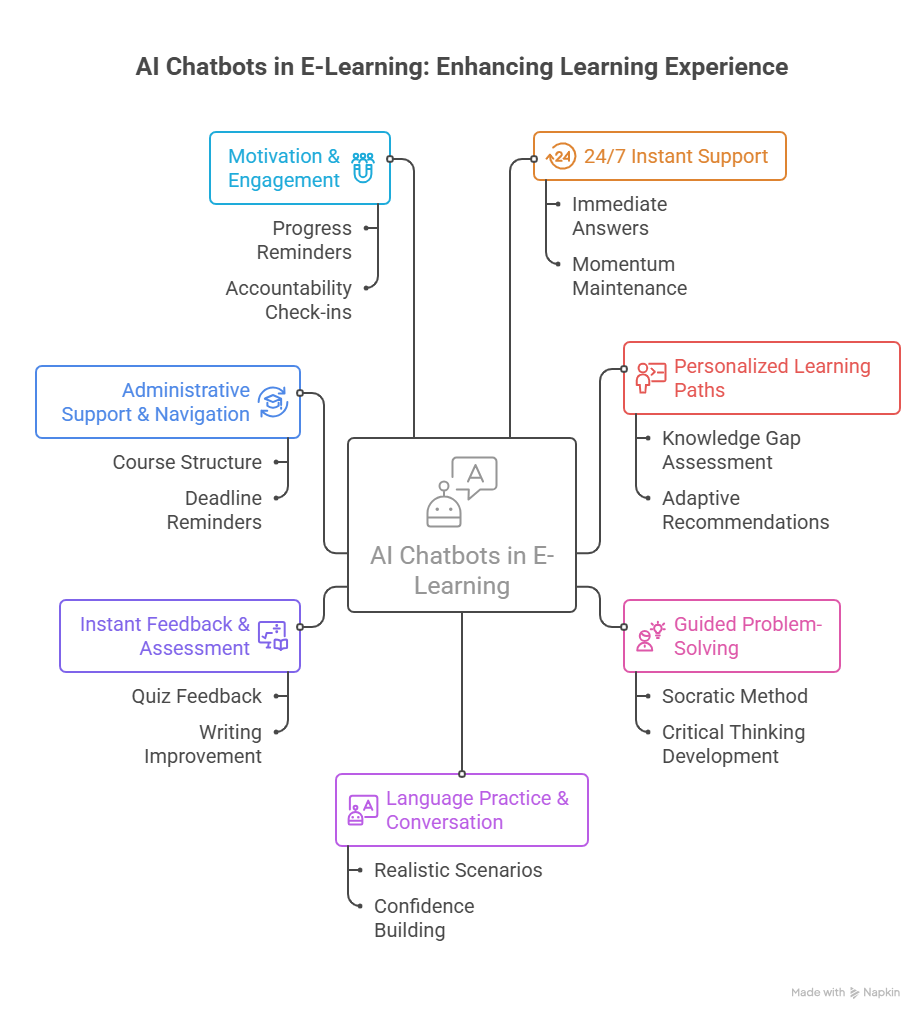
1. 24/7 Instant Support
The scenario is familiar: a learner sits down at 10 pm to work through a module. They hit a concept they don't understand. In traditional e-learning, they have three options: struggle alone, search the internet for explanations that may or may not match the course context, or wait until tomorrow for help. Most choose option three and never return.
AI chatbots eliminate this friction. Questions get answered immediately, any time, maintaining the momentum that drives completion.
2. Personalized Learning Paths
One-size-fits-all content assumes all learners start at the same place and learn at the same pace. That's rarely true.
AI chatbots can assess knowledge gaps through diagnostic questions, then adapt recommendations based on performance. A learner who breezes through foundational concepts moves ahead quickly. A learner who struggles gets additional practice and alternative explanations before advancing.
Khan Academy's Khanmigo demonstrates this well. It tracks student work across the platform and suggests next steps based on individual progress, not a predetermined sequence.
If a student consistently struggles with fractions, Khanmigo recognizes the pattern and recommends targeted practice. The result is learning that meets each person where they are, not where the course designer assumed they'd be.
3. Guided Problem-Solving
There's a pedagogical principle that direct answers don't teach. When someone gives you the answer, you might remember it briefly. When you work through the problem yourself with guidance, you understand it deeply.
This is the Socratic method, teaching through questions rather than statements. It's highly effective but traditionally requires a skilled human tutor. AI chatbots can now deliver this at scale.
It never gives direct answers. Instead, it asks questions: "What do you think happens next?" "What have you tried so far?" "Can you explain your reasoning?" It guides learners to discover solutions themselves, developing critical thinking alongside content knowledge.
For learners accustomed to getting answers from search engines, this approach feels different. But the retention and skill development are substantially better.
4. Language Practice & Conversation
Language learning has a unique challenge: you need speaking practice, but most learners lack conversation partners. Traditional courses teach vocabulary and grammar, but can't provide the real-time conversational practice that builds fluency.
AI chatbots solve this by serving as tireless, judgment-free conversation partners.
Duolingo Max's Roleplay feature creates scenarios where learners practice realistic conversations with AI characters. You might practice ordering coffee in a Parisian café, discussing vacation plans with a colleague, or navigating a job interview. The AI responds naturally, corrects mistakes gently, and adapts to your skill level.
The benefit isn't just practice volume, it's practice without embarrassment. Learners make mistakes freely, ask for repetition without feeling foolish, and build confidence before facing real conversations.
5. Instant Feedback & Assessment
Delayed feedback reduces learning effectiveness. When you submit an assignment and get feedback a week later, you've often forgotten the context and reasoning behind your answers. The learning opportunity has passed.
AI chatbots provide immediate feedback on quizzes, writing exercises, and problem sets. You answer a question and instantly understand what you got right, what you got wrong, and why.
This works across content types. Quiz feedback includes explanations, not just correct/incorrect indicators. Writing feedback suggests improvements in real-time. Programming courses offer code review as learners work. Language courses correct grammar and pronunciation immediately.
Research supports the impact: 72% of students report being more engaged when learning with AI tutors that provide instant feedback. Engagement drives completion, and completion drives outcomes.
6. Administrative Support & Navigation
Not every question is about content. Many are logistical: When is the assignment due? How do I access my certificate? What's the next module?
These seem trivial, but unanswered, they create friction that causes a dropoff. AI chatbots handle administrative queries instantly, knowing course structure, deadlines, and platform features.
Georgia State's "Pounce" chatbot demonstrates the scale handling enrollment, advising, and reminders while reducing support ticket volume significantly.
7. Motivation & Engagement
Self-paced learning is isolating. No cohort, no instructor noticing when you fall behind, no social accountability. It's easy to postpone today's lesson to tomorrow, then next week, then never.
AI chatbots provide nudges that keep learners engaged: progress reminders, milestone celebrations, personalized encouragement, and accountability check-ins. The chatbot becomes an accountability partner, not judgmental, but present.
Real-World Examples
Khanmigo (Khan Academy)
Khanmigo is Khan Academy's GPT-4-powered AI tutor, and it represents the most sophisticated implementation of educational AI available to consumers.
For students, Khanmigo guides problem-solving using the Socratic method. It won't give direct answers, it asks questions that lead students to discover solutions themselves.
It tracks progress across Khan Academy's content library and personalizes recommendations based on individual performance.
For teachers, Khanmigo assists with lesson planning, rubric creation, and generating exit tickets. It summarizes student work to help teachers quickly assess progress and identify who needs additional support.
Duolingo Max
Duolingo Max adds GPT-4-powered features to the already-popular language learning app.
Roleplay creates conversational scenarios where learners practice with AI characters. These aren't scripted dialogues the AI responds naturally to whatever the learner says, creating authentic practice opportunities.
Explain My Answer provides detailed grammar explanations when learners make mistakes. Instead of just marking an answer wrong, it explains the underlying rule and provides examples.
Duolingo Max represents a premium tier, but it demonstrates how AI transforms language learning from passive exercise completion to active conversation practice.
Corporate L&D Applications
Beyond academic settings, AI chatbots transform corporate learning. Onboarding assistants guide new employees through training. Compliance bots answer regulatory questions.
Skill assessment chatbots identify gaps and recommend training. Just-in-time support provides answers when employees need them, not just during scheduled sessions.
Key Features for E-Learning Chatbots
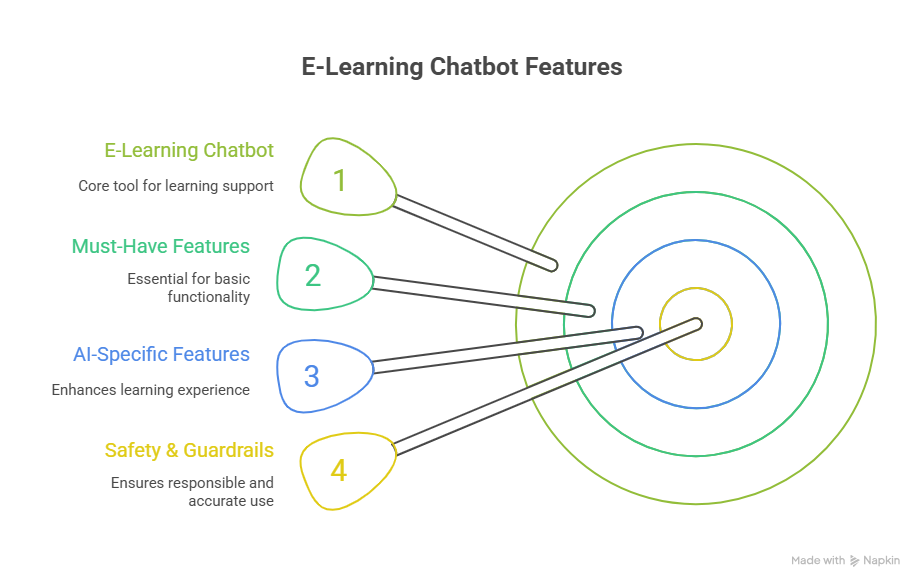
Must-Have Features
LMS Integration connects the chatbot with your learning management system—Moodle, Canvas, Blackboard, or custom platforms. Integration allows the chatbot to access course content, track learner progress, and provide context-aware responses.
Content-Aware Responses ensure the chatbot understands your specific course material, not just generic knowledge. A chatbot that can't answer questions about your actual content isn't useful for learning support.
Multi-Modal Support handles text, voice, and potentially image inputs. Learners might type questions, speak them, or share screenshots of problems they're stuck on.
Progress Tracking logs learner interactions and surfaces insights for instructors and administrators. Understanding how learners use the chatbot reveals where the content needs improvement.
Handoff to Human provides escalation paths when the bot can't help. Some questions require human judgment. Graceful handoff maintains learner trust.
Multi-Language Support serves global learner populations. If your platform operates internationally, your chatbot needs to communicate in learners' languages.
Mobile-friendly design ensures the chatbot works on any device. Many learners access content on phones and tablets.
AI-Specific Features
Socratic Tutoring guides learners toward answers rather than providing them directly, developing deeper understanding and retention.
Adaptive Difficulty adjusts based on learner performance, providing more challenge for advanced learners and more support for struggling ones.
Personalized Recommendations suggest the next content based on individual learning history and performance patterns.
Learning Analytics aggregates interaction data into reports that help instructors understand learner behavior and improve course design.
Safety & Guardrails
Content Boundaries keep the chatbot focused on learning topics, preventing off-topic conversations that waste time or create liability.
Age-appropriate responses matter for platforms serving younger learners.
Accuracy Safeguards reduce hallucination risk through grounding responses in course content and flagging uncertainty.
Data Privacy Compliance ensures learner interaction data is handled according to relevant regulations, FERPA, GDPR, or industry-specific requirements.
Planning an AI Chatbot for Your LMS?
LMS integration checklist, feature requirements, and vendor evaluation criteria.
Implementation Considerations
Challenges to Plan For
Content Quality determines chatbot quality. An AI chatbot trained on poorly organized or inaccurate course content will provide poor responses. Garbage in, garbage out.
Hallucination Risk means AI can generate plausible-sounding but incorrect information. This is especially problematic in educational contexts where accuracy matters. Human oversight and content grounding reduce but don't eliminate this risk.
Over-reliance occurs when learners use the chatbot as a shortcut rather than a learning tool. Some learners will try to get answers rather than understanding. Design choices like Socratic responses that don't give direct answers can mitigate this.
Integration Complexity depends on your existing technology stack. Connecting a chatbot with legacy LMS systems, authentication, and content databases requires technical work.
Cost scales with usage. AI API costs accumulate as learner interactions increase. Budget for ongoing operational expenses, not just initial development.
Best Practices
Start with Specific use cases rather than trying to build everything at once. An FAQ bot that handles common administrative questions is simpler than a full AI tutor and might deliver significant value on its own.
Train on Quality Content specific to your courses. Generic AI knowledge isn't enough. The chatbot needs to understand your curriculum, terminology, and context.
Maintain Human Oversight by monitoring interactions, reviewing chatbot responses, and correcting errors. AI improves with feedback.
Set Clear Expectations so learners understand what the chatbot can and can't do. Overpromising creates frustration when the bot falls short.
Measure Impact by tracking completion rates, engagement metrics, support ticket volume, and learner satisfaction before and after implementation. Data justifies continued investment.
Build vs. Buy
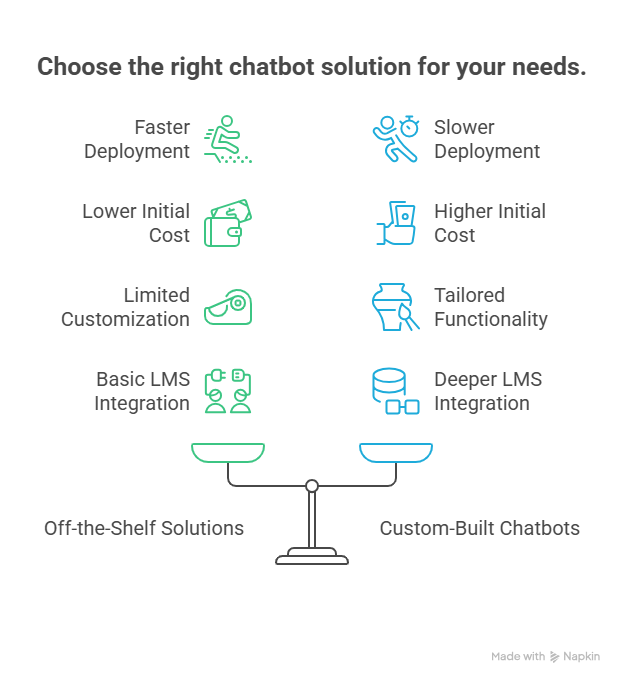
Off-the-shelf solutions offer faster deployment and lower initial costs but limited customization. Custom-built chatbots require higher investment but deliver tailored functionality and deeper LMS integration.
Most organizations benefit from starting lighter to prove value, then investing in custom development as needs clarify.
Ready to Add AI Chatbots to Your E-Learning Platform?
Custom chatbot development built for your content and learners.
Conclusion
E-learning's biggest problem isn't content. There's more high-quality educational content available today than at any point in history.
The problem is support. Students don't fail courses because videos are bad. They fail because they get stuck at 11 pm with no one to help. They lose momentum waiting for answers. They give up when concepts don't click, and there's no one to explain them differently.
AI chatbots solve this by providing instant, personalized, 24/7 support at scale. The completion rate gap between unsupported self-paced courses and supported learning experiences shows what's possible when learners get help when they need it.
The question is whether your e-learning experience will evolve to meet learner expectations or watch completion rates stay stuck while competitors pull ahead. If you are looking for an e-learning chatbot, contact our expert today!
FAQs
What is an AI chatbot for e-learning?
An AI-powered conversational assistant that helps learners by answering questions, explaining concepts, providing feedback, and guiding them through course content. Unlike basic FAQ bots, AI chatbots understand context, generate personalized responses, and adapt to individual learner needs.
How do AI chatbots improve course completion rates?
By providing instant 24/7 support when learners get stuck, offering personalized guidance based on individual progress, and maintaining engagement through check-ins and encouragement.
Can AI chatbots integrate with my existing LMS?
Yes. AI chatbots integrate with platforms like Moodle, Canvas, Blackboard, and custom LMS systems through APIs. Integration allows the chatbot to access course content, track learner progress, and provide responses grounded in your specific curriculum.
Will AI chatbots replace human instructors?
No. Chatbots handle routine questions, provide instant feedback, and support learners around the clock—freeing instructors to focus on complex guidance, mentorship, and the human connection that AI can't replicate. The best implementations combine AI availability with human expertise.
How much does it cost to build an AI chatbot for e-learning?
Costs vary by complexity. Simple FAQ bots start around $10-20K. Full AI tutors with LMS integration, custom content training, and advanced features range from $50-150K+. Ongoing costs include AI API usage, maintenance, and content updates as courses evolve