
Here's a number that should get every school administrator's attention: teachers who use AI tools weekly save an average of 5.9 hours per week. Over a school year, that's six full weeks of time recovered.
That's according to a 2025 Gallup and Walton Family Foundation survey of over 2,200 U.S. teachers. And it's not just teachers benefiting. Schools implementing AI-powered administrative systems report up to 80% reduction in administrative workload, with 60% reporting meaningful cost savings.
The problem is familiar to anyone who's run a school. Attendance tracking. Scheduling. Fee collection. Parent communication. Compliance reporting. Student records. Staff management. Each task is essential. Each task consumes hours that could go toward what actually matters student outcomes.
AI-powered school management systems change this equation. They automate the repetitive work, surface insights from data, and free administrators to focus on students instead of spreadsheets.
This guide covers what AI actually brings to school management, eight key operations it can automate, real benefits with numbers, and practical implementation guidance.
What Is AI in School Management?
AI in school management goes beyond basic software automation. It uses machine learning, natural language processing, and predictive analytics to make school operations smarter, faster, and more proactive.
The distinction matters. Traditional school management software stores data and automates basic workflows. AI-powered systems analyze patterns, predict outcomes, and make intelligent decisions.
Consider the difference in approach:
Traditional software tracks attendance records. AI-powered systems predict attendance patterns and flag students showing early signs of chronic absenteeism.
Traditional software generates schedules. AI-powered systems optimize schedules by considering hundreds of constraints simultaneously teacher availability, room capacity, subject requirements, student needs and produce conflict-free timetables in minutes rather than weeks.
Traditional software sends notifications. AI-powered systems personalize communication timing and channel based on parent engagement patterns.
Traditional software reports on grades. AI-powered systems identify struggling students weeks before they fail, giving educators time to intervene.
The shift is fundamental: from reactive to proactive, from data storage to data intelligence, from manual workflows to autonomous operations.
Four key AI capabilities drive this transformation in school management: pattern recognition across attendance and performance data, predictive analytics for identifying at-risk students and forecasting enrollment, natural language processing for chatbots and document processing, and intelligent automation for scheduling, reporting, and communication.
8 School Operations AI Can Automate
1. Attendance Tracking & Management
Manual roll calls eat into instruction time. Paper-based systems create delays and errors. Administrators often don't see attendance problems until patterns are entrenched.
AI-powered attendance systems use facial recognition, RFID, or biometric scanning to capture attendance instantly. Records update in real-time. Parents receive automatic notifications when students are absent. Administrators get dashboards showing attendance patterns across the entire school.
More importantly, AI detects patterns that humans miss. It identifies students with emerging chronic absenteeism before the problem becomes severe. It spots correlations like students who consistently miss Monday mornings or the period after lunch.
Teachers reclaim instruction time, administrators get real-time visibility across the entire institution, and at-risk students are identified early enough for intervention to work.
2. Timetable & Scheduling
Anyone who's created a school timetable manually knows the pain. Weeks of work. Constant conflicts. Spreadsheets that become unmanageable. And when a teacher calls in sick, the whole system strains.
AI scheduling systems generate conflict-free timetables in minutes—sometimes seconds. They process hundreds of variables simultaneously: teacher availability, subject requirements, room capacities, student course selections, lab equipment access, break times, and more.
When changes happen and they always do AI adjusts on the fly. A teacher absence doesn't require manual scrambling. The system suggests optimal substitutions that minimize disruption.
Resource utilization improves because AI identifies scheduling patterns that humans overlook, ensuring classrooms and labs are used efficiently rather than sitting empty during prime hours.
What traditionally takes weeks of administrative work becomes a streamlined process that frees staff for higher-value activities.
3. Fee Management & Financial Operations
Fee management in schools typically involves manual invoicing, tracking payments across multiple channels, chasing late payments, and reconciling records all while trying to maintain positive relationships with families.
AI-powered fee management automates the entire workflow. Invoices generate automatically based on enrollment data. Payment reminders go out at optimal times. Online payment integration captures transactions in real-time. Dashboards show financial status across the institution.
The predictive element adds another layer. AI can identify families likely to have payment delays based on historical patterns, allowing proactive outreach before accounts become delinquent. It spots anomalies that might indicate errors. It forecasts cash flow based on enrollment and payment trends.
Schools using AI-powered financial management systems report saving up to 40% of administrative time per term on fee-related tasks.
4. Student Information Management
Student data in most schools lives in multiple systems that don't communicate well. Enrollment information in one database. Grades in another. Health records somewhere else.
Generating a comprehensive report means pulling data from multiple sources and manually combining it.
AI-powered student information systems create a unified database with intelligent capabilities. Natural language processing can extract information from forms and documents automatically.
AI-powered search lets administrators find student records quickly using natural queries. Cross-system synchronization keeps data consistent.
Report generation that once took hours happens in seconds. Custom reports that required IT support can be created by administrators directly. The single source of truth for student data eliminates the inconsistencies that plague fragmented systems.
Is Your School Ready for AI-Powered Management?
Find out which manual processes are costing you the most time.

5. Parent & Student Communication
Schools receive hundreds of routine inquiries. What time does school start? When is the next parent-teacher conference? Has my child's fee been received?
What's on the lunch menu? Each question is important to the parent asking it. Collectively, they consume enormous staff time.
AI chatbots handle 70-75% of these routine inquiries without human intervention. They're available 24/7, responding instantly whether the question comes at 2pm or 2am. They communicate across channels SMS, WhatsApp, email, mobile apps meeting parents where they are.
Beyond answering questions, AI personalizes communication. Notifications about attendance, grades, and upcoming events can be tailored to individual families. Sentiment analysis on parent feedback helps administrators understand community concerns before they escalate.
The staff time freed from answering routine questions can go toward the conversations that actually require human judgment and relationship-building.
6. Predictive Analytics for Student Success
This is where AI delivers perhaps its most significant impact: identifying students who need help before they fail.
Traditional approaches to at-risk students are reactive. A student fails a class, and then intervention begins. By that point, the student may have disengaged, fallen behind peers, and developed negative associations with school.
AI-powered early warning systems analyze patterns across multiple data sources attendance, assignment completion, grades, engagement metrics, behavioral indicators to flag students showing early signs of struggle.
Georgia State University provides a compelling case study. They analyzed ten years of student data to create 800 indicators of academically at-risk students, then built an early warning system that sends push notifications to advisors when students show warning signs.
The system has prompted over 200,000 advisor interventions, and the university has eliminated achievement gaps between high-risk student populations and the general student body.
For K-12 schools, similar approaches work. A middle school might notice that students with declining engagement in 6th grade are at high risk by 8th grade. Using an early warning dashboard, they can identify those 6th graders early in fall and implement mentoring programs before problems compound.
7. Exam & Assessment Management
Exam scheduling, administration, and grading consume significant time in any school. Creating exam timetables that don't conflict with each other or with room availability.
Grading objective assessments. Tabulating results. Generating report cards. Each step takes time and introduces potential for error.
AI streamlines the entire process. Exam scheduling considers all constraints room availability, subject combinations, student enrollments to generate conflict-free schedules automatically.
For objective assessments, AI-assisted grading provides instant results. Result tabulation and report card generation that once required days happens in hours.
According to surveys, 68% of teachers say automating grading makes their jobs less stressful. The quality often improves too AI applies grading criteria consistently in ways that are difficult for humans managing hundreds of papers.
8. Staff & HR Management
School HR involves unique complexities. Leave management must account for academic calendars and ensure class coverage. Payroll connects to attendance. Workload balancing across teachers affects both staff satisfaction and educational quality.
AI-powered HR modules automate leave management with intelligent substitution suggestions. Payroll integration with attendance systems reduces errors. Workload analysis ensures fair distribution of teaching loads, identifying imbalances before they cause burnout.
Performance tracking provides data for professional development decisions. Forecasting helps administrators plan for staffing needs based on enrollment trends.
Real Benefits of AI in School Management
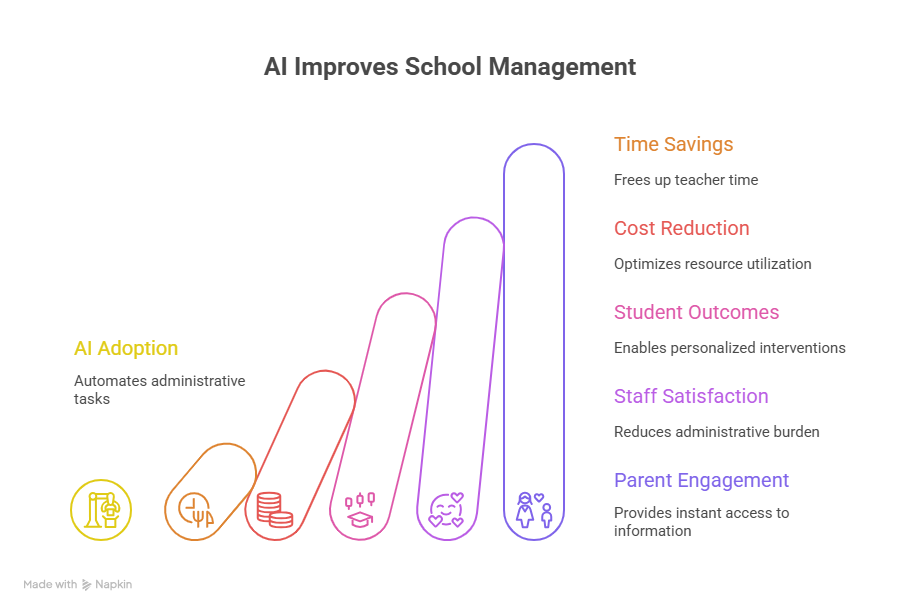
Time Savings
The numbers are consistent across research. Teachers using AI weekly save 5.9 hours per week equivalent to six weeks over a school year. For administrative tasks specifically, AI scheduling reduces timeline from weeks to minutes. Report generation goes from hours to seconds.
That time doesn't disappear. It redirects toward higher-value activities: actual teaching, student interaction, strategic planning, and the work that made people choose education in the first place.
Cost Reduction
The math is straightforward reduced manual labor on repetitive tasks, fewer errors requiring rework, optimized utilization of physical resources like classrooms and labs, and better forecasting reducing waste.
Initial investment in AI systems typically pays for itself through operational efficiencies. The schools seeing the best ROI are those that strategically deploy AI for high-volume, repetitive tasks first.
Improved Student Outcomes
When teachers spend less time on paperwork, they have more time for students. When at-risk students are identified in week three rather than after they've failed, interventions actually work. When data drives decisions, resources go where they have the greatest impact.
The connection between administrative efficiency and student outcomes isn't always obvious, but it's real. Every hour an administrator spends on manual scheduling is an hour not spent on educational leadership.
Staff Satisfaction
Beyond quality, there's the satisfaction of spending time on meaningful work rather than paperwork. AI-powered workload balancing creates fairer distribution of responsibilities. Reduced administrative burden contributes to lower burnout.
Teacher retention is a persistent challenge in education. Administrative burden is consistently cited as a factor in burnout and departure. AI that genuinely reduces that burden contributes to keeping experienced educators in classrooms.
Better Parent Engagement
Parents increasingly expect instant access to information about their children's education. AI enables that without requiring staff to be available 24/7. Chatbots answer questions at any hour. Personalized notifications keep parents informed about attendance, grades, and events. Real-time access to student information builds trust and engagement.
Stronger parent engagement correlates with better student outcomes. AI makes that engagement scalable.
Planning an AI School Management System?
Data prep, vendor criteria, implementation milestones all in one checklist.
Key Features to Look For Must-Have Features
Unified Dashboard: All modules attendance, scheduling, fees, communication, analytics accessible from a single interface. Switching between disconnected systems wastes time and creates data silos.
Mobile Access: Apps for administrators, teachers, parents, and students. Education happens everywhere, and management tools need to be accessible everywhere.
Role-Based Access: Different users need different permissions. Teachers see their classes. Parents see their children. Administrators see everything. Security and usability both require appropriate access controls.
Integration Capabilities: Schools have existing systems LMS platforms, accounting software, state reporting systems. AI school management systems need APIs that connect with existing infrastructure.
Data Security & Compliance: Student data is sensitive and regulated. Look for FERPA compliance (in the U.S.), encryption for data at rest and in transit, secure cloud hosting, and clear data handling policies.
Scalability: Your school may grow. Your system should grow with it without requiring replacement.
Analytics & Reporting: Real-time dashboards and custom report capabilities. The value of data depends on ability to access and understand it.
AI-Specific Features
Predictive Analytics: At-risk student identification, enrollment forecasting, payment prediction. The proactive capabilities that distinguish AI from basic automation.
Intelligent Automation: Smart scheduling that optimizes rather than just generates. Workflows that adapt to patterns.
Natural Language Processing: Chatbots that actually understand questions. Document processing that extracts information automatically.
Continuous Learning: AI systems that improve over time as they learn your institution's patterns.
Implementation Considerations
Challenges to Anticipate
Data Quality: AI is only as good as the data it learns from. If your current systems have inconsistent, incomplete, or inaccurate data, AI will struggle. Data cleanup is often a necessary first step.
Change Management: New systems require new workflows. Staff need training not just on how to use the system but on how their roles evolve. Resistance to change is normal and needs to be addressed proactively.
Integration Complexity: Connecting new AI systems with legacy infrastructure can be technically challenging. Plan for integration work and potential customization.
Privacy & Security: AI systems processing student data require robust security. Evaluate vendors carefully on data handling practices.
Cost: AI school management systems require investment. Weigh initial costs against long-term savings and benefits. Phase implementation to manage cash flow.
Best Practices for Implementation
Start Small: Pilot with one module attendance or scheduling are common starting points. Prove value before expanding.
Clean Your Data: Invest time in data quality before AI deployment. The return on that investment compounds.
Train Thoroughly: Staff need to understand and trust the system. Undertrained users underutilize capabilities and generate frustration.
Monitor & Adjust: AI outputs need human oversight, especially initially. Review predictions and automated decisions for accuracy. Provide feedback that helps the system improve.
Plan for Evolution: Roles will change as AI handles more routine work. Prepare staff for how their jobs will evolve, emphasizing the higher-value work they'll be able to focus on.
Key Questions to Ask Vendors
- How does your AI handle our specific constraints and requirements?
- What data security certifications do you have?
- Can you integrate with our existing systems? What training and support do you provide?
- What does typical implementation timeline look like?
- How has your system performed for schools similar to ours?
Ready to Automate Your School Operations?
Custom AI-powered school management systems built for your institution.
Conclusion
School management has always been complex. Multiple systems, endless paperwork, reactive problem-solving. AI doesn't eliminate the complexity it handles it.
The institutions seeing real results aren't just digitizing paper processes. They're using AI to predict problems before they happen, automate workflows that used to consume hours, and surface insights that drive better decisions.
Teachers save six weeks a year. Administrators shift from data entry to strategic planning. At-risk students get interventions early enough to make a difference.
The technology is mature. The case studies are proven. The question is whether your institution is ready to make the shift.
Ready to bring AI to your school management?
Third Rock Techkno builds custom AI school management system at the core from intelligent scheduling to predictive analytics. We help K-12 schools and educational institutions automate operations while keeping students at the center.
FAQs
What is a school management system?
Software that centralizes daily school operations attendance, scheduling, fees, student records, and parent communication into one platform. It replaces scattered spreadsheets and paper processes with a unified system accessible to administrators, teachers, and parents.
How does AI improve school management software?
AI automates repetitive tasks like attendance tracking and fee reminders, generates conflict-free timetables in minutes, and predicts which students need intervention before they fail. It turns school data into actionable insights instead of just storing it.
Can AI track student attendance automatically?
Yes. AI-powered systems use facial recognition, RFID, or biometrics to mark attendance in real-time without manual roll calls. Parents get instant notifications for absences, and administrators see patterns like chronic absenteeism early.
What is the best school management software for small schools?
Look for cloud-based systems with modular pricing start with core features like attendance and fees, then add modules as needed. Avoid enterprise systems with features you won't use and costs you can't justify.
Does AI replace school administrators?
No. AI handles the repetitive, time-consuming tasks data entry, scheduling, routine parent queries so administrators can focus on students, staff support, and decisions that require human judgment.