
Here's a number that should make every eLearning app owner uncomfortable: the average course completion rate on platforms like Coursera sits at just 13%.
Think about that. For every 100 people who sign up, 87 never finish.
It's not that the content is bad. It's that traditional eLearning apps treat every learner the same way. Same pace. Same content order. Same experience for a complete beginner and someone who's halfway there already.
That's where AI changes the game.
The global eLearning market is racing toward $400 billion by 2026. But the apps that'll capture that market aren't the ones with the most content, they're the ones that keep learners coming back. And right now of students already use AI tools for learning, according to the Digital Education Council.
The question isn't whether to add AI to your eLearning app. It's the features that actually move the needle on engagement.
This guide breaks down the seven AI features that turn passive learners into active ones and the business metrics that prove they work.
7 AI Features That Keep Learners Coming Back
Let's skip the buzzwords and get to what actually works. These aren't theoretical features from a research paper. They're the ones driving results in real eLearning apps right now.
1. Adaptive Learning Paths
Traditional eLearning works like a highway with no exits. Everyone takes the same route, regardless of where they started or how fast they're moving.
Adaptive learning flips this completely.
AI tracks how each learner performs what they struggle with, what they breeze through, and how they interact with different content types. Then it adjusts the learning path in real time.
If someone's already solid on basic concepts, the system skips ahead. If they're stuck on a particular topic, it serves up additional explanations, practice problems, or alternative formats until things click.
How it Works Technically
The AI uses algorithms that analyze three things: learner profile data (background, preferences), real-time performance (quiz scores, time spent), and historical patterns (what worked for similar learners). Based on this, it continuously recalibrates the content sequence.
Real-World Example
Duolingo does this exceptionally well. Miss a question about verb conjugation? The app doesn't just mark it wrong and move on. It notes the gap, adjusts your practice schedule, and brings that concept back until you've genuinely mastered it.
The Engagement Impact
According to Whatfix, the global adaptive learning market jumped from $2.87 billion to $4.39 billion in 2025 alone, a 52.7% increase. That growth isn't accidental. Studies show AI-based adaptive platforms can improve retention rates by up to 60% compared to traditional methods.
2. Personalized Content Recommendations
Netflix figured this out years ago. Show people what they actually want to watch, and they'll stick around longer.
The same principle applies to learning.
AI-powered recommendation engines analyze a learner's behavior, what topics they engage with, how long they spend on different content types, what they skip, and what they replay. Then they serve up suggestions that feel almost eerily relevant.
How it Works Technically
Natural Language Processing (NLP) and reinforcement learning work together here. NLP helps the system understand the content itself, what topics it covers, and what skill level it targets.
Reinforcement learning tracks what each learner responds to and keeps refining recommendations based on engagement signals.
Why it Matters for Engagement
Think about the alternative. A learner finishes a module and sees a generic "up next" suggestion that has nothing to do with their goals. They bounce. But show them something directly connected to what they just learned, or something that fills a gap they didn't even know they had? They click. Think about the alternative. A learner finishes a module and sees
The Numbers
Platforms using AI-driven personalization report significantly higher session times and return rates. When learners feel like the app "gets" them, they're far more likely to come back tomorrow.
Thinking About Adding AI to Your eLearning App?
We help EdTech companies figure out which AI features actually move the needle and which ones are just hype.

3. AI Chatbots and Virtual Tutors
Here's when most learners get stuck: 11 PM on a Tuesday, working through a concept that just won't click.
In a traditional setup, they have two options. Wait until office hours (and probably forget the question by then). Or give up and move on with a gap in their understanding.
AI tutors solve this by being available around the clock without the cost of human tutors working night shifts.
But the good ones don't just answer questions. They guide learners toward answers using the Socratic method, asking follow-up questions that help people work through problems themselves.
Real-World Example:
Khan Academy's Khanmigo, powered by GPT-4, does exactly this. Ask it for the answer to a math problem, and it won't just tell you. It'll ask what you've tried, point out where your thinking went sideways, and walk you through the logic step by step.
In pilot programs, 47% of students using Khanmigo reported feeling more confident in problem-solving. Teachers noticed increased engagement, especially from quieter students who were hesitant to ask questions in class.
The Business Case
AI chatbots can handle the vast majority of routine learner queries, scheduling questions, navigation help, and basic concept explanations without human intervention.
That frees up your support team for complex issues while giving learners instant responses whenever they need them.
4. Smart Gamification
Gamification isn't new. But most apps do it wrong.
Slapping badges on everything doesn't magically make learning fun. Neither does a leaderboard that just makes slower learners feel bad about themselves.
Smart gamification uses AI to adjust the challenge level, personalize rewards, and create competition that motivates rather than discourages.
The Difference AI Makes
Instead of fixed difficulty levels, AI-powered gamification adapts challenges based on individual performance. Struggling learners get achievable goals that build confidence. Advanced learners get pushed harder to stay engaged.
The system also learns what motivates each person. Some respond to competition (leaderboards). Others prefer personal milestones (streaks, progress bars). AI figures out which incentives work for whom and adjusts accordingly.
The Stats are Hard to Ignore
According to BuildEmpire, eLearning courses with gamification see a 90% completion rate compared to just 25% for non-gamified courses. That's not a small improvements, it's the difference between a product that works and one that doesn't.
Employees retain 22% more information when training is gamified. And 67% of students say gamified courses are more engaging than traditional ones.
What Good Gamification Looks Like
Duolingo's streak system is the textbook example. Miss a day, lose your streak. It sounds simple, but the psychological pull of maintaining a 50-day streak is powerful.
The app also uses AI to time notifications perfectly, reminding you to practice right when you're most likely to actually do it.
5. Real-Time Analytics and Dropout Prediction
Most eLearning platforms can tell you who dropped out. Few can tell you who's about to.
That's the difference AI makes in analytics.
By monitoring engagement patterns, login frequency, time between sessions, quiz performance trends, and content interaction rates, AI can flag at-risk learners before they disappear. This gives instructors or the system itself a chance to intervene.
How Predictive Analytics Work
The AI builds models based on historical data. What did learners who eventually dropped out have in common? Maybe they stopped logging in daily. Maybe their quiz score started slipping. Maybe they started skipping video content.
Once the system identifies these patterns, it watches for them in active learners. When someone starts showing warning signs, the platform can trigger interventions, such as a personalized email, a push notification, a recommendation to revisit foundational content, or an alert to a human instructor.
Real-World Example
Georgia State University's GPS Advising system uses this approach and generated over 200,000 advisor interventions. The system identifies students who might struggle as early as week 3 of a course, with 74% accuracy that improves to 89% by week 15.
For eLearning App Owners
This isn't just about completion rates. Predictive analytics help you understand where your content fails. If a specific module consistently correlates with dropouts, that's a signal to redesign it. Data turns guesswork into strategy.
6. Automated Content Generation
Creating quality eLearning content is expensive and time-consuming. A single hour of polished eLearning content can take 40-100 hours to develop.
AI is changing that math dramatically.
Generative AI can now create quizzes, summaries, flashcards, and even draft lesson outlines in minutes. It won't replace instructional designers entirely, but it handles the heavy lifting so humans can focus on quality and creativity.
What AI Can Generate
- Quizzes and assessments - Based on lesson content, AI can generate multiple-choice questions, true/false questions, and even scenario-based assessments.
- Summaries and recaps - Automatically condense lengthy content into key takeaways.
- Flashcards - Extract important terms and concepts for spaced repetition practice.
- Multilingual content - Translate and localize courses for global audiences faster than ever.
- Course outline - Generate structured lesson plans based on learning objectives.
The Engagement Connection
Faster content creation means more relevant, timely content. If a new industry regulation drops, you can have training ready in days instead of months. If learners consistently struggle with a specific concept, you can quickly generate supplementary materials.
Fresh content keeps learners engaged. Stale content drives them away.
The Productivity Impact
According to surveys, 44% of teachers now use AI for research and content gathering, 38% for lesson planning, and 37% for generating classroom materials. One educator reported tasks being cut by 10-20%, saving 5-10 hours per week.
Not Sure Where to Start with AI for Your Learning Platform?
We'll walk you through what works for your learners, your content, and your budget.
7. Microlearning with AI Curation
People don't have time for hour-long modules anymore.
According to research, the average employee has just 24 minutes per week for learning. That's not a typo. Twenty-four minutes.
Microlearning breaks content into 3-10 minute chunks that fit into the cracks of a busy day. But without AI, microlearning can feel disjointed, random bits of information without a clear path.
AI curation solves this by intelligently sequencing micro-content based on each learner's goals, knowledge gaps, and available time.
How it Works
The AI knows your learning objectives. It knows what you've what yo've already mastered. It knows you have 8 minutes before your next meeting. So it serves up the perfect bite-sized lesson, not too easy, not too hard, and directly relevant to what you're trying to learn.
Over time, these small sessions compound into real skill development.
The Retention Advantage
Studies show microlearning can boost retention compared to traditional long-form content. Mobile learning, often delivered in micro-format, boosts productivity, with learners completing training faster.
Why This Matters for Engagement
The biggest enemy of eLearning isn't bad content. It's friction. The easier you make it to learn something in a spare moment, the more often people will do it. AI-curated microlearning removes the friction of deciding what to learn next.
How These Features Actually Impact Your Numbers
Features don't matter if they don't move business metrics. Here's what the data shows.
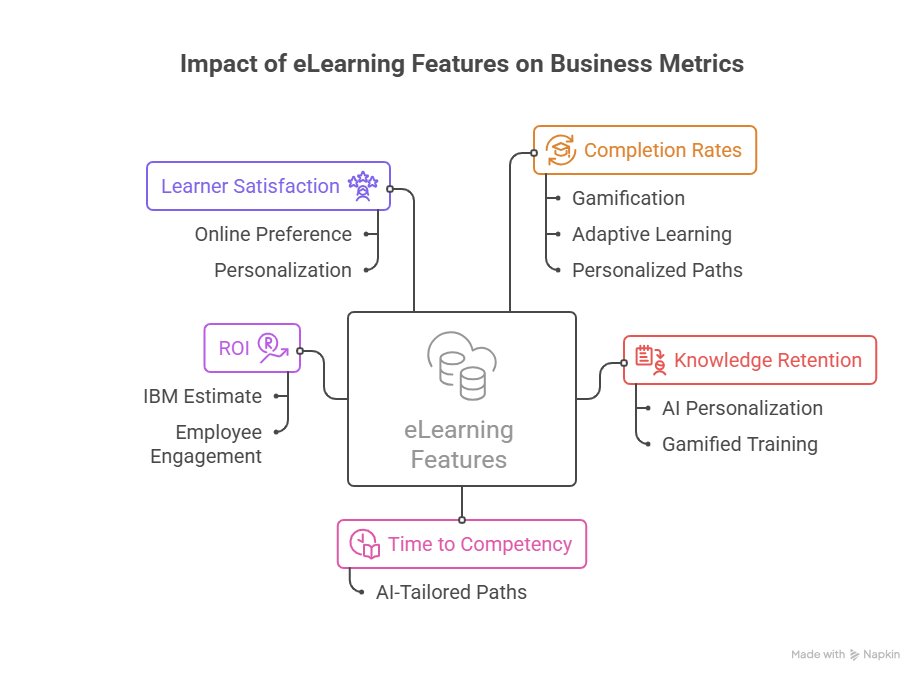
Completion Rates
The gap between gamified and non-gamified courses tells the whole story. Add adaptive learning and personalized paths, and you're looking at fundamentally different outcomes. AI-powered platforms routinely report 2-3x higher completion rates than traditional approaches.
Knowledge Retention
eLearning already beats traditional classroom instruction retention rates of 25-60% versus 8-10%. Add AI personalization, and retention improves further. Gamified training adds another 22% improvement in information retention.
Time to Competency
AI-tailored learning paths can increase efficiency, according to recent research. That means employees or students reach proficiency faster valuable for corporate training where time is money.
ROI
IBM estimates that every dollar spent on eLearning produces $30 in productivity gains. With AI amplifying engagement and completion, that ROI only grows. Companies using digital learning tools report a 35% increase in employee engagement.
Learner Satisfaction
85% of learners now prefer online learning over traditional classroom settings. When that online experience is personalized and adaptive, satisfaction scores climb even higher.
What Most eLearning Apps Get Wrong with AI
Adding AI isn't automatically a win. Plenty of apps bolt on "AI features" that don't actually improve anything. Here's where they go wrong.
Mistake 1: AI Without Strategy
Throwing AI at every feature doesn't make sense. The question should always be: what specific problem does this solve? AI for the sake of AI creates complexity without value.
Mistake 2: Ignoring the Data Foundation
AI is only as good as the data feeding it. Apps that don't properly track learner behavior, content interactions, and outcomes end up with AI that makes mediocre recommendations based on incomplete information.
Mistake 3: Over-Automating the Human Element
Some things still need a human touch. Complex questions, emotional support, and nuanced feedback AI can assist, but fully replacing human connection in learning often backfires. The best apps use AI to enhance human interactions, not eliminate them.
Mistake 4: Generic Implementation
Using off-the-shelf AI without customization leads to generic experiences. An AI trained on general data won't understand the nuances of your specific content, learners, or industry. Custom training and fine-tuning matter.
Mistake 5: Neglecting Privacy and Trust
AI in eLearning requires significant data collection. Apps that don't handle this transparently, clear privacy policies, user control over data, and ethical AI practices lose learner trust fast.
Ready to Build an AI-Powered eLearning App?
Let's turn your idea into a platform that actually keeps learners engaged.
Building an AI eLearning App That Works
If you're planning to build or upgrade an AI-powered eLearning app, here's what separates successful projects from expensive failures.
Start with Use Cases, Not Technology
Don't start by asking, "How can we use AI?" Start by asking "what's broken in our learner experience?" Maybe it's completion rates. Maybe it's content discoverability. Maybe it's support response times. AI is the solution, not the starting point.
Data Infrastructure Matters
Before implementing AI features, make sure you're collecting the right data in the right format. Learner behavior tracking, content tagging, and outcome measurement. This foundation determines whether your AI will be smart or mediocre.
Plan for Iteration
The first version of any AI feature won't be perfect. Build in feedback loops. Monitor performance. Continuously train and refine your models based on real user behavior.
EdTech Experience Is Non-Negotiable
Building AI into eLearning isn't the same as building AI into an eCommerce app or a CRM. Learning has its own patterns, metrics, and user psychology. Development partners who understand education will make better decisions at every step.
Consider the Full Stack
AI features don't exist in isolation. They need to integrate with your LMS, your content management system, your analytics tools, and your user experience. Fragmented implementation creates fragmented experiences.
Conclusion
The eLearning market is massive and growing. But size doesn't guarantee success for individual apps.
AI isn't magic. But applied thoughtfully, it turns static courses into adaptive experiences that meet learners where they are. Adaptive paths. Smart recommendations.
Always-available tutoring. Gamification that actually works. Analytics that predict problems before they happen. These aren't future features. They're what leading platforms are using right now.
The question for eLearning app owners is simple: will your platform keep up, or get left behind?
Ready to build an eLearning platform that learners actually finish? Let’s talk.
FAQs
Why should we choose Third Rock Techkno as our project's preferred FlutterFlow development agency?
Third Rock Techkno is a reputed FlutterFlow development agency comprising talented developers who stay updated on the latest developments in the platform. They strive hard to deliver innovative yet creative applications that utilize the platform in the best possible way.
What makes the FlutterFlow platform better than other contemporary methods?
The biggest advantages of the FlutterFlow platform are its beginner-friendliness and low-code approach, which allows even novice developers to try developing an application using this innovative platform.
What post-deployment services can I expect from Third Rock Techkno after completing the FlutterFlow project?
We provide app store deployment services consisting of direct publishing and version control. Our developers also have a knack for leveraging Firebase integration, which helps them flourish while developing applications using FlutterFlow, which allows them to get analytics instantly.
Which engagement model does Third Rock Techkno follow for FlutterFlow development projects?
Third Rock Techkno follows a flexible engagement model for FlutterFlow development projects.
Does Third Rock Techkno sign an NDA to protect the ideas we share with your FlutterFlow development team?
Definitely! We sign an NDA to ensure that your app idea remains safe with us and you do not have to worry about someone else taking advantage of your conception.