
Here's a stat that would have seemed impossible five years ago: 86% of education organizations now use generative AI. That's the highest adoption rate of any industry.
Not healthcare. Not finance. Not tech. Education.
According to Microsoft's 2025 AI in Education Report, schools and universities have embraced AI faster than sectors that have been automating for decades. A Walton Family Foundation survey found 60% of teachers now use AI in their regular teaching routines, and most report significant improvements in lesson planning, grading efficiency, and student engagement.
The global EdTech market tells the same story. It reached $252 billion in 2025 and is projected to hit $721.5 billion by 2033. That's not gradual adoption. That's a fundamental shift in how education works.
Digital transformation in education is no longer about putting textbooks online or adding smartboards to classrooms. In 2025, it's about AI-powered personalization, intelligent automation, and reimagining how students learn and institutions operate.
This guide covers what digital transformation actually means today, the six key areas being transformed, the technologies driving change, real challenges institutions face, and a practical implementation roadmap
What Is Digital Transformation in Education?
Digital transformation in education means using technology, especially AI, to fundamentally change how teaching, learning, and administration work. It's not just digitizing paper processes. It's reimagining educational experiences from the ground up.
Think of it in three levels:
Digitization is converting analog to digital. Scanning documents. Moving forms online. It's necessary but basic.
Digitalization is the use of digital tools to improve existing processes. Learning management systems. Online assessments. Automated attendance tracking. Better, but still working within traditional frameworks.
Digital transformation is fundamentally reimagining processes with technology. AI-powered personalized learning that adapts to each student in real-time. Predictive analytics identifies struggling students before they fail. Autonomous agents handling admissions workflows end-to-end.
Why is 2025 different from previous years? AI moved from experimental to essential. A 2024 Ellucian survey found 93% of faculty and administrators expect to expand their use of AI over the next two years. Students are digital natives who expect instant, personalized experiences.
Post-pandemic, hybrid and online learning became a permanent infrastructure, not temporary workarounds.
The institutions succeeding today aren't asking whether to transform. They're asking how fast they can move.
6 Key Areas of Digital Transformation in Education
1. Teaching & Learning
This is where AI in education delivers its most visible impact.
Traditional classrooms force all students through identical content at identical paces. Some students are bored. Others are struggling. Everyone gets the same lesson regardless of where they actually are in their learning journey.
AI-powered adaptive learning platforms change this equation. Systems like DreamBox, Knewton, and Khan Academy analyze each student's performance in real-time, identifying strengths, weaknesses, and optimal learning patterns. Then they dynamically adjust content difficulty, pacing, and presentation style.
DreamBox, for example, makes over 48,000 micro-adaptations per student per hour. When a student struggles with fractions, it doesn't just repeat the same lesson.
It identifies the specific conceptual gap and serves targeted content addressing that precise weakness.
Intelligent tutoring systems like Khanmigo provide 24/7 support that supplements classroom instruction. Unlike simple chatbots, these systems guide students toward understanding rather than just providing answers.
They ask questions, encourage students to articulate their thinking, and lead them through problem-solving step by step.
The time savings for teachers are substantial. Research from MagicSchool AI indicates that teachers using AI tools save 7-10 hours every week on routine tasks like lesson planning, grading, and content creation.
That's time redirected to what actually matters: inspiring students and providing personalized support.
2. Student Engagement & Support
Students expect instant responses. They're used to apps that know their preferences, platforms that anticipate their needs, and services available 24/7. Educational institutions operating on email-and-office-hours timelines feel archaic by comparison.
AI-powered engagement tools close this gap. Druid AI reports that up to 75% of conversations with educational institutions can be automated using AI agents. That includes admissions questions, financial aid inquiries, campus service requests, and administrative processes, all handled instantly, any time of day.
But the real power is proactive intervention. Predictive analytics identify at-risk students before they fail by analyzing patterns in attendance, assignment completion, engagement metrics, and assessment scores. Instead of discovering a student is struggling after they've already failed, advisors get alerts weeks in advance.
Georgia State University famously deployed AI to reduce summer melt by keeping admitted students engaged with personalized outreach. The University of West Florida rolled out an AI agent for prospective student engagement and achieved a 32% increase in graduate admissions yield.
The shift isn't just automation, it's anticipation. The best systems don't wait for students to ask for help. They notice when help is needed and reach out first.
3. Administration & Operations
Administrative burden is where educational staff hours go to die. Enrollment processing. Document verification. Status updates. Scheduling. Compliance reporting. These tasks are essential but repetitive, and they consume time that could go toward student interaction.
AI is transforming back-office operations at every level.
In admissions, AI agents handle inquiry responses, document collection, application screening, and status updates. NYU Grossman School of Medicine saves more than 6,000 hours annually just on initial application screening.
Document verification that once took weeks now happens in hours. AI-powered systems using OCR can auto-process incoming documents, detecting missing items, sending reminders, and verifying authenticity without human intervention.
The pattern is consistent: automate the repetitive work so humans can focus on judgment, relationships, and complex problem-solving.
4. Assessment & Analytics
Traditional assessment is a lagging indicator. Students take a test, wait days or weeks for results, and by the time feedback arrives, the class has moved on. Gaps in understanding accumulate until they become failures.
AI-powered assessment changes the feedback loop entirely. Platforms like Gradescope use machine learning to group similar answers, apply consistent rubrics, and provide detailed feedback at scale.
But the bigger shift is from summative to continuous assessment. Learning analytics tracks student engagement and understanding in real-time. Teachers can identify misconceptions within minutes rather than waiting for graded tests. Interventions happen when they can still make a difference.
Predictive models go further, forecasting which students are likely to struggle before problems manifest. These early warning systems give educators time to intervene with targeted tutoring, adjusted workloads, or simply a check-in conversation before a student falls too far behind.
5. Content Creation & Curriculum
Creating quality educational content is enormously time-intensive. Lesson plans. Quizzes. Rubrics. Differentiated materials for students at different levels. Supplementary resources for topics where students commonly struggle. Teachers spend hours on content creation that could otherwise go toward instruction.
Generative AI tools are transforming this work.
MagicSchool AI offers over 80 different tools within a single platform, from rubric generation to assessment creation to producing multiple explanations for difficult concepts. Eduaide.AI provides 110+ resource types that teachers can generate, all grounded in evidence-based pedagogical practices.
Differentiation, once prohibitively time-consuming, becomes practical. Diffit can take any text and instantly adapt it to multiple reading levels while generating comprehension questions automatically. Students reading the same content at different levels can participate in the same class discussions.
The teacher's role shifts from content creator to content curator. AI handles the mechanical work of production; humans focus on selection, adaptation, and connection to student needs.
Is Your E-Learning Platform Ready for AI?
Find out where chatbot support would have the biggest impact on learner outcomes.

6. Accessibility & Inclusion
Digital transformation has the potential to break down barriers that have historically excluded learners.
Students with disabilities, language barriers, or limited access to quality instruction can now access personalized learning experiences adapted to their needs.
AI-powered accessibility tools are making this real. Microsoft Immersive Reader uses AI to make text more accessible by reading content aloud, breaking words into syllables, highlighting parts of speech, translating into dozens of languages, and adjusting formatting for easier reading.
Students with dyslexia, visual impairments, or language barriers can access the same content as their peers.
Text-to-speech and speech-to-text capabilities help students with hearing challenges or learning differences. Real-time translation makes educational content accessible across language barriers. Adaptive interfaces adjust to various physical and cognitive needs.
UNESCO's guidance on AI in education emphasizes this potential: AI can help achieve universal access to learning when implemented thoughtfully.
The key is ensuring these tools reach the students who need them most, not just those at well-resourced institutions.
Technologies Driving the Transformation
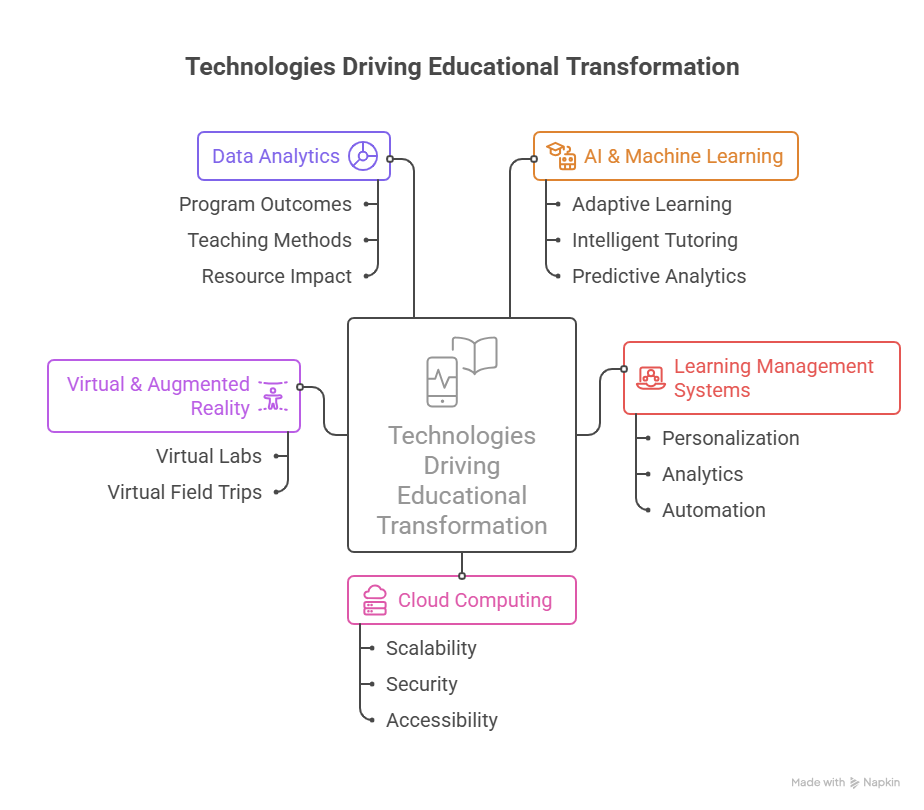
AI & Machine Learning
AI is the engine behind most of what's changing in education. Adaptive learning platforms use machine learning to personalize instruction. Intelligent tutoring systems provide individualized support at scale.
Predictive analytics identify at-risk students. Generative AI creates content. AI agents automate administrative workflows.
In 2025, AI isn't a separate tool it's embedded infrastructure. Every major LMS, SIS, and EdTech platform is integrating AI capabilities. The question isn't whether to use AI but how to use it effectively.
Learning Management Systems
Google Classroom, Canvas, Moodle, and similar platforms remain the central hub for digital learning. What's changed is their capability.
Modern LMS platforms now incorporate AI for personalization, analytics, and automation. They're no longer just content repositories, they're intelligent systems that adapt to how students learn.
Cloud Computing
Cloud infrastructure makes sophisticated technology accessible to institutions of all sizes. Schools don't need massive IT departments to deploy advanced tools. Cloud-based platforms handle scalability, security, and updates. Students and faculty access resources from anywhere, on any device.
Virtual & Augmented Reality
VR and AR create immersive learning experiences impossible in traditional classrooms. Virtual chemistry labs let students experiment with dangerous reactions safely.
Virtual field trips take students to historical sites, ecosystems, or even inside the human body. These technologies are moving from novelty to practical classroom tools.
Data Analytics
Learning analytics platforms aggregate data from multiple sources, such as LMS activity, assessment results, attendance, and engagement metrics, to surface actionable insights.
Institutions can identify which programs produce the best outcomes, which teaching methods work for different student populations, and where resources would have the greatest impact.
Digital Transformation Challenges in Schools
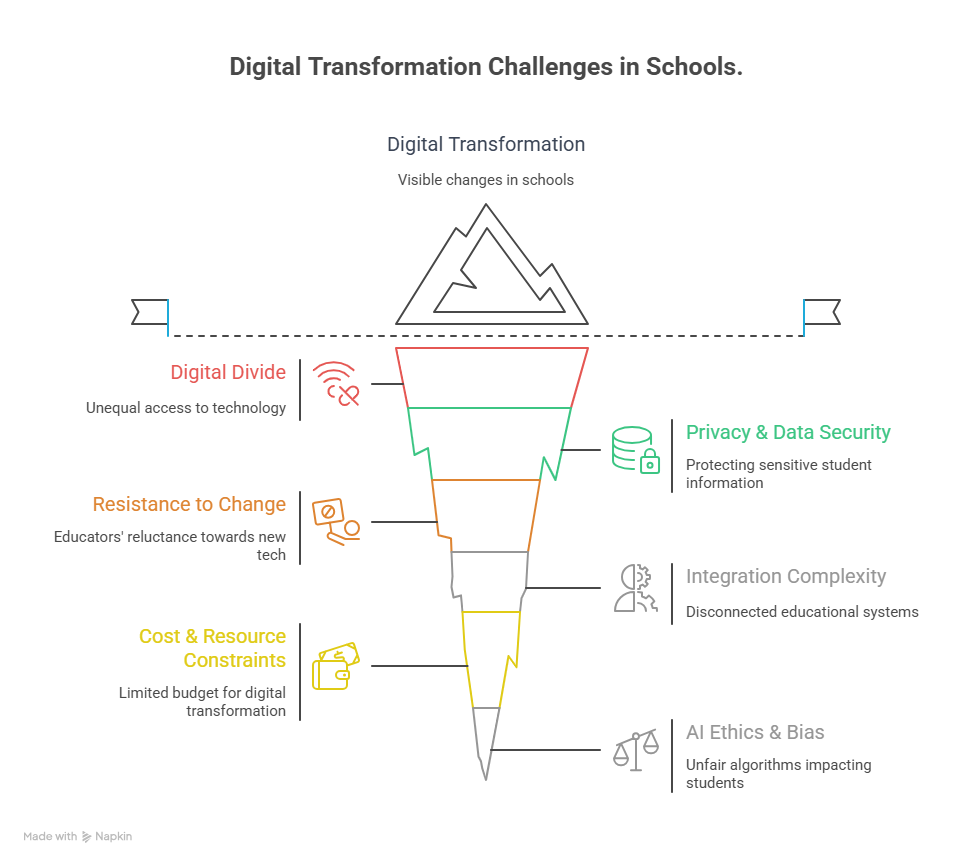
The Digital Divide
Not all students have equal access to technology. Not all schools have equal infrastructure. Digital transformation can widen existing gaps if implementation isn't intentional about equity.
Solutions exist: device lending programs, partnerships with internet providers, offline-capable applications, and community access points. But they require deliberate investment and planning.
Technology that only works for students who already have advantages isn't a transformation, it's an amplification of inequality.
Privacy & Data Security
AI systems process enormous amounts of student data. That data is sensitive and protected by regulations like FERPA in the US and GDPR in Europe. Institutions must ensure their technology partners maintain appropriate security certifications and data handling policies.
Transparency matters too. Students and families should understand what data is collected, how it's used, and what protections exist. Trust is essential for adoption.
Resistance to Change
Not every educator is comfortable with technology. Some fear AI will replace them. Others don't have time to learn new systems while managing existing workloads. Change management is as important as technology selection.
The most successful implementations involve teachers from the beginning, provide adequate training and support, and communicate clearly that AI augments human capabilities rather than replacing human judgment. Phased rollouts with volunteer early adopters build internal champions.
Integration Complexity
Educational institutions often run dozens of separate systems, such as SIS, LMS, CRM, financial systems, and communication platforms that don't communicate well with each other. Data lives in silos. Workflows require manual handoffs between systems.
Modern platforms with robust APIs help, but integration remains a significant challenge. Strategic vendor selection and a clear data architecture matter more than any individual tool.
Cost & Resource Constraints
Digital transformation requires investment. Technology costs, training costs, infrastructure costs, and ongoing support costs add up. Not every institution has the budget for comprehensive transformation.
The practical approach: start small with high-impact projects that demonstrate clear ROI, then reinvest savings into expansion. Automation that saves staff hours pays for itself. Yield improvements from better engagement fund further investment.
AI Ethics & Bias
AI models can perpetuate biases present in their training data. Algorithms making recommendations about students carry real consequences. Institutions need policies ensuring AI is used ethically, with human oversight for significant decisions.
Regular audits, diverse perspectives in implementation, and transparency about how AI influences outcomes are essential safeguards.
The Future of Digital Learning
The trajectory is clear. AI will become invisible infrastructure embedded in every platform, every workflow, every interaction. Students won't think about AI any more than they think about electricity. It will simply be how things work.
Assessment will shift from high-stakes testing events to continuous, embedded evaluation. Learning will be measured as it happens, making separate testing increasingly obsolete.
Personalization will scale. Every student will have access to adaptive learning and intelligent tutoring that was once available only to those who could afford private instruction.
But some things won't change. Technology enhances; humans connect. Teachers will remain essential in their roles, evolving from content delivery to mentorship, facilitation, and the irreplaceable work of inspiring students. The best education will always combine technological capability with human relationships.
Ready to Add AI Chatbots to Your E-Learning Platform?
Custom chatbot development built for your content and learners.
Conclusion
Digital transformation in education has moved from an optional experiment to an essential infrastructure. The institutions thriving in 2025 aren't necessarily the ones with the biggest budgets. They're the ones strategically integrating technology to improve student outcomes while keeping humans at the center.
The technology is mature. The case studies are proven. The question isn't whether to transform, it's how quickly you can move without breaking what already works.
Start with clear problems, not impressive technology. Pilot before scaling. Keep teachers involved. Measure what matters. And remember that the goal isn't digital transformation for its own sake. The goal is better education for every student.
Ready to transform your educational institution?
Third Rock Techkno builds custom EdTech solutions from AI-powered learning platforms to intelligent administrative systems. We help schools, universities, and EdTech companies implement digital transformation that actually improves outcomes.
FAQs
What is digital transformation in education?
Using technology especially AI to fundamentally change how schools teach, students learn, and institutions operate. It goes beyond digitizing paper to reimagining education with adaptive learning, automation, and data-driven decisions.
How is AI used in education today?
Personalized learning paths, intelligent tutoring systems available 24/7, automated grading with instant feedback, predictive analytics identifying struggling students early, and administrative automation for enrollment and scheduling.
What are the biggest barriers to digital transformation in schools?
Unequal student access to technology, data privacy concerns, staff resistance to new tools, integration challenges with legacy systems, budget constraints, and ensuring AI doesn't perpetuate existing biases.
What technologies do schools need for digital transformation?
AI and machine learning for personalization, a modern learning management system, cloud infrastructure for scalability, data analytics for insights, and increasingly virtual/augmented reality for immersive learning.
How long does school digital transformation take?
Pilot projects launch in 1-3 months. Meaningful transformation across multiple areas takes 6-12 months. Full institutional change is ongoing start small, prove ROI, then scale.