
An eLearning platform development company designs, builds, and ships the software your training or course business runs on, whether that is a white-label platform rebranded as yours or a fully custom build.
Picking the right one is a high-stakes call, because the corporate learning market is large enough that vendors of every quality level are competing for your budget, the genuinely great and the barely-finished-the-template alike.
The market sets the context. The global learning management system market was worth about $24.09 billion in 2025 and is projected to reach $31.61 billion in 2026 on the way to $104 billion by 2034, according to Fortune Business Insights. That growth pulls in strong development partners and weak ones alike, so the cost of choosing badly has gone up, not down.
- Decide white-label versus custom before you shortlist any eLearning platform development company.
- White-label costs roughly $4,000 to $25,000 a year and ships in weeks; custom runs $15,000 to six figures and takes months.
- The best partner shows a real portfolio with outcomes, not just screenshots, and runs a paid discovery phase before quoting.
- Red flags: no named references, a fixed price before scoping, vague answers on data ownership, and no plan for maintenance.
- Match the choice to your situation: buy white-label for speed, build custom when your workflow or data rules are unusual.
Quick answer
An eLearning platform development company designs and builds custom learning systems — LMS, LXP or training apps — tailored to your content, learners and integrations. In 2026 the right partner brings education-domain expertise, a modern stack, and support beyond launch. This guide covers what they do, costs, and how to choose one.
How to Choose the Right eLearning Platform Development Company
Before you compare quotes, get clear on what a strong partner looks like. The best eLearning platform development companies share a few traits worth naming: they specialize in learning software rather than treating it as one vertical among twenty, they can show shipped products in both white-label and custom builds, they own the strategy conversation about business model, scalability, and monetization instead of just taking orders, and they have references in your industry who will actually pick up the phone.
Hold every candidate to that bar, then run the checks below- the ones that separate a company that ships from one that disappears after the invoice.
- Look at the portfolio for outcomes, not screenshots. Ask what the platform changed for the client: completion rates, time saved, learners served. A real eLearning platform development company can name results.
- Insist on a paid discovery phase. Any partner who quotes a fixed price before understanding your courses, users, and integrations is guessing, and you pay for the guess later.
- Check data ownership in writing. Confirm you own the learner data and the code, where the data is hosted, and how you would migrate off if the relationship ends.
- Ask how they handle integrations. Your CRM, HR system, SSO, and payment gateway are where projects stall. A good partner has done these before and will say so specifically.
- Get the post-launch plan. Maintenance, support response times, and who fixes a production bug at 9 pm. A platform is a living system, not a delivery.
White-Label Online Course Platform Versus Custom Development
This is the decision that drives your budget, your timeline, and how much the platform can ever do. Both are valid. The mistake is choosing on price alone instead of on fit, because price is the loudest number in the room and a famously bad decision-maker.
The rule of thumb we give clients: if a configured platform can do 90% of what you need, buy white-label and spend the saved budget on content. If the missing 10% is the reason your business exists, build custom. A white-label LMS is the fastest, lowest-risk path for most course businesses; a custom build earns its cost when your differentiator lives in the software itself.
We help training teams and course businesses scope white-label versus custom before they spend. See our eLearning app development →
How Much eLearning Platform Development Costs in 2026
Cost scales with scope, and the bands below come from 2026 development-cost analyses lined up against the quotes buyers actually receive.
Two costs hide under every quote. White-label has no big upfront fee but charges per portal or per learner every year, so a fast-growing business can pay more over five years than a one-time custom build would have cost. Custom carries maintenance at 15 to 20 percent of build cost per year. Ask any vendor to model the five-year total, not just the sticker. The sticker is the part everyone puts on the slide; the five-year total is the part you are introduced to later.
What an eLearning Platform Development Company Actually Delivers
The phrase covers two very different services, and conflating them is the first mistake buyers make. Some companies resell and rebrand an existing platform; others write software from scratch; and a few will happily let you assume it is the second while quietly doing the first. Most good partners do both and will tell you which fits your case.
A capable eLearning platform development company should be able to deliver any of the following, and be honest about which it does best:
- White-label setup. Taking a proven platform, applying your brand, configuring it, and integrating it, with no code written from scratch.
- Custom development. Building the platform around your exact course logic, user roles, assessments, and reporting.
- Integrations. Connecting the platform to your CRM, HR system, payment gateway, and single sign-on.
- Content and authoring. Tools for your team to build courses, plus standards like SCORM and xAPI for interoperability.
- AI features. Adaptive paths, AI tutoring, auto-generated assessments, and analytics that flag at-risk learners.
At Third Rock Techkno, we sit on both sides of this. We run FlipE, our own white-label digital learning platform, and we build custom platforms for clients, including a document-archive learning system for the National Institute for Newman Studies and an AI publishing system for Smart Book. That dual view is why we are honest with every buyer about the white-label versus custom decision.
Third Rock Techkno has shipped EdTech for education and enterprise clients since 2015. Talk to us →
Reviews and Portfolio: How to Vet a Company Before You Sign
Marketing pages all look the same, every one of them is award-winning and trusted by industry leaders, so the real signal is outside them. Sometimes the only thing the award proves is that the company hired a good web designer. Before you shortlist any eLearning platform development company, run these checks.
- Read third-party reviews, on Clutch, GoodFirms, or G2, and look for repeated themes in the criticism, not just the star rating.
- Ask for two references you can call, ideally in your industry, and ask each what went wrong and how the team handled it.
- Study one case study in depth, looking for the problem, the technical decisions, and a measurable result, not a list of features.
- Test their discovery. The questions a company asks in the first call tell you more than its portfolio. Vague questions mean a vague build.
"The best signal of a strong eLearning development partner is the quality of the questions they ask you before they quote, not the polish of their portfolio."— Third Rock Techkno, from client engagements since 2015
Which Path Fits Your Business
To make this concrete, match your situation to the recommendation below.
What We Build and Integrate at Third Rock Techkno
Most of this guide is vendor-neutral. Here is the part that is not. We build both sides of the choice above, and we connect to the tools you may already run.
On integrations, we work with the platforms course businesses and enterprises already use, including Moodle, Canvas, Open edX, TalentLMS, LearnWorlds, and Thinkific, plus the standards that keep content portable: SCORM, xAPI, and LTI.
We also wire up the connections that usually stall a launch, single sign-on, your CRM and SIS system, and payment gateways. Because we have done these before, integration is a planned step rather than the surprise that blows the timeline.
We also run two of our own platforms, so you can judge finished work instead of a pitch deck.
FlipE: Our White-Label Learning Platform
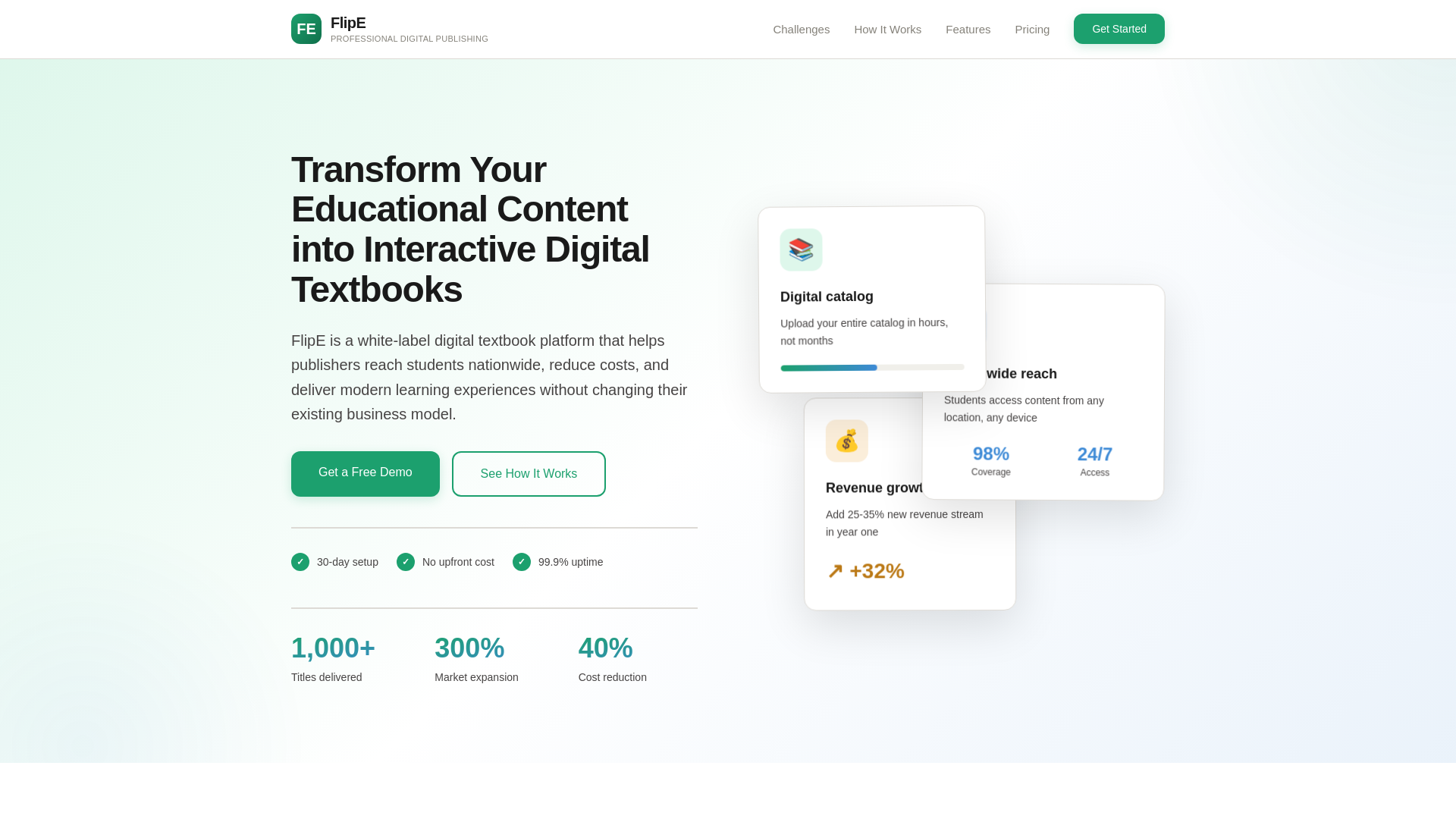
FlipE lets a school, publisher, or training business launch a white-label digital textbook and course platform under its own brand, reach students nationwide, and cut delivery costs without changing how its team already works. Because we built it, connecting FlipE to your existing systems is a configuration job rather than a rebuild, which is exactly what makes a white-label launch fast.
Sourcebook: Our AI Content Engine
Sourcebook turns any document, a textbook chapter, a PDF, or a set of notes, into interactive, AI-generated learning. It is the content engine that sits behind a platform: drop in source material, and it produces lessons, questions, and activities. For a course business, that removes the slowest part of going to market, building the content itself.
If you want a head start, FlipE gives you a white-label base, and Sourcebook gives you the content engine; if your needs are bespoke, we build custom from there. Either way, the integration work is ours, not the problem you stay awake solving.
What to Settle Before You Sign
The companies that get this right do one thing first: they decide white-label or custom on evidence, not on the lowest quote. Write a one-page brief naming your learners, your must-have integrations, your data rules, and your deadline, then judge every eLearning platform development company against it.
That single page turns a six-figure guess into a scoped decision, and it is the fastest way to find the partner who fits and to screen out the ones who were quietly planning to learn on your budget. When you are ready, see how we approach eLearning app development, or talk to our team about your build.