

Today's investors face an overwhelming flood of financial information. Markets generate terabytes of data daily, companies release constant updates, and global events impact asset prices in increasingly complex ways.
Individual investors struggle to process this information volume, while professional managers face pressure to deliver insights faster than competitors.
This data abundance creates a paradox: more information is available than ever before, yet extracting meaningful signals from the noise becomes increasingly difficult.
Investors often resort to simplistic analyses, follow crowd sentiment, or rely too heavily on limited historical patterns. Meanwhile, information asymmetry between institutional and retail investors continues to widen.
Traditional approaches, such as manual chart analysis, fundamental research across numerous sources, or simple screening tools, fail to capture the multidimensional nature of modern markets.
Investors find themselves either drowning in data or missing critical insights that could inform better decisions.
Understanding AI Market Analysis
AI market analysis systems represent a transformative approach to investment intelligence. These systems leverage advanced algorithms, natural language processing, and machine learning to synthesize vast datasets, identify non-obvious patterns, and generate actionable insights tailored to investor needs.
Unlike basic charting tools or news aggregators, sophisticated market analysis AI can process multiple data dimensions simultaneously, including price movements, trading volumes, fundamental metrics, sentiment indicators, macroeconomic factors, and more.
The technology functions as both a research assistant to surface relevant information and an analytical engine to identify potential opportunities and risks.
Investment professionals implementing these systems report significant enhancements to their decision processes. Individual investors gain access to analytical capabilities previously available only to institutions.
Both groups benefit from broader information coverage and more nuanced pattern recognition than humanly possible through manual analysis.
Key Capabilities Transforming Investment Research
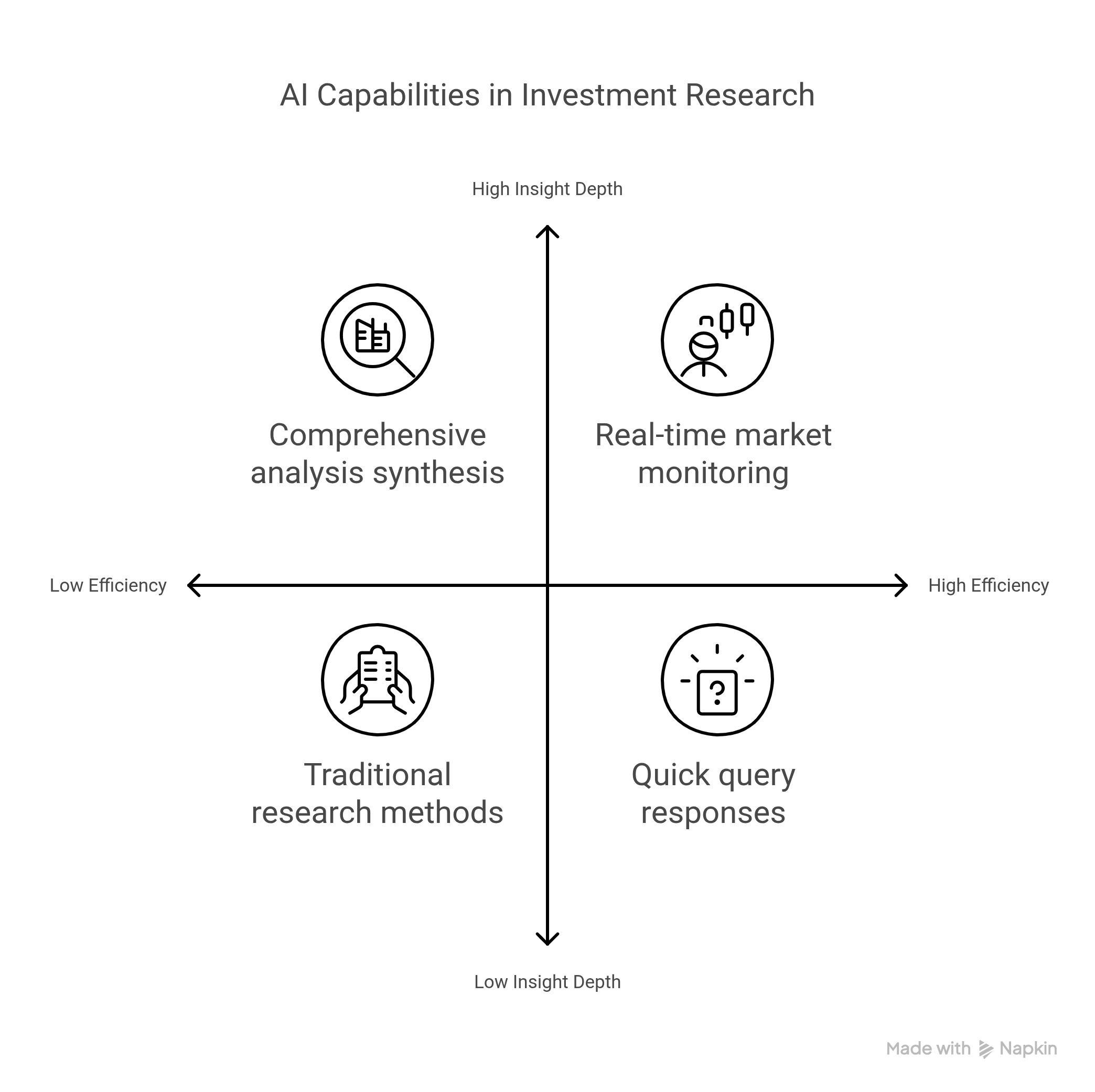
The AI system transforms how investors access and process market information.
- Answers natural language queries about specific companies, sectors, or market conditions.
- Synthesizes information from multiple sources into coherent insights.
- Monitors real-time market developments against investor priorities.
- Identifies correlations between seemingly unrelated market factors.
- Tracks developing news and events with potential market impact.
- Provides contextual understanding of market movements.
This conversational capability dramatically reduces research time. Rather than navigating multiple financial platforms and news sources, investors can simply ask questions: "How are semiconductor stocks performing relative to broader technology?" or "What factors are driving the recent volatility in energy markets?"
Investment advisors particularly value how the system helps them quickly prepare for client conversations.
When clients ask about specific companies or market conditions, advisors can access comprehensive analysis in seconds rather than scheduling follow-up calls after conducting research.
Sophisticated Data-Driven Forecast Modeling
Beyond information access, the system offers analytical capabilities.
- Identifies historical patterns relevant to current market conditions.
- Generates probability-based scenarios for future price movements.
- Evaluates multiple forecasting models against recent accuracy.
- Calculates confidence intervals for different time horizons.
- Incorporates fundamental, technical, and sentiment factors.
- Highlights potential catalysts that could affect projections.
This forecasting approach provides a nuanced perspective beyond simple price predictions. Rather than claiming to know exactly where markets will go, the system presents possible scenarios with associated probabilities and contributing factors, helping investors understand the range of potential outcomes.
Portfolio managers appreciate how the system presents multiple analytical perspectives simultaneously. By comparing technical pattern analysis, fundamental valuation models, and sentiment indicators, they gain a more comprehensive understanding than any single analytical approach could provide.
Personalized Risk Assessment and Opportunity Identification
The system tailors analysis to each investor's specific situation
- Evaluates how potential investments align with stated objectives.
- Identifies concentration risks within existing portfolios.
- Highlights overlooked opportunities matching investor criteria.
- Assess how market developments might affect specific holdings.
- Monitors portfolio-specific risk factors.
- Suggests diversification strategies based on correlation analysis.
This personalized approach transforms generic market data into relevant insights. When exploring potential investments, investors receive analysis specifically addressing how choices might complement or introduce risks to their existing portfolios.
Financial advisors find particular value in the system's ability to screen for opportunities matching specific client parameters. Rather than manually searching for investments meeting multiple criteria, they can efficiently discover options aligning with client goals, risk tolerance, and preferences.
Measurable Benefits for Investment Processes
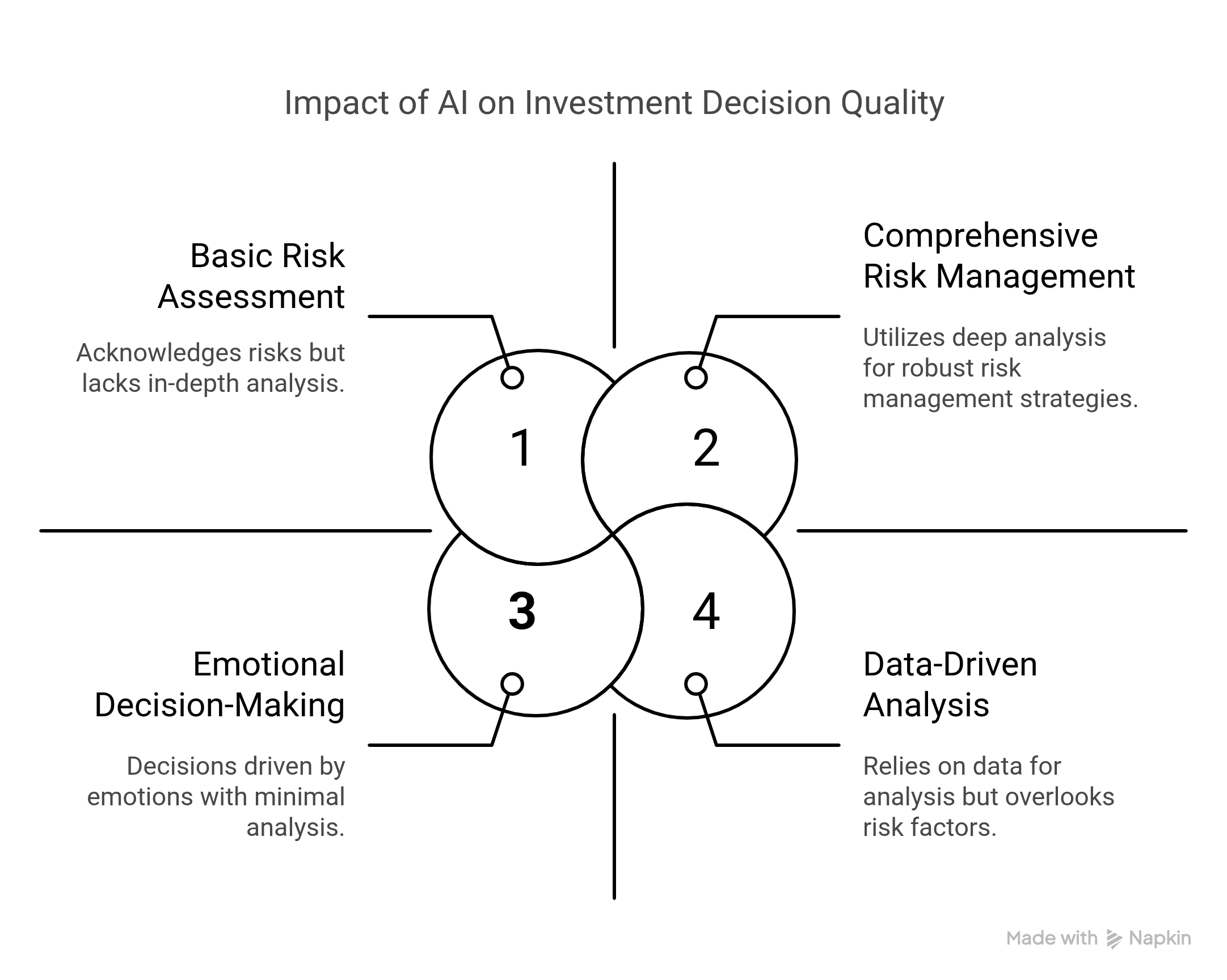
Enhanced Decision Quality Through Broader Information Processing
The most fundamental benefit comes through improved analytical depth
- More comprehensive consideration of relevant factors.
- Reduced recency and availability biases in analysis.
- Better recognition of historical patterns and analogues.
- Greater awareness of potential risks and scenarios.
- More systematic evaluation of investment theses.
- Improved understanding of market sentiment context.
Positioning and risk management. By considering a wider range of factors and potential scenarios, investors make decisions with greater awareness of both opportunities and vulnerabilities.
Individual investors note that the system helps them avoid common behavioral pitfalls. By providing objective analysis and historical context during volatile market periods, the AI helps counterbalance emotional reactions that often lead to poor timing decisions.
Significant Time Efficiency in Research Workflows
Beyond analytical quality, the system creates substantial time savings
- Reduced hours spent gathering basic market information.
- Faster identification of relevant news and developments.
- More efficient screening for investment candidates.
- Automated monitoring of existing positions.
- Streamlined preparation for client and team discussions.
- Better allocation of research focus to the highest-value activities.
Professional investors report that AI assistance allows them to evaluate more opportunities while conducting deeper analysis on their highest-conviction ideas. Rather than spreading attention thinly across many potential investments, they can quickly eliminate less promising options and focus where deeper human judgment adds greatest value.
Wealth management practices find that enhanced research efficiency translates directly to improved client service. Advisors spend less time on routine market research and more time understanding client needs and communicating personalized recommendations.
Improved Long-Term Results Through a Disciplined Approach
The systematic nature of AI analysis encourages investment discipline.
- More consistent application of investment philosophy.
- Better adherence to predefined risk parameters.
- Reduced influence of market noise on decision making.
- More effective portfolio diversification.
- Earlier identification of developing risks.
- Greater patience with fundamentally sound positions during volatility.
Investment committee members note that having AI-generated analysis as a starting point leads to more productive discussions focused on strategic questions rather than information gathering.
This shifts governance conversations toward higher-value considerations about approach and risk management.
Implementation Considerations for Investment Organizations
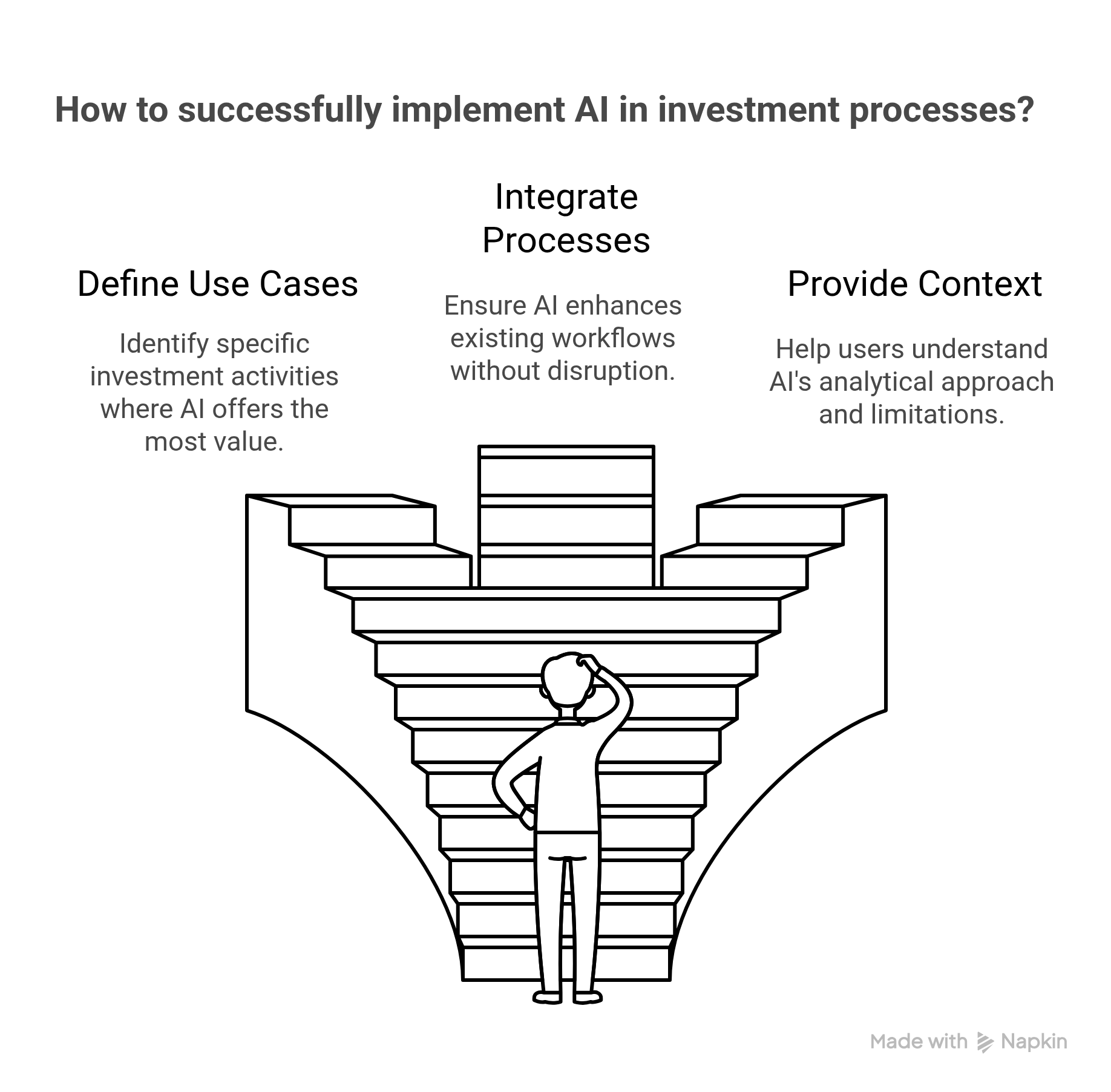
While benefits are substantial, successful deployment requires thoughtful planning:
- Begin with clear use cases - Define specific investment activities where AI assistance offers the greatest value.
- Integrate with existing processes - Ensure the system enhances rather than disrupts established workflows.
- Provide appropriate context - Help users understand the system's analytical approach and limitations.
- Establish model monitoring - Regularly assess forecast accuracy and analytical relevance.
- Balance automation and judgment - Clarify where human decision-making remains essential.
- Address compliance requirements - Ensure appropriate documentation of AI-assisted decision processes.
Organizations that follow these implementation practices typically see faster adoption and stronger results from their investment in AI market analysis.
Future Development in Investment Analysis
As these technologies continue to evolve, investment organizations can anticipate several promising enhancements:
- Alternative data integration will incorporate unconventional information sources like satellite imagery or social media trends
- Scenario simulation will model potential market reactions to hypothetical events or policy changes
- Natural language generation will produce comprehensive research reports based on AI analysis
- Multi-asset correlation analysis will identify relationships across traditionally separate markets
- Sustainability impact assessment will evaluate the environmental and social implications of investment choices
Forward-thinking investment organizations are already preparing for these capabilities by building strong foundations with current-generation systems.
Conclusion
AI market analysis represents a significant advancement in how investors process information and form decisions.
By enhancing human judgment with computational pattern recognition and comprehensive data synthesis, these systems enable more thorough analysis while reducing time spent on routine research.
For investment professionals seeking to improve decisions while managing growing information complexity, AI market analysis offers a compelling solution.
As markets continue generating ever-larger data volumes and complexity increases, these analytical capabilities will increasingly differentiate successful investment approaches from those overwhelmed by information overload.