

According to Precedence Research, the global low-code development platform market will reach approximately 67.01 billion by the end of 2033, with an estimated CAGR of 22.92%. This growth can be attributed to the increasing demand for rapid application development and the soaring number of people adopting digital transformation initiatives across multiple industries.
Also, Gartner predicts that the market demand for app development services will grow by a bare minimum of 5 times compared to the IT capacity to deliver them. This is where software developers can use no-code technology to fill this wide IT gap, allowing business users to develop IT solutions independently.
The biggest advantage of no-code technology is that it can be used to create customized and scalable apps. The biggest problem that business owners will face is choosing the best no-code app development platform.
To help you make the right business call, we have dedicated this blog to comparing two prominent no-code app development platforms: FlutterFlow vs. Adalo. By the time you finish this blog, we promise you will get a definitive answer to this question:
Which is better for no-code app development, FlutterFlow or Adalo?
So, without further ado, let us start with this highly anticipated no-code platform comparison.
Quick answer: FlutterFlow is better for scalable, production-grade apps because it compiles to real Flutter code and exports the source; Adalo is simpler for quick internal tools. Choose FlutterFlow for performance, complex logic, and app-store apps; choose Adalo for fast, lightweight prototypes.
What is FlutterFlow?
FlutterFlow is a simple no-code app development platform that allows developers to use its drag-and-drop functionality as pre-built components to develop cross-platform apps that make your web and mobile apps look graceful by using the good things of the Flutter framework.
This particular attribute helps this platform achieve native performance, the desired level of customization, and scalability to make your app set a new benchmark in your industry.
When you opt for the FlutterFlow platform, you sign up for:
- Drag-and-drop builder with pre-built components.
- Direct Firebase integration for real-time databases and authentication.
- Custom Logic with the help of API connections and workflows.
- One-click deployment to Android, iOS, and web.
It is a seamless match for startups and businesses looking for production-ready apps at the rates of knots. This platform helps to narrow the gap between no-code simplicity and developer-level flexibility.
So, if you wish to have complete control over the development process without requiring technical coding, the FlutterFlow platform is the right choice for your business needs.
What is Adalo?
Adalo has been developed for entrepreneurs and small business people so they do not have to devote time to writing technical code while creating fully functional web and mobile apps that look visually appealing.
This no-code app development platform's devotion to staying simple to its core makes it an ideal choice for prototyping, MVPs, and lightweight apps that require swift deployment.
When you opt for Adalo, you sign up for:
- Drag-and-drop interface that consists of customizable templates.
- A built-in database that enables you to manage your data hassle-free.
- Pre-made integrations that include Zapier, Stripe, and Google Sheets.
- Instant Publishing to web and app stores.
It is perfectly suited for developing internal tools, simple apps, or even marketplaces. The amazing thing about this platform is that it prioritizes speed instead of deep customization. Opt for this platform if you prefer to follow a simplistic way with zero fuss to launch an app. However, keep your expectations low when it comes to advanced scalability or complex logic.
Now that you have a basic understanding of these no-code app development platforms, it is time to compare their features by examining how they operate at the smallest level.
Your App Idea Deserves a Powerhouse Team
Partner with Third Rock Techkno and launch with confidence.

FlutterFlow vs Adalo: Features Comparison
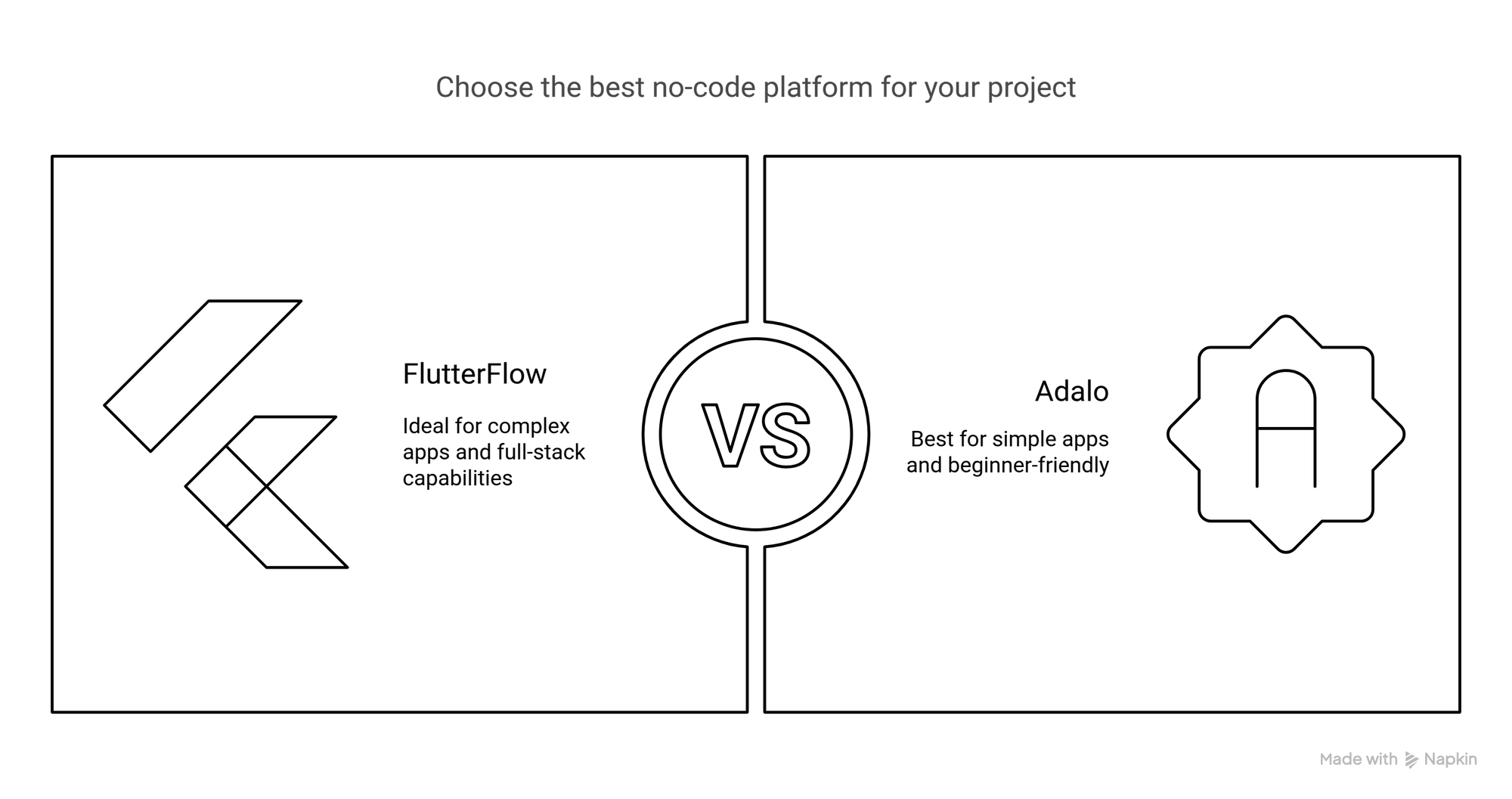
The ultimate choice between FlutterFlow and Adalo depends on precise project requirements, such as scalability, user-friendliness, or customization.
Here is a precise breakdown of the features to help you make the wise call.
1. Use Case Versatility
FlutterFlow for no-code wins the race for complex apps like SaaS tools or marketplaces that require dynamic UI, Firebase integrations, and multi-screen logic.
On the other hand, Adalo for no-code is recommended for simpler apps like basic CRUD apps and directories that make optimal use of its drag-and-drop functionality. However, the scalability that it provides to the app is limited.
2. Full-Stack Capabilities
The FlutterFlow platform is compatible with backend integrations like APIs, Firebase, and custom functions, making it closer to full-stack capabilities. Whereas Adalo comprises third-party connectors and built-in databases, it cannot compensate for the lack of advanced backend flexibility.
3. Performance
Since the FlutterFlow platform runs on Flutter, it provides near-native speed and seamless animations. While the applications developed using Adalo are functional, they may lag with heavy data loads due to abstraction layers.
4. Ecosystem & Community
The developer community of FlutterFlow is thriving. They provide templates and tutorials that may be key to cracking advanced use cases. Meanwhile, the Adalo community is more beginner-friendly, which makes it right for swift fixes. However, they have fewer resources if you are dealing with a complex development issue.
5. Code Ownership
FlutterFlow enables exporting clutter-free Flutter code, which gives you complete control over further development. Adalo puts a seal, confining you to the platform and resulting in zero code export, constraining your long-term flexibility.
6. Learning Curve and Customization
FlutterFlow has a steeper learning curve, but the rewards of using its deep customization, such as custom widgets and logic, pay off in the long run. While Adalo is effortless to commence, it has some limitations when it comes to tweaking design and functionality beyond fundamentals.
Now that we have examined the features of FlutterFlow and Adalo, let us examine the distinct pricing approaches of these no-code platforms.
FlutterFlow vs Adalo: Pricing Comparison
Here is a comparative study of the pricing plans that will give you an overview of the low-code platform comparison between FlutterFlow and Adalo.
FlutterFlow
- Free Plan
This is a seamless way for developers to familiarize themselves with the powerful platform's restricted features and app use.
2. Pro Plan
This is a paid plan that requires $30 per month. However, it provides most of the features that are adequate for individual developers and small teams. This plan is tailor-made for companies with basic project needs.
3. Premium Plan
When you opt for the premium plan, you need to spend $60 per month. However, instead of that, you get team collaboration features and advanced functionalities necessary to perform demanding projects.
4. Pay-as-you-go-model
Under this plan, you can extend your app usage beyond the limits and pay for every extra active user and installation.
Adalo
- Free Plan
This plan comprises 200 records for every app you plan to build, with limitless app actions and a single app editor. It works seamlessly on unlimited screens and allows you to test apps, collections, and databases.
2. Starter Plan
This is a paid plan that charges $45 monthly. Here, you can avail of one published app, limitless app actions, and a solitary app editor. This plan assists you in integrating a custom design, publishing to the web and app stores, a custom domain, and custom fonts.
3. Professional Plan
When you opt for the professional plan, you need to spend $65 on a monthly subscription. This plan provides two published apps, limitless app actions, and five app editors. It also enables you to integrate design versions, geolocation, and custom integrations in the app.
4. Team Plan
For this plan, you need to spend $200 on a monthly subscription, and in place of that, you will end up with limitless app actions, ten app editors, and five published apps. It allows you to integrate Xano integration, a collections API, and priority support.
5. Business Plan
This plan requires a $250 monthly subscription. It offers ten published apps, limitless app actions, and app editors, as well as the opportunity to integrate special add-on pricing.
Pros and Cons of Each Platform
Here is a look at the pros and cons of FlutterFlow and Adalo no-code platforms.
Pros of FlutterFlow
- Code Expert
Unlike Adalo, which locks you in, FlutterFlow allows you to export clutter-free and production-ready Flutter code. If you ever need to hand off to developers later, opt for the FlutterFlow platform, as it proves to be a decisive factor for startups looking to scale their apps beyond conventional no-code.
2. Scalability
Adalo is an ideal choice for simple apps. However, FlutterFlow can manage complex apps without fuss. With the help of custom logic and Firebase integration, your app will not suffer downtime, whether it counters heavy traffic or complex features.
3. Customization
Adalo's drag-and-drop functionality has been raved about because it is easy to operate. However, it is rigid. On the other hand, FlutterFlow provides granular control like animations, custom widgets, and even tweaks in manual code. If you are not a big fan of cookie-cutter restraints, FlutterFlow provides you with an escape route.
4. Backend Support
Although Adalo's built-in database is neat, the Firebase and API support in FlutterFlow helps get real-time data, user authentication, and serverless functions without requiring any makeshift solution.
Cons of FlutterFlow
- Steeper Learning Curve
The biggest positive point of Adalo is its pick-and-play interface, which is easy to master, unlike FlutterFlow, wherein you need to take time to comprehend basic Flutter concepts like widgets and layouts, Firebase setup if you are utilizing backend, and workflow logic for advanced users.
If you want to build an app at a quick turnaround time, you must grind a bit in learning. This is where Adalo can be less frustrating.
2. Manual Data Handling
The biggest loophole of FlutterFlow is that it coerces you to configure Firebase manually, unlike Adalo, which has an in-built database. Hence, you must set up collections by adhering to security rules, managing relationships between data, and encountering errors if your app is not managed properly.
Although the FlutterFlow platform gives you the much-needed power, it requires you to be more responsible. If you wish to launch an app swiftly without database headaches, Adalo’s simplicity has a potential edge over the FlutterFlow platform.
Pros of Adalo
- Ease of Use
Unlike the FlutterFlow platform, which requires you to wrestle with widgets and Firebase, Adalo is quite straightforward. It has a genuine drag-and-drop interface with no hidden complexity, an intuitive and user-friendly interface, and no need for any backend knowledge.
So, why do you want to click through five menus when you can do the same thing with a solitary menu? If you are looking for a platform without technical coding knowledge, Adalo is the right fit.
2. Swift Prototyping
The flexibility of FlutterFlow comes when we discuss setup time. However, when it comes to Adalo, it consists of a working prototype even before your coffee gets cold, including:
- Pre-built templates for customary app types
- Real-time on mobile devices
- Zero configuration paralysis
If you need to test an idea swifly as a developing startup, opt for Adalo. it is a perfect match for developing MVPs quickly.
3. Built-in Database
When directly compared to the manual Firebase set of the FlutterFlow platform, Adalo provides you with the following.
- Production-ready database out of the box.
- Simplistic relationship management.
- Zero security rules to configure.
Adalo helps you achieve the goal of effectively storing user data without making you the database admin!
Cons of Adalo
1. Limited Customization
When you use the FlutterFlow platform, you can tweak every single pixel. However, this is the biggest limitation of Adalo because you end up getting.
- Basic templates that are exclusively made by the platform.
- Rigid components with which you cannot help with the exclusive branding of your app.
- Zero custom widgets or code injections.
If you want your app to look similar to the other three apps in the App Store, opt for Adalo.
2. No Code Export
When you opt for the FlutterFlow platform, you can export and properly hand it off to the developers. However, in the case of Adalo:
- Your app lives on their platform.
- There is no way to migrate to custom development.
- It is like building on rented land with zero deed.
Nothing hurts more than realizing that your app has outgrown the Adalo platform and cannot be migrated to another platform.
3. Limited Scalability
The biggest plus point of the FlutterFlow platform is its ability to scale with your business app’s requirements. However, Adalo starts choking if
- The number of users exceeds a few thousand.
- Database relationships get complicated.
- You require advanced business logic.
A simplistic app that became an instant success became a slow, buggy, and impossible case to improve, all thanks to the Adalo platform.
Read Also : AppGyver Alternatives: Which Platform to Choose for Rapid Prototyping in 2025
When to Choose FlutterFlow?
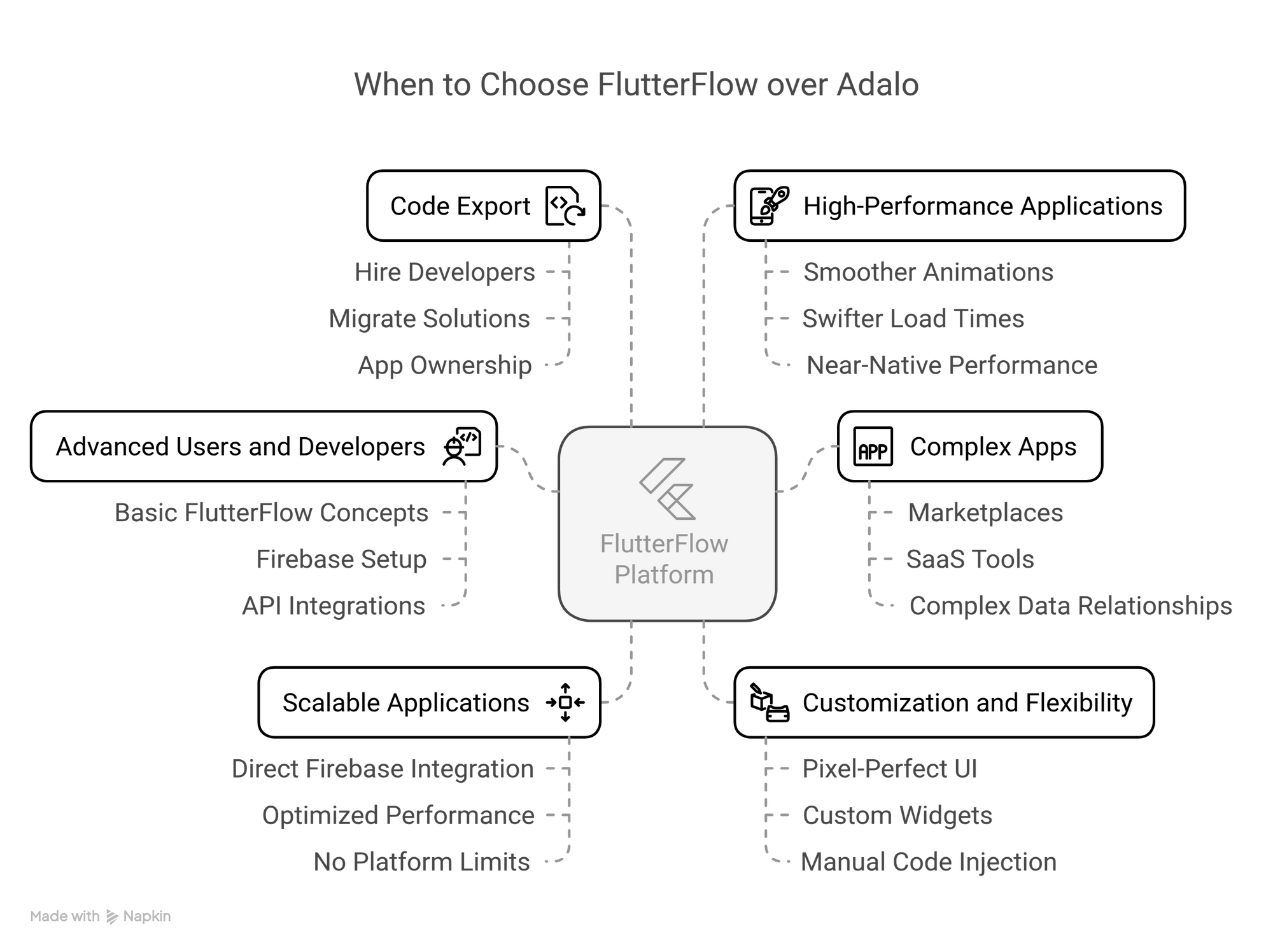
The FlutterFlow platform is not for every individual. It is totally contingent upon your project requirements. Here are some of the reasons to opt for it before Adalo.
1. Advanced Users and Developers
If you and your development team have the working knowledge of writing technical code, this platform's granular control can prove gratifying.
When compared to the rigid simplicity of Adalo, the FlutterFlow platform proves to be rewarding for those who comprehend:
- Basic FlutterFlow concepts
- Firebase setup and security rules
- API integrations
While Adalo restricts your ability, FlutterFlow hands over the key to unlock the doors instantly.
2. Complex Apps
Whether your app requirement is dynamic UIs, real-time data sync, or multi-step workflows, FlutterFlow can effectively deal with it while Adalo falters big time. This platform can help you develop the following.
- Marketplaces with custom dashboards
- SaaS tools with user permissions/roles
- Apps needing complex data relationships
If the apps requires a flowchart, opt for the FlutterFlow platform, while if the app's logic fits a napkin, choose Adalo
3. Scalable Applications
The biggest drawback of Adalo is that it starts to struggle when the number of active users on the app crosses the 10K mark. This is where the FlutterFlow platform’s ability to scale according to the requirements of the app makes it imperative to use:
- Direct Firebase integration
- Optimized performance (Flutter-based)
- Zero arbitrary platform limits
Startups end up opting for the FlutterFlow platform because they plan to succeed.
4. Customization and Flexibility
The templates of Adalo look like the platform. On the other hand, FlutterFlow provides you with:
- Pixel-perfect control over UI.
- Custom widgets and animations.
- Prowess to inject manual code.
If you wish to take advantage of your brand while promoting your app, the limitations in Adalo will frustrate you in the long run.
5. Code Export
The FlutterFlow platform allows you to export clutter-free Flutter code, which is vital in case you:
- Plan to hire FlutterFlow developers later.
- Need to migrate to custom solutions.
- Wish to get complete ownership of your app.
Adalo locks you in, while FlutterFlow shows that there are zero restrictions on developing apps on the platform.
6. High-Performance Applications
The Flutter foundation in the FlutterFlow platform ensures:
- Smoother animations.
- Swifter load times.
- Near-native performance.
Although Adalo apps work, FlutterFlow apps provide a premium feeling.
When to Choose Adalo?
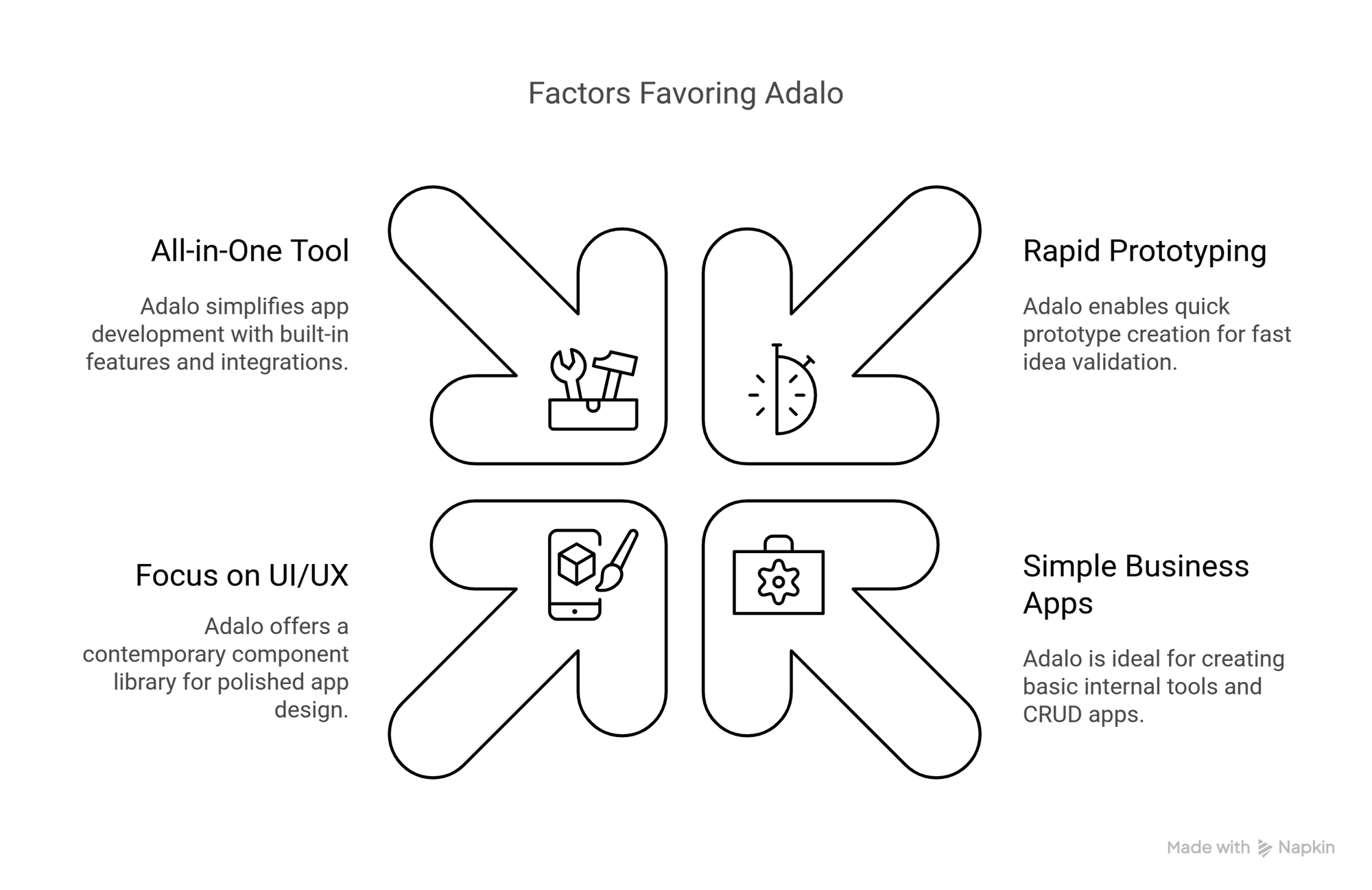
The biggest plus point of the FlutterFlow platform is its scalability and power. On the other hand, Adalo wins when you need simplicity and speed in your application. Here are some situations where selecting Adalo is a wise call.
1. Rapid Prototyping and MVPs
If time is crucial for you and you wish to validate an idea before your competitors get into it, let the drag-and-drop interface of Adalo win the race for you by:
- Building clickable prototypes in hours and not the customary weeks.
- Iterate on the basis of user feedback in real-time.
- Avoid over-engineering before proving demand.
What sense does it make to build an app using the FlutterFlow platform for months when it can be done in hours using Adalo?
2. Simple Business Apps
If you wish to develop internal tools, CRUD apps, or directories, Adalo is the right fit as it consists of the following:
- Pre-built templates for common use cases.
- Zero back-end configuration required.
- Intuitive logic builders with no Firebase headaches.
If you wish to develop a simple app, Adalo is the right choice, as the FlutterFlow platform can become overkill.
3. Focus on UI/UX
The core strength of Adalo is present in:
- Clutter-free, contemporary component library.
- Real-time visual feedback (zero compile steps).
- Mobile-first design methodology.
Although the FlutterFlow platform provides more customization options, Adalo allows you to get a polished, attractive app at the rate of knots.
4. All-in-One Tool
The best thing about Adalo is that it gets rid of complexity by providing the following:
- Built-in database requiring zero Firebase setup.
- Native integrations like Zapier, Stripe, etc.
- One-click publishing.
While FlutterFlow needs stitch-together services, Adalo bundles them as a package.

FlutterFlow Integrations
Discover how powerful integrations in FlutterFlow can elevate your app connect with Firebase, Stripe, REST APIs, and more without writing code.Difference Between FlutterFlow and Adalo for No-Code App Development
| Points of Difference | FlutterFlow | Adalo |
|---|---|---|
| Target Audience | Developers and advanced no-code users | Beginners and non-technical users |
| Platform Output | Cross-platform apps (Android, iOS, and web) | Primarily mobile apps with basic web support |
| Design Flexibility | High customization with Flutter code integration | Limited customization with drag-and-drop UI |
| Learning Curve | Steeper due to its advanced features and logic flows | Easier with a beginner-friendly interface |
| Performance | Near-native performance using the Flutter framework | Moderate performance; not as optimized as FlutterFlow |
| Backend Integration | Supports Firebase, Supabase, APIs, and custom functions | Built-in database; supports external APIs with limitations |
| Code Export | Full-source code export (Flutter) | No direct code export (hosted on Adalo’s platform) |
| Advanced Features | Custom functions, animations, conditional logic, push notifications | Basic logic, limited animations, and fewer advanced features |
| Pricing | Free tier available; advanced features on paid plans | Free plan available; scales with features and app complexity |
| Community and Support | Growing community with strong developer backing | Beginner-focused community with responsive support |
| Ideal Use Case | Complex, scalable apps that may need custom code later | Simple MVPs, internal tools, and apps for non-tech creators |
Popular Apps Created Using Flutter Flow and Adalo: A No-Code Platform Comparison
Here is a brief overview of some thriving apps developed using the prowess of FlutterFlow and Adalo no-code platforms.
Amazing Apps Developed Using the FlutterFlow Platform That Are Growing At a Rapid Pace.
FlutterFlow is not simply a platform for launching no-code apps, it also sets the right example of scaling swiftly for the following apps:
1. COIN
The Concept of the App: A community-driven investment app
What Makes it Impressive?
- Manages real-time financial data using Firebase.
- Clutter-free and custom UI rivaling native apps.
- Scaled to 50k+ users without requiring any rebuilds.
FlutterFlow Edge: Complex dashboards developed without requiring any technical coding.
2. TAGALONG
The Concept of the App: Airbnb-style app for local experiences.
What Makes it Impressive?
- Effectively manages payments, reviews, and bookings.
- Dynamic maps and user profiles.
- Launched MVP in three weeks (normally takes more than three months).
FlutterFlow Edge: Integrated Swipe and Google Maps API visually.
3. Kawenter
The Concept of the App: Digital menu platform for restaurants.
What Makes it Impressive?
- To date, 500+ eateries across Europe have utilized it
- QR code ordering system
- Real-time menu updates
FlutterFlow Edge: Easily scaled Firebase back-end
If you believe the Adalo platform is useful only for creating rapid prototypes, you can look at the apps given below to understand its prowess. These apps are growing rapidly without requiring even a single line of code.
1. Gigit
The Concept of the App: An Uber-like freelance marketplace that connects businesses with local service providers.
What Makes it Impressive?
- 800+ active providers.
- $180,000+ processed verified payments.
- 12 US cities launched.
Adalo Edge: Transformed the raw idea of a solopreneur into a fully functional app before hiring the first employee.
2. Joy Blossom
The Concept of the App: A mental wellness app with daily exercises
What Makes it Impressive?
- 30,000+ monthly revenue through subscription model
- 15,000+ downloads (2003 figures)
- Built by a non-technical founder in six weeks
Adalo Edge: Enabled a therapist-turned-founder to build the app all alone without any outside help.
3. Fitlink
The Concept of the App: A subscription-based fitness coaching app that connects trainers with clients
What Makes it Impressive?
- Stripe integration for payments
- In-app messaging for coach-client communication
- Zero code for maintenance
Adalo Edge: Developed this recurring revenue stream via subscriptions by using the prowess of Adalo by a non-technical founder.
Ready to Build with FlutterFlow or Adalo?
Let’s turn your vision into a high-performance product starting today.
Why Choose Third Rock Techkno for Your No-Code/Low-Code Development Needs?
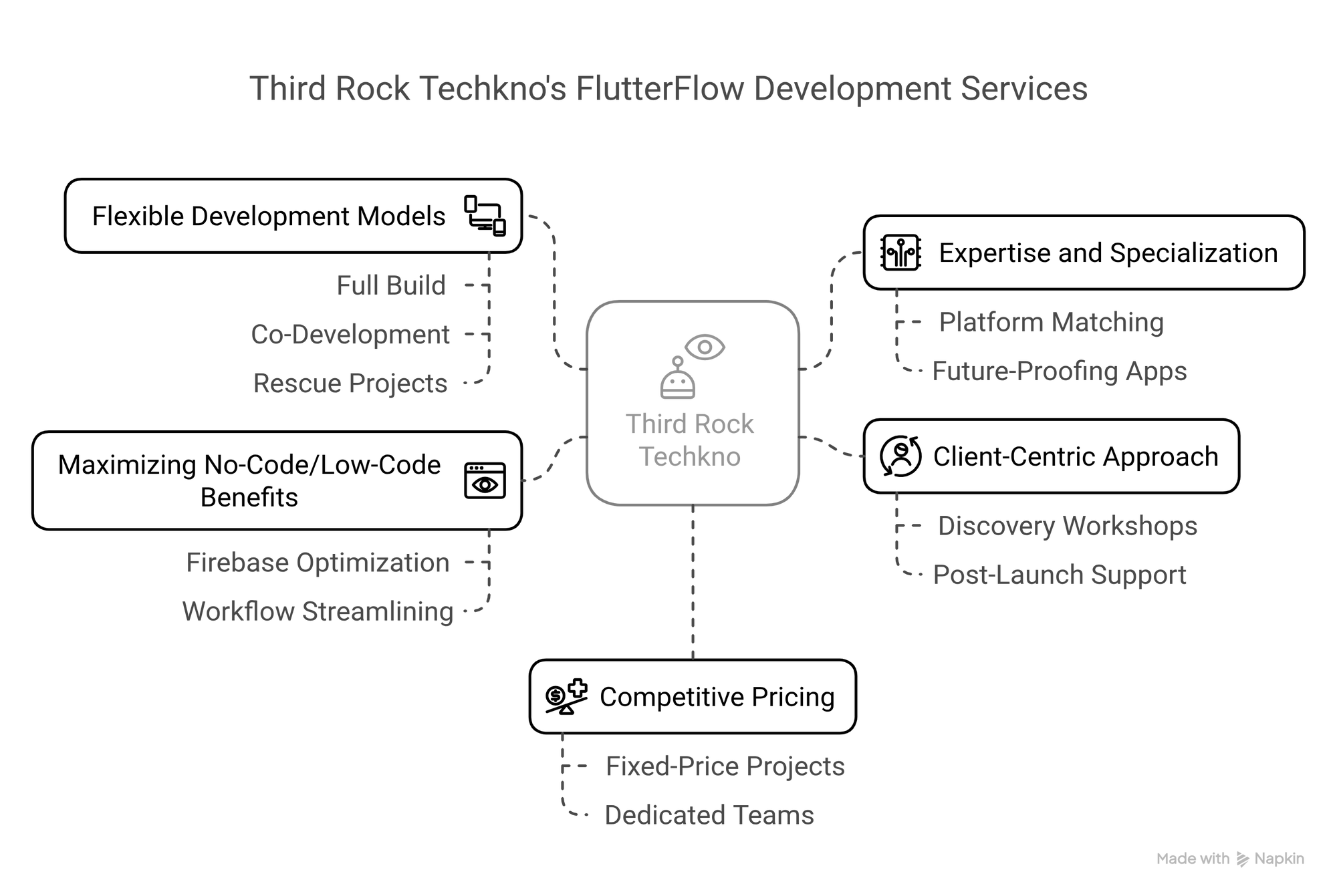
1. Expertise and Specialization
Our technical team at Third Rock Techkno completely understands that every no-code platform is different. Hence, our team comprehends FlutterFlow and Adalo's nuances, which helps us match the right platform according to your project requirements.
For example, we use the FlutterFlow platform for application scalability and Adalo for rapid MVPs. We avoid technical debt by structuring apps for long-term use. All the apps that we create extend functionality with custom code wherever required. This way, we don’t just build your app; we future-proof it for long-term use.
2. Client-Centric Approach
We always prioritize our clients' needs. We are not just another generic agency; we concentrate on providing favorable business outcomes by conducting discovery workshops to align tools with your requirements. You can always count on us to provide white-label solutions that fit your brand requirements seamlessly. You can also count on us for post-launch support to ensure the best adoption of your app.
3. To Maximize the Benefits of No-Code/Low-Code Development
We optimize Firebase setups for complex apps to amplify the strengths of no-code app development platforms like FlutterFlow and minimize their weaknesses. We use Adalo to streamline workflows for economical MVPs and hybrid models that blend no-code speed with custom code.
4. Competitive Pricing
We provide enterprise-level quality without requiring you to pay enterprise-level costs. We offer flexible engagement models like:
- Fixed-price projects with zero surprises.
- Dedicated teams for long-term builds.
- Cost savings vs. traditional development.
5. Flexible Development Models
We allow you to scale up or down with no strings attached. Select what fits your app:
- Full build (idea to app store)
- Co-development (augment your team)
- Rescue projects (fix failing no-code apps)
FlutterFlow vs Adalo: Which No-Code App Development Platform is Right for Your Business Needs?
The ultimate decision of whether to opt for FlutterFlow vs. Adalo is totally contingent upon the complexity of the project, the scalability requirements, and the amount of flexibility you can give the designers. If your priority is potent customization, hassle-free workflows, and Firebase integration, FlutterFlow for no-code is, without any doubt, the right way to go.
This is particularly important to develop scalable apps that need complex logic. While if your business app requires a simple, drag-and-drop builder with built-in database features, Adalo for no-code can help you get faster prototyping for lightweight applications.
This no-code comparison blog in no way highlights that either tool is superior to the other. It is about selecting a no-code platform that meets your business needs. If you require high-performance apps with granular control, FlutterFlow has all the means to help you succeed. If you prefer rapid prototyping with minimal setup, go for Adalo.
If you are looking for an official FlutterFlow partner, we can help you build the app quickly. With over a decade of experience in mobile app development, I will ensure your app will help you scale your business. Contact our FlutterFlow expert today!