
The global LMS market will hit $123.78 billion by 2030, but here's what that number doesn't tell you. 37% of organizations plan to replace their current LMS within the next year.
Why? Because traditional learning management systems were built to manage content, not to teach. They store courses. They track completions. And they treat every learner exactly the same way.
AI-driven LMS platforms change this fundamentally. They don't just deliver content, they adapt to each learner in real-time, predict who's struggling before they drop out, and create personalized learning paths that would take human instructors months to build manually.
This isn't an incremental improvement. It's a complete redesign of how digital learning works.
What Is an AI-Powered LMS?
A traditional LMS is essentially a digital filing cabinet with a tracking system. You upload courses, assign them to learners, and measure completion rates. Everyone gets the same content in the same sequence at the same pace.
An AI-powered LMS operates differently. It uses machine learning algorithms to analyze how each learner interacts with content, what they struggle with, how fast they progress, when they're most engaged, and adjusts the experience accordingly.
Traditional LMS vs AI-Powered LMS:
Traditional LMS vs AI-Powered LMS
| Feature | Traditional LMS | AI-Powered LMS |
|---|---|---|
| Content Delivery | Static, one-size-fits-all | Dynamic, personalized per learner |
| Learning Paths | Fixed sequences | Adaptive based on performance |
| Assessments | Standard difficulty | Adjusts to learner proficiency |
| Intervention | Manual review of reports | Predictive alerts for at-risk learners |
| Course Creation | Weeks of manual work | AI-assisted generation in hours |
| Feedback | Delayed instructor responses | Real-time AI tutoring |
The practical difference: learners using adaptive AI systems achieve better learning outcomes and higher engagement compared to traditional platforms, according to McKinsey research on personalized learning.
7 Ways AI Is Reshaping the Future of LMS
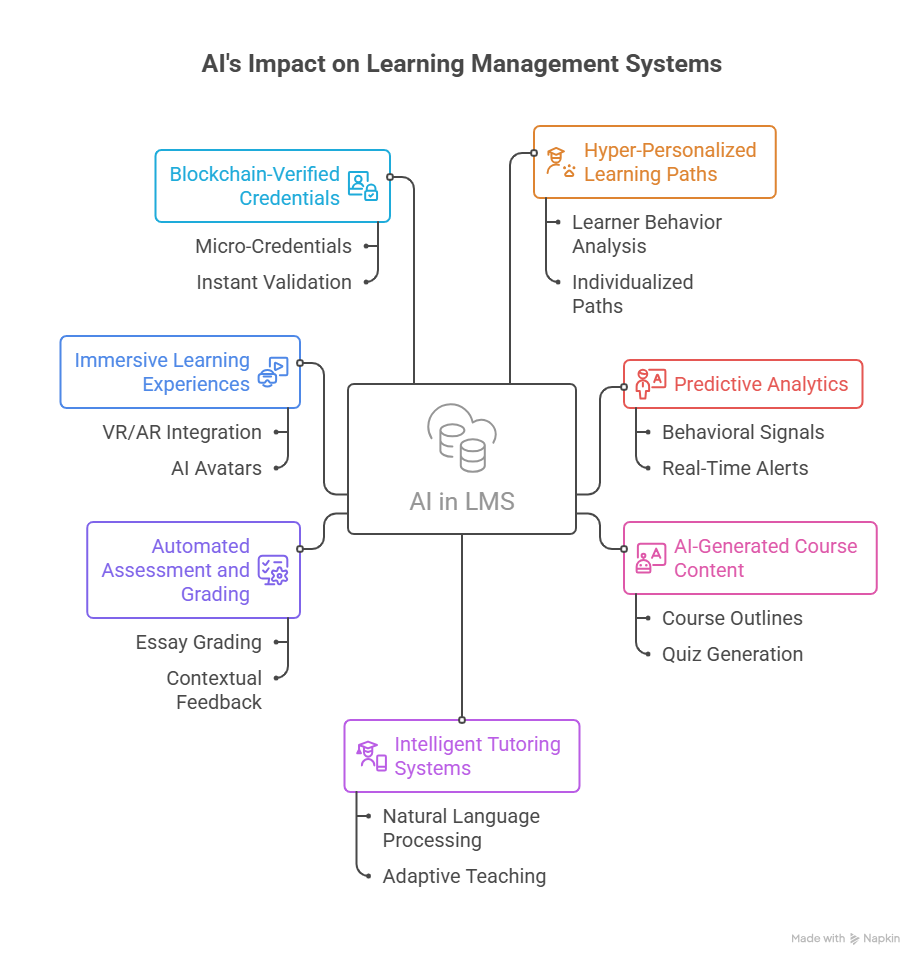
1. Hyper-Personalized Learning Paths
Traditional LMS platforms force learners through predetermined sequences. If you already understand Module 3, you still have to sit through it. If Module 5 requires knowledge you're missing, you struggle through anyway.
AI-driven platforms analyze learner behavior continuously—not just test scores, but time spent on each section, mouse movements, pause patterns in videos, and response confidence to create genuinely individualized paths.
How it works in practice:
- A learner struggling with calculus concepts gets additional prerequisite content on algebra fundamentals.
- Someone demonstrating mastery skips ahead to advanced material.
- Visual learners automatically receive more video content; readers get text-based alternatives.
2. Predictive Analytics for At-Risk Learners
Before a student drops out, dozens of behavioral signals announce their struggle. They miss deadlines. They're clicking through videos without watching. Their quiz scores are declining.
Traditional LMS platforms wait for instructors to notice. AI-powered systems detect these patterns in real-time and alert educators before it's too late.
Candy, a community college, implemented predictive analytics in their LMS and reduced course dropout rates in the first semester by enabling instructors to intervene within days instead of weeks.
3. AI-Generated Course Content
Creating quality course content is one of the biggest bottlenecks in eLearning. A single interactive course can take weeks of instructional design, video production, and assessment creation.
AI-powered LMS platforms can now generate course outlines, scripts, quizzes, and even interactive elements from learning objectives. An instructor can describe a course goal, and the AI suggests a curriculum structure, creates quiz questions at multiple difficulty levels, and generates discussion prompts.
4. Intelligent Tutoring Systems Embedded in LMS
Imagine a tutor available to every learner, at any time, who never gets tired, never gets frustrated, and adapts their teaching style to each individual.
AI-powered tutoring within LMS platforms can:
- Answer questions in natural language, not just multiple choice.
- Recognize when a learner is confused and rephrase explanations.
- Break complex concepts into simpler components.
- Provide immediate, personalized feedback.
Candidate schools using embedded AI tutoring report higher engagement, and learners complete courses faster with better retention.
Your LMS Is Managing Learning, Not Enabling It
Most platforms just track completions. We help you build systems that actually make learners succeed.

5. Automated Assessment and Grading
Grading is consuming. Instructors spend 6+ hours per week on manual assessment, even in smaller courses.
AI can now automatically grade essays, generate detailed feedback, identify learning gaps, and flag suspicious submission patterns. More importantly, it understands context; it knows that a certain mistake suggests a knowledge gap, while another suggests a careless error.
6. Immersive Learning Experiences
AI is converging with VR/AR to create truly immersive learning environments. Medical students practice surgeries in AI-powered simulations. Language learners have conversations with AI avatars that respond in real-time.
AI adapts the difficulty and content based on performance, making simulations progressively more realistic and challenging.
7. Blockchain-Verified Credentials
AI combined with blockchain allows instant verification of skills and credentials. Learners earn micro-credentials for specific competencies, verified by AI assessment, and stored on blockchain so employers can instantly validate them without contacting institutions.
How AI-Powered LMS Platforms Work
The architecture behind AI-powered LMS is sophisticated, but the user experience is simple.
- Data Collection: Every learner interaction is logged, including time spent on modules, assessment answers, mouse movements, video interaction patterns, and forum participation.
- Machine Learning Analysis: Algorithms analyze this data to identify patterns unique to each learner: their pace, preferred content format, common mistakes, optimal time of day for learning, and risk of disengagement.
- Adaptive Delivery: The system adjusts in real-time. If an assessment reveals a gap, supplementary content appears automatically. If a learner is progressing faster than peers, the next module unlocks early.
- Predictive Intervention: The system flags at-risk learners and recommends specific interventions for instructors.
Implementation: Making the Transition
Migrating to AI-powered LMS isn't a flip-the-switch move. But smart organizations follow a proven path.
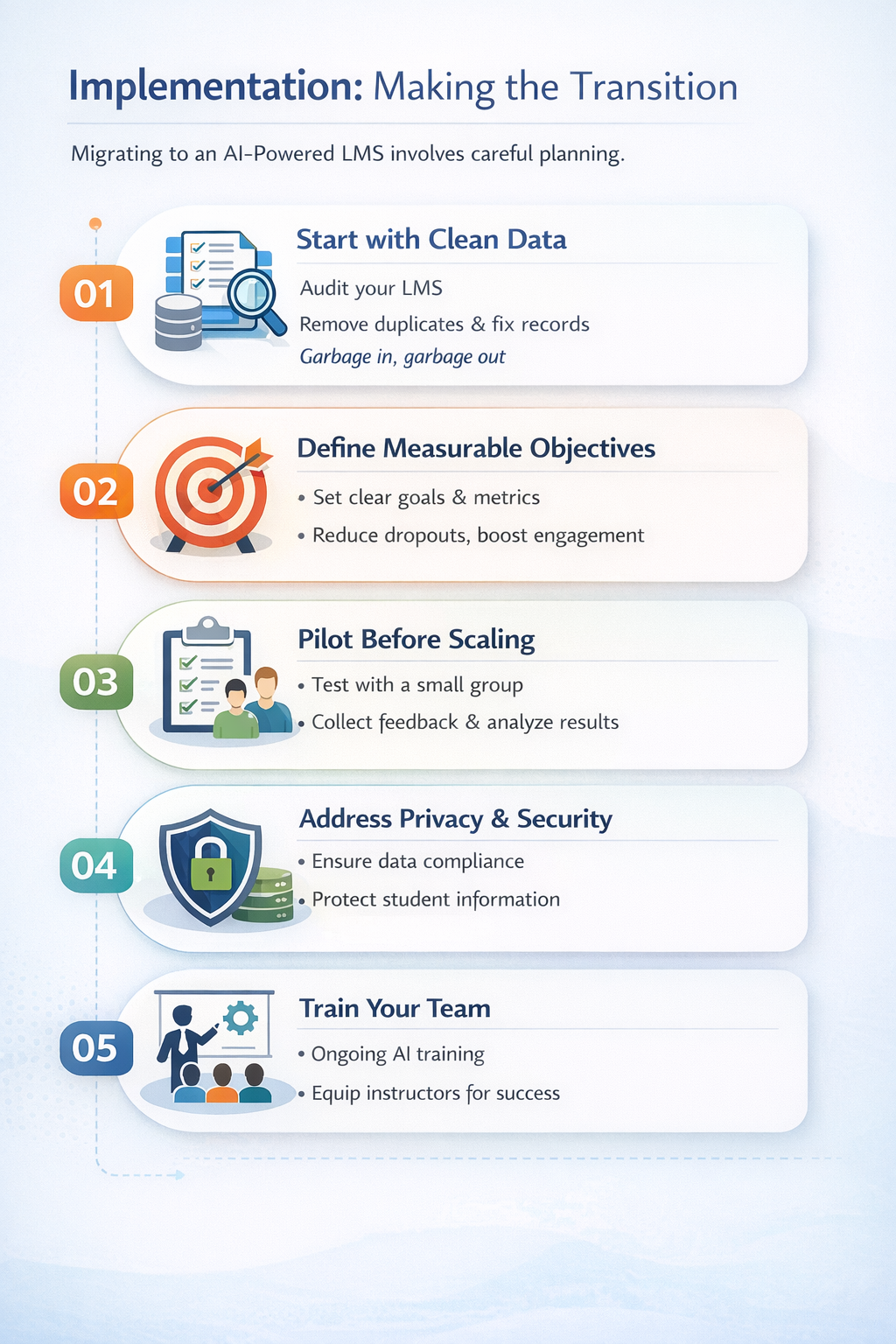
1. Start with Clean Data
AI is only as good as the data it learns from. Before migrating, audit your current LMS. Remove duplicate records, standardize learner information, and ensure historical course data is complete. This might seem tedious, but garbage in means garbage out.
2. Define Measurable Objectives
What specific problems are you solving? Are you trying to reduce dropouts? Improve completion times? Increase engagement? Define metrics upfront so you can measure impact.
3. Pilot Before Scaling
Start with one department or course. Run the pilot for a full semester. Collect feedback from instructors and learners. Measure against your objectives. Then expand.
4. Address Privacy and Security
AI requires data. Ensure you have clear privacy policies, learner consent, and secure storage. Regulatory compliance (FERPA, GDPR) isn't optional.
5. Train Your Team
Your instructors need to understand how the AI works, how to interpret reports, and how to act on recommendations. Training isn't a one-time event—it's ongoing as the system evolves.
What's Next: LMS Trends in 2025-2026
The market for AI-powered LMS isn't slowing. Here are the trends to watch:
- Neuroadaptive Learning: Systems that analyze brain activity (via EEG) combined with traditional data to optimize learning in real-time.
- AI-Powered Social Learning: AI will facilitate peer learning at scale, matching learners with complementary skills and creating dynamic study groups.
- Wearable Integration: LMS platforms will connect with smartwatches and AR glasses, enabling learning outside traditional settings—during commutes, breaks, even in field work.
- AI agent as Learning Coach: Evolving beyond tutoring, AI agents will act as full learning coaches, setting goals, tracking progress, celebrating wins, and adjusting strategies.
- Blockchain + AI Credentials: Verifiable, portable, instant credentials that follow learners throughout their careers.
Ready to Build an LMS That Actually Teaches?
We've built learning platforms since 2015. Let's turn your training goals into a system that works. Book a call with our EdTech team.
Conclusion
The future of LMS isn't about better filing cabinets. It's about systems that genuinely understand learners and adapt to help them succeed.
Organizations that implement AI-powered LMS now will gain a competitive advantage. They'll have higher engagement, lower dropout rates, and measurable learning outcomes. Their instructors will spend more time teaching and less time managing administrative overhead.
Starting small with clean data, clear objectives, and a pilot program reduces risk while building internal expertise. The future of learning is adaptive, personalized, and intelligent. Your LMS should be too.
Ready to upgrade from a traditional LMS to an AI-powered learning platform?
Let’s build a system that actually improves learning outcomes book a call with our experts today.
Ready to upgrade from a traditional LMS to an AI-powered learning platform?
Let’s build a system that actually improves learning outcomes book a call with our experts today.
FAQs
What is an AI-powered LMS?
An AI-powered LMS uses machine learning to personalize learning experiences, automate content creation, predict learner needs, and provide intelligent tutoring.
How much do AI LMS platforms cost? ?
Pricing varies significantly by platform and scale. Enterprise solutions like Docebo and Absorb typically require custom quotes based on user count and features.
Can AI replace human instructors?
No AI augments rather than replaces human instruction. AI handles routine tasks (content delivery, basic questions, progress tracking) and identifies learners needing intervention, freeing instructors to focus on mentorship, complex problem-solving, and relationship building that machines cannot replicate.
How long does AI LMS implementation take?
Basic AI features can be activated within days for cloud platforms with built-in capabilities. Full enterprise implementation, including data preparation, integration with existing systems, and custom workflow development, typically takes 3-6 months.
Is AI LMS only for large organizations?
No. Cloud-based AI LMS platforms have made these capabilities accessible to organizations of all sizes. Many platforms offer tiered pricing that scales with user count, and AI-assisted course creation can actually reduce the resources needed for effective training.