
Your school group just spent three years and a seven-figure budget implementing an ERP. Now, leadership wants AI capabilities. The last thing you need is another rip-and-replace cycle and the good news is, you don't need one.
Across the UAE and Saudi Arabia, schools are sitting on mature technology stacks LMS platforms, Student Information Systems, ERPs that were never designed for AI but hold enormous untapped data potential. The smartest institutions aren't replacing these systems. They're choosing to build an AI layer on existing school systems instead.
This guide walks you through the architecture, integration strategy, and ROI logic for adding an AI layer to your school's technology stack without disrupting operations or exceeding your IT budget.
Let's start with what an "AI layer" actually means and why it's the most cost-effective modernization path for GCC institutions in 2026.
Quick answer: You build an AI layer on existing systems by connecting LLMs and ML models to your data through APIs and a middleware layer, without replacing your LMS, ERP, or CRM. This adds AI features—search, automation, insights—while keeping your current software intact.
What IT Means to Build and AI Layer on Existing School Systems
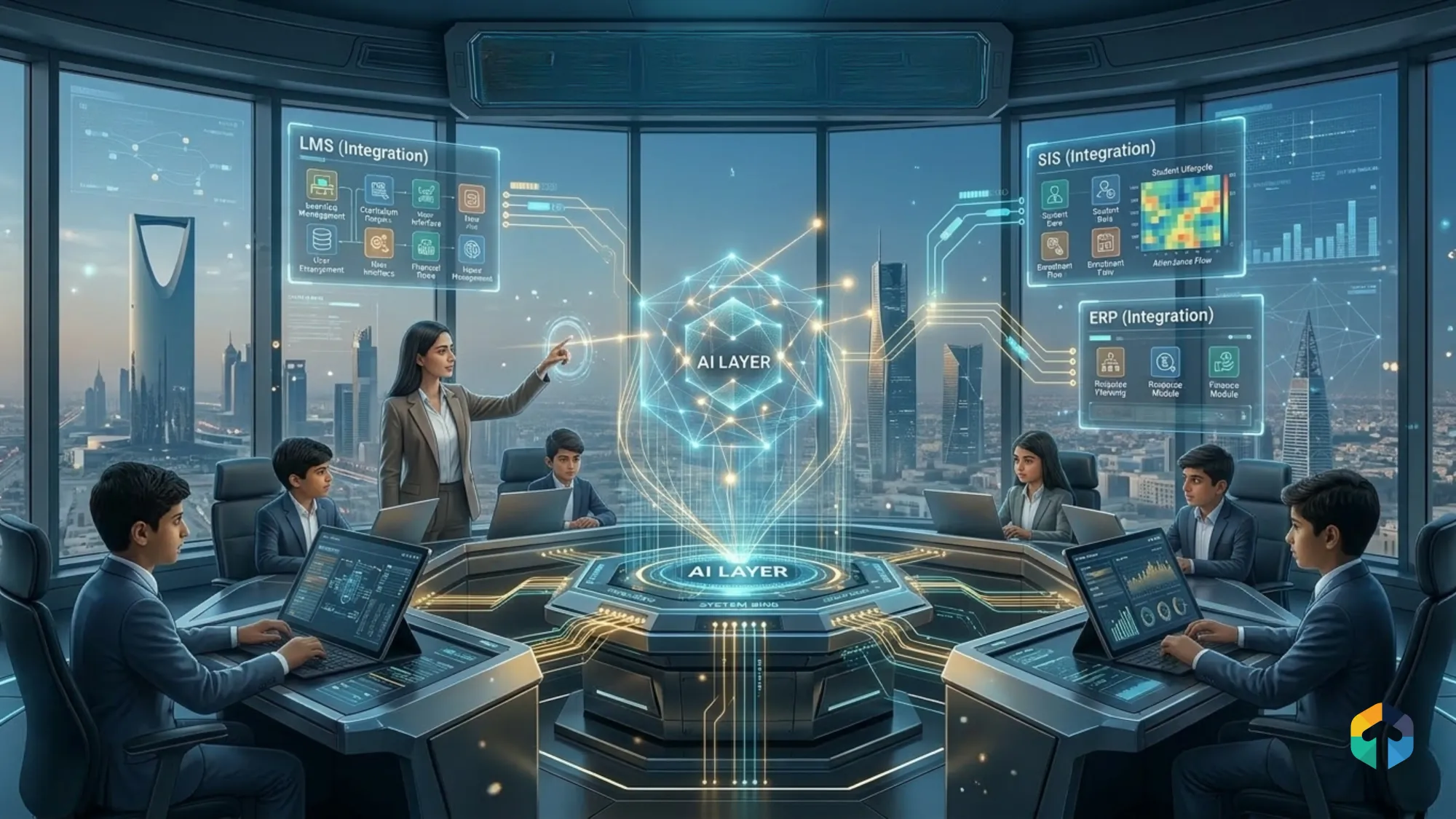
When we talk about building an AI layer on existing school systems, we're describing a middleware or integration layer that sits on top of your current LMS, SIS, and ERP. It extracts data from these systems and enables AI-driven automation, predictions, and insights without modifying the core software underneath.
The Architecture in Plain Terms
The architecture is straightforward in concept, even if execution requires precision. API-based connectors pull data from your existing platforms into a unified data layer typically a data lake or warehouse.
AI and machine learning services then consume this unified data to deliver actionable outputs: attendance predictions, automated fee reminders, learning analytics dashboards, and more.
Three Approaches GCC Schools Consider
GCC schools typically weigh three options when modernizing their technology stack. Here's how they compare:
Not Sure Where to Start With AI Integration?
We run a free 30-minute systems audit for GCC schools. You'll get a clear map of your stack and the fastest path to AI value.

The first option buying a new all-in-one AI-native platform means ripping out your existing systems and starting from scratch. It's expensive, risky, and slow.
The second option bolting on disconnected AI tools as point solutions creates fragmentation, data silos, and low ROI.
The AI layer approach sits in the middle and delivers the best of both worlds. You preserve your existing investment while unlocking AI value across the entire stack.
Why This Matters for Your School
For school CTOs and IT architects evaluating options, the calculus is simple. The question isn't whether your school needs AI. The question is whether you build it on what you already have or start from zero.
School ERP AI Integration: Where to Start and What to Connect First
The biggest mistake school technology teams make is trying to connect everything at once. Successful school ERP AI integration starts with identifying the highest-value modules first the systems where AI delivers the fastest, most visible returns.
Four High-Value Integration Points
Four integration points consistently rank highest in GCC school environments:
Attendance prediction uses historical data patterns to flag at-risk students before they disengage. Schools using this report catching dropout signals 4-6 weeks earlier than manual monitoring.
Fee collection automation reduces manual follow-ups and accelerates cash flow. Automated reminders with smart escalation sequences typically improve collection rates by 15-25%.
Learning analytics surfaces actionable insights from LMS data that teachers can act on in real time. This is where LMS AI modernization GCC schools are seeing the fastest adoption.
Parent communication automation handles routine queries, reminders, and updates without consuming staff hours. AI chatbots now handle 60-70% of standard parent inquiries at schools with mature implementations.
The Prioritization Framework
The prioritization framework for school CTOs: start with systems that have the cleanest data and the most manual workflows. These yield the fastest ROI with the least integration friction.
Expand to more complex integrations like predictive student performance models or enrollment forecasting in later phases, once the data pipeline is proven.
Assessing API Readiness
API readiness is a critical assessment point. Not every LMS, SIS, or ERP in the GCC market has robust API capabilities.
Before committing to an integration approach, audit your current platforms. If APIs are limited or non-existent, middleware solutions, webhooks, or custom connectors can bridge the gap but factor the cost and timeline implications into your planning.
The schools that get this right don't try to boil the ocean. They pick one high-impact use case, prove the value, and then expand. That's how you build an AI layer on existing school systems without burning budget or credibility.
How to Integrate AI with Existing School ERP: A Step-by-Step Framework
Implementation is where most AI modernization projects either gain momentum or stall out. The schools that succeed follow a phased framework rather than attempting a full-scale rollout from day one.
Phase 1: Data Audit and Unification
Catalogue every data source across your LMS, SIS, and ERP. Identify where data overlaps, where gaps exist, and where quality issues live.
Build a unified data schema that the AI layer can consume reliably. This phase is foundational. Skip it, and everything that follows will be built on unstable ground.
Phase 2: Pilot a Single Use Case
Select one high-impact, low-risk application. AI-powered attendance alerts, automated fee reminders, or a basic parent communication bot are good starting points.
Build the integration end-to-end for that one use case. Measure results against clear KPIs before committing to expansion. A 60-90 day pilot timeline is typical.
Phase 3: Scale and Automate
Once the pilot proves ROI, expand the AI layer to additional modules. Predictive analytics for student performance, AI chatbots for parent queries, and automated reporting dashboards for school leadership are natural next steps.
Each expansion follows the same pattern: define the use case, integrate the data, measure the outcome. This is how school software automation layer projects succeed methodically, not heroically.
Your 6-Step Implementation Checklist
If your school is ready to move from evaluation to execution, here's what to prioritize:
- Audit existing systems and APIs. Document every platform, its data structure, and its integration capabilities.
- Define AI use cases ranked by impact and feasibility. Prioritize based on data readiness and operational value, not on what sounds most impressive.
- Build or select your middleware/integration layer. Choose between custom development, off-the-shelf middleware, or a hybrid approach based on your technical capacity.
- Pilot one use case with measurable KPIs. Set a 60-90 day timeline with clear success criteria before expanding.
- Evaluate and iterate. Review pilot results honestly. Adjust the data pipeline, the AI model, or the integration architecture as needed.
- Scale across the full technology stack. Expand to additional modules methodically, maintaining data quality standards at each stage.
This framework applies whether you're working with a legacy ERP or a modern cloud-based SIS. The principles for how to build an AI layer on existing school systems remain the same.
ROI of Building an AI Layer on School Management Software in the GCC
ROI is the conversation that moves AI modernization from a technology discussion to a board-level decision. For GCC school decision-makers, the cost comparison between an AI layer approach and full system replacement is stark.
Cost Comparison: AI Layer vs. Full Replacement
A full ERP or LMS replacement for a mid-sized school group in the UAE or Saudi Arabia typically involves:
- Multi-year implementation timeline (2-3 years is common).
- Significant staff retraining costs.
- Operational downtime that disrupts the academic calendar.
- Total cost of ownership frequently in seven figures.
An AI layer, by contrast, can be deployed in phases over months not years with minimal disruption to existing operations and at a fraction of the cost.
The Metrics That Matter
The ROI metrics that matter to school leadership are tangible:
Hours saved in administrative workflows. Schools report 15-30 hours per week recovered from manual data entry and follow-up tasks.
Parent satisfaction scores improve from faster, more consistent communication. Response times drop from days to minutes.
Fee collection cycles shorten through automated reminders and smart follow-up sequences.
Data-driven decision-making at the leadership level improves. Real-time dashboards replace quarterly PDF reports.
The Risk Calculation
The risk calculation also favors the phased approach. The risks of not modernizing are real:
- Competitive disadvantage as neighboring schools adopt AI capabilities.
- Potential regulatory non-compliance as UAE and Saudi Arabia tighten digital transformation requirements.
- Talent attrition as your best staff leave for more technologically advanced institutions.
Both the UAE's smart school mandates and Saudi Vision 2030 education KPIs are accelerating pressure on school groups to demonstrate digital transformation progress. An AI layer helps schools meet these expectations without the upheaval of a full infrastructure overhaul.
This is why the ROI of building an AI layer on existing school systems consistently outperforms the alternatives for GCC institutions.
Want to See How This Works in Schools Like Yours?
We've built AI integration layers for school groups across the UAE and Saudi Arabia. Let's show you what's possible with your existing systems.
The Future of AI-Enhanced School Systems in the GCC
The evolution of school technology stacks in the GCC over the next 2-3 years is predictable in direction, even if the exact timeline remains fluid. AI-native features will become table stakes in LMS and ERP procurement. Vendors that can't demonstrate embedded AI capabilities will lose ground.
The Early Mover Advantage
The transition period rewards schools that built integration layers early. Schools with an operational AI layer will have a data advantage years of unified, structured data feeding their AI models that late movers can't replicate by simply purchasing a new platform.
This is where enterprise AI for GCC schools becomes a strategic differentiator, not just a technical upgrade.
Three Capabilities to Evaluate Now
Three emerging AI capabilities should be on every school CTO's evaluation list:
Generative AI for personalized learning paths is moving from pilot to production in leading schools globally. Students get customized content based on their learning patterns.
Predictive models for enrollment forecasting give school groups a strategic planning advantage that directly impacts revenue. Know which grades will be oversubscribed 12 months in advance.
AI-driven compliance monitoring automates the reporting burden that consumes administrative hours every accreditation cycle. SIS AI features in 2026 will increasingly include built-in compliance dashboards.
Build an Asset, Not a Shortcut
Position the AI layer as a strategic asset, not a technical shortcut. Schools that build this capability in-house or with a trusted development partner retain control over their data, their AI models, and their modernization roadmap.
They're not locked into a vendor's product decisions or pricing trajectory.
School CTOs and IT architects who build an AI layer on existing school systems now aren't just solving today's automation gaps. They're building the foundation that every future technology decision at their institution will sit on.
Conclusion
Building an AI layer on existing school systems is the most pragmatic, cost-effective, and strategically sound path to modernization for GCC institutions in 2026.
Three takeaways matter above all else:
First, you don't need to replace your ERP, LMS, or SIS to unlock AI value. An integration layer delivers faster ROI with lower risk.
Second, start with one high-impact use case, prove the value, then scale methodically. Don't try to transform everything at once.
Third, the schools that build this capability now will define the technology standard for GCC education over the next decade.
The question isn't whether your school needs AI. It's whether you build it on what you already have or start from scratch.
Your Systems Already Have the Data. Let's Make Them Smarter.
We builds custom AI layers for schools, universities and institutes and in no rip-and-replace, no downtime. Just results from what you already have.
[Talk to Our AI Experts Today!]
Adding AI to systems you already run? See our AI in software services and AI development services, or compare the top AI development companies.