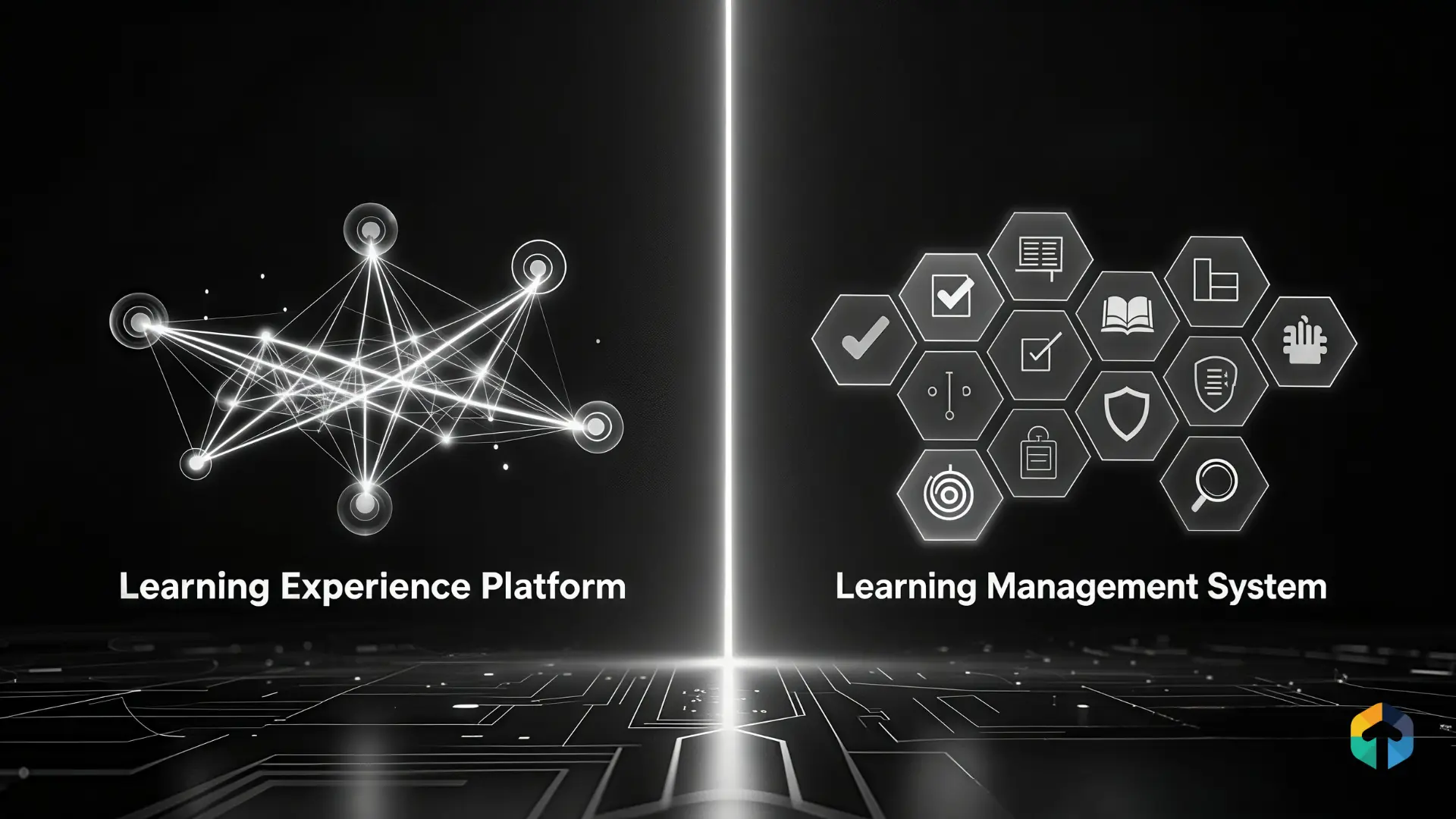
If you're reading this, you probably already know what an LMS and LXP are. You're not here for definitions, you're here because you need to pick one (or figure out if you need both), and every article you've read so far is written for corporate HR teams, not educators. Let's fix that.
TLDR: The Quick Answer
- LMS = You design the curriculum. Students follow structured courses, complete assignments, and get graded. Think Canvas, Moodle, Blackboard.
- LXP = Students explore based on interests. Personalized recommendations, self-paced discovery, multiple content sources.
- K-12 schools and universities typically need an LMS for curriculum delivery and accreditation tracking.
- Online course platforms and supplemental learning often benefit from LXP features.
- The real answer: Most educational institutions need LMS functionality first, with LXP elements layered in for enrichment.
Now, let's get into the details.
The Core Difference
Here's the simplest way to think about it:
An LMS is like a traditional classroom, digitized. The teacher (or institution) decides what students learn, in what sequence, with clear assessments and grades. It mirrors the structure educators already know syllabus, assignments, deadlines, exams.
An LXP is like a library with a really smart librarian. Students browse, discover what interests them, get personalized recommendations, and learn at their own pace. The platform adapts to each learner's preferences and suggests "you might also like this" based on what they've already explored.
Neither approach is wrong. They just solve different problems.
The LMS mindset: Education is a path. Students start at point A, follow the curriculum, and arrive at point B with measurable outcomes.
The institution controls the journey, what's taught, when it's taught, and how mastery is assessed. This is how formal education has worked for centuries, and an LMS digitizes that model effectively.
The LXP mindset: Learning is exploration. Students have different interests, different gaps, and different goals. Instead of forcing everyone through the same path, give them tools to discover what they need and let them build their own journey.
The platform learns what engages each student and surfaces relevant content automatically.
An LMS asks: "Did every student complete the required coursework?"
An LXP asks: "Are students curious, engaged, and developing broader skills?"
Not Sure Which Platform Fits Your School?
Let's talk through your specific needs curriculum structure, SIS integration, student engagement goals and figure out what actually makes sense.

Where This Gets Practical:
In an LMS, a 10th-grade biology teacher uploads lecture videos, assigns readings, creates quizzes, and grades lab reports. Every student in the class sees the same content in the same order. The teacher knows exactly who submitted what and who's falling behind.
In an LXP, a student interested in marine biology might get recommendations for ocean ecosystem videos, articles about coral reef conservation, a TED talk on marine plastic pollution, and a peer's notes from a summer internship at an aquarium.
The platform notices they watched the coral reef video twice and starts surfacing more environmental science content.
Both are valuable. But they serve fundamentally different purposes.
The Fundamental Tension
Traditional education requires structured standards, grades, transcripts, and accreditation. Students need credentials that mean something. But modern learning research also tells us that curiosity-driven, self-directed learning leads to deeper understanding and better retention.
The LMS vs LXP debate is really about where your institution sits on that spectrum, and whether you can find ways to get the benefits of both.
LXP vs LMS: Quick Comparison
When an LMS Makes Sense
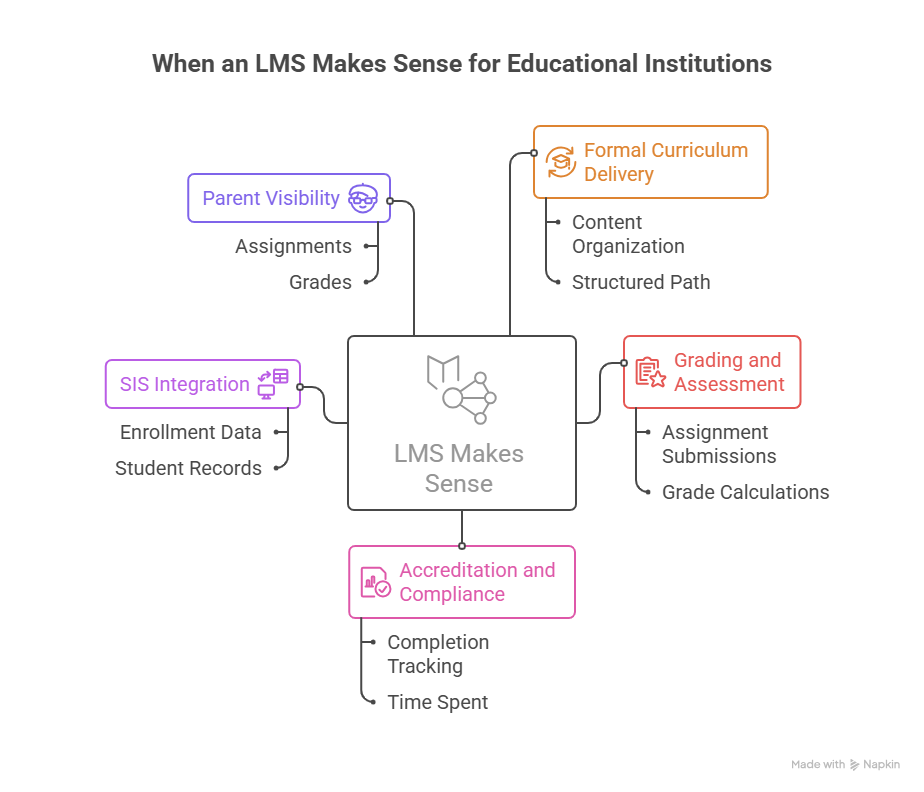
For most schools and universities, an LMS isn't optional, it's foundational. Here's why. You probably need an LMS if:
1. You're Delivering a Formal Curriculum
Whether it's a K-12 math course or a university biology program, a structured curriculum requires structured delivery. An LMS lets you organize content by week, module, or unit, and ensures every student follows the same path.
2. Grading and Assessment Matter
Schools need grades. An LMS handles assignment submissions, rubrics, grade calculations, and gradebook management. LXPs typically don't have robust grading systems because they're not designed for formal assessment.
3. Accreditation and Compliance are on the Line
Universities and professional programs often need to prove that students completed specific coursework for accreditation. An LMS tracks completion, time spent, and assessment scores data you'll need for audits and reviews.4. You need SIS integration.
4. Your Need SIS Integration
Student Information Systems (like PowerSchool, Infinite Campus, or Banner) hold your enrollment data, student records, and official grades. LMS platforms are built to integrate with these systems. Most LXPs aren't.
5. Parents Need Visibility
For K-12, parent portals matter. Parents want to see assignments, grades, and upcoming deadlines. LMS platforms typically offer parent-facing views. LXPs rarely do.
Popular education LMS examples: Canvas, Moodle, Blackboard, Google Classroom, Schoology, Brightspace (D2L).
When an LXP Makes Sense
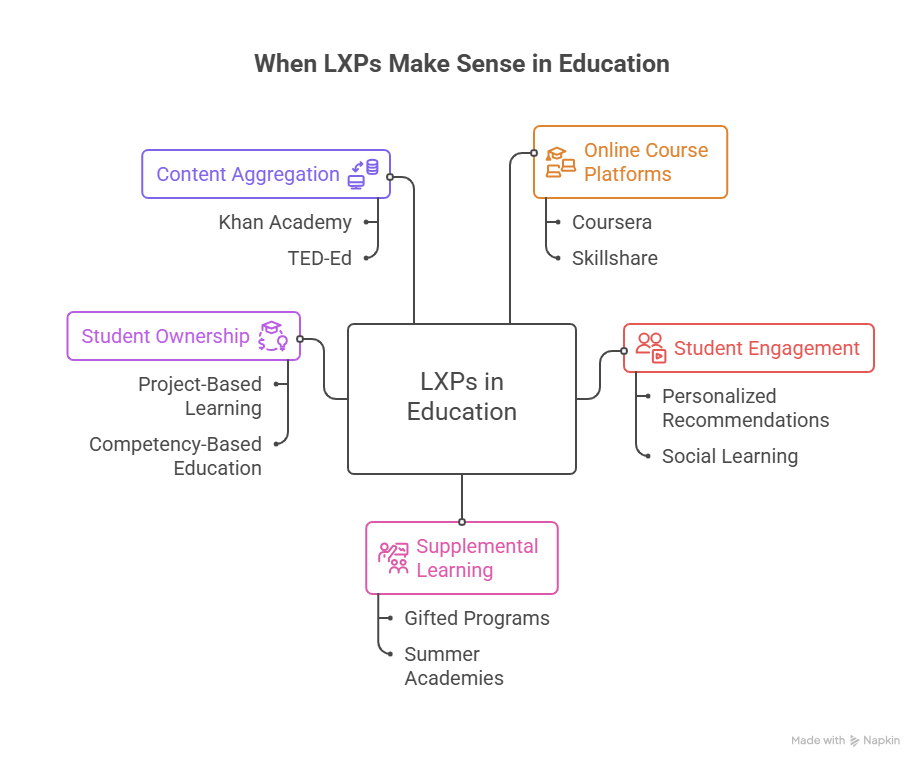
LXPs are newer to education, and honestly, most traditional schools don't need a standalone LXP. But there are scenarios where LXP features add real value:
1. You're running an online course platform
If you're building an EdTech product, think Coursera, Skillshare, or a niche learning platform, an LXP model often fits better. Learners browse a catalog, pick what interests them, and move at their own pace.
2. Student engagement is a problem you're actively trying to solve
If students are completing assignments but not actually engaging with learning, LXP features like personalized recommendations, social learning, and varied content formats can help. Some institutions layer these features on top of their LMS.
3. You Offer Supplemental or Enrichment Learning
Gifted programs, after-school learning, summer academies, or professional development for teachers often work better with an exploratory model rather than rigid course structures.
4. You Want Students To Own Their Learning Journey
Project-based learning, competency-based education, or schools with strong student agency philosophies often find LXP models more aligned with their pedagogy.
5. You're Aggregating Content from Multiple Sources
If you want students to access Khan Academy, YouTube educational content, TED-Ed, and your own materials in one place, an LXP's content aggregation features make this easier.
Popular LXP/LXP-like platforms in education: Degreed, EdCast, Coursera for Campus, LinkedIn Learning (for higher ed), various custom-built platforms.
Stuck Between Off-the-Shelf Options?
You're not alone. Sometimes the right answer is a custom build that does exactly what you need.
The Honest Truth: Schools Need LMS First, LXP Second
Here's what most EdTech vendors won't say clearly: if you're a school or university, you need LMS functionality before you need LXP functionality.
Why? Because formal education has non-negotiable requirements:
- Curriculum delivery that aligns with standards
- Grading and transcripts
- Accreditation documentation
- Parent communication (for K-12)
- SIS integration
LXPs aren't designed for these. They're designed for exploratory, self-directed learning, which is valuable, but supplementary in most educational contexts.
Three ways educational institutions approach this:
1. LMS as primary, LXP features as add-ons
Most common approach. Your LMS handles the core academic program. You might add LXP-like features through integrations or supplemental platforms for enrichment, electives, or professional development.
2. LMS for academics, separate LXP for extracurricular learning
Some universities use an LMS for credit-bearing courses but offer an LXP for student professional development, career exploration, or lifelong learning alumni programs.
3. A custom platform that blends both
Institutions with specific needs (online universities, bootcamps, innovative K-12 models) sometimes build custom platforms that combine LMS structure with LXP flexibility.
Questions to ask yourself:
- Do we need formal grading and transcripts? (If yes, you need LMS)
- How important is student choice and exploration in our model?
- Does our SIS need to integrate with this platform?
- Are we supplementing traditional education or replacing it?
- What's our students' appetite for self-directed learning?
What to Actually Look For (Practical Checklist)
Forget the feature comparison matrices with 200 line items. Here's what actually matters for educational institutions:
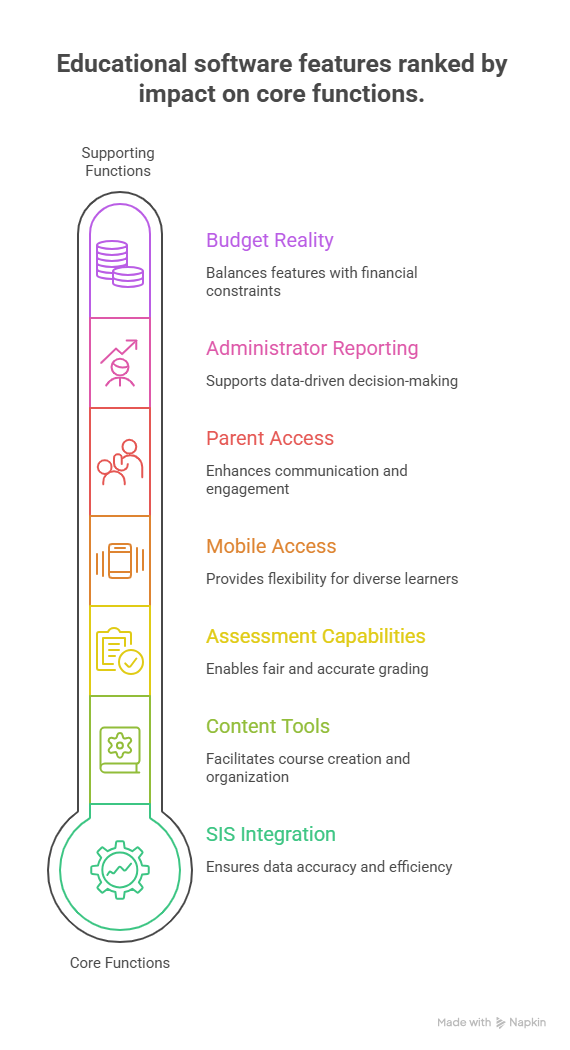
SIS and gradebook integration
- Does it sync with your Student Information System?
- Can grades flow back automatically?
- How does enrollment data get updated?
Content and curriculum tools
- Can faculty easily build and organize courses?
- Does it support your content types (video, documents, SCORM, interactive)?
- How easy is it to copy and update courses each term?
Assessment capabilities
- What quiz and test options exist?
- Can you use rubrics for assignment grading?
- Does it support plagiarism detection?
Mobile and offline access
- Do students need to learn on mobile devices?
- What about students with unreliable internet at home?
- How does the mobile experience compare to desktop?
Parent and guardian access (for K-12)
- Is there a parent portal?
- What can parents see and not see?
- Can you communicate with parents through the platform?
Reporting for administrators
- Can you track course completion across the institution?
- What data is available for accreditation reporting?
- Can you identify at-risk students early?
Budget reality
- What's the per-student pricing model?
- Are there implementation and training costs?
- What's the total cost of ownership, including IT support?
Ready to Build Your Learning Platform?
We've built LMS platforms, LXP features, and custom hybrids for schools and EdTech companies since 2015.
Conclusion
If you've read this far, here's the honest advice:
Start with what your institution actually requires.
For most K-12 schools and universities, that's an LMS with solid SIS integration, grading tools, and faculty-friendly course building. Once that's running smoothly, you can explore adding LXP features for enrichment or specific programs.
Choosing between an LMS and LXP is really about understanding what your students, teachers, and administrators need today and what your educational model demands.
At Third Rock Techkno, we've spent over a decade building custom learning platforms for schools, universities, and EdTech companies.
Whether you need an LMS with specific SIS integrations, an LXP for your online course platform, or a custom hybrid that fits your unique educational model, our team can help you design and build it.
FAQs
Can an LXP replace an LMS for a school?
For most traditional schools, no. Schools need grading, curriculum sequencing, SIS integration, and parent portals features that LXPs typically don't prioritize. However, alternative education models might find an LXP sufficient if formal grading isn't central.
Which platform is better for online universities?
Online universities typically need robust LMS functionality for accreditation and degree programs, but often add LXP features for student engagement and professional skill development. Many end up with hybrid approaches LMS for credit courses, LXP for supplemental learning.
How much do these platforms typically cost for schools?
Education LMS pricing varies widely. Free options like Moodle and Google Classroom exist, but require IT support. Commercial LMS platforms typically run $3-8 per student annually for K-12, and higher for universities with premium support.
What about Google Classroom is that an LMS or LXP?
Google Classroom is a lightweight LMS. It handles assignment distribution, submission, and basic grading, but lacks the depth of Canvas or Blackboard. It works well for K-12 schools already in the Google ecosystem, but may fall short for universities or institutions needing advanced features.
How long does LMS implementation typically take for schools?
For a straightforward implementation with existing content: 2-4 months, including training. For complex implementations with SIS integration, content migration, and custom configurations: 6-12 months. Summer is typically when schools make the switch to minimize disruption.