

The Scheduling Challenge in Modern Healthcare
Access to care remains one of healthcare's most persistent challenges. Patients frequently face long wait times on phone lines, limited appointment availability, and frustrating scheduling processes.
Meanwhile, medical practices struggle with inefficient scheduling systems, high no-show rates, and administrative staff overwhelmed by routine booking tasks.
This scheduling bottleneck creates problems for everyone involved. Patients delay seeking care due to access barriers, clinics experience revenue loss from unfilled appointments, and administrative teams spend hours on tasks that add little clinical value.
Traditional solutions adding more staff, extending phone hours, or implementing basic online booking often fail to address the core inefficiencies in matching patient needs with provider availability.
The costs extend beyond mere inconvenience. Scheduling inefficiencies contribute to care gaps, decreased patient satisfaction, and wasted clinical capacity. As healthcare faces continued staffing challenges and increasing demand, the need for more intelligent appointment systems has become critical.
Understanding AI Agent Appointment Scheduling
AI appointment scheduling represents a transformative approach to healthcare access. It moves beyond static booking systems to create dynamic, intelligent patient-provider matching.
These systems combine natural language processing, machine learning, and healthcare-specific knowledge to optimize appointment scheduling processes.
Unlike basic online calendars, AI scheduling assistants understand appointment types, provider specialties, insurance requirements, and patient preferences.
They function as intelligent gatekeepers, ensuring patients see the right provider at the right time while maximizing clinical resource utilization.
Medical practices implementing these systems have experienced substantial improvements in scheduling efficiency.
Organizations report significant reductions in phone call volume, improved appointment utilization, and more equitable access to care across patient populations.
Key Capabilities Enhancing Patient Access
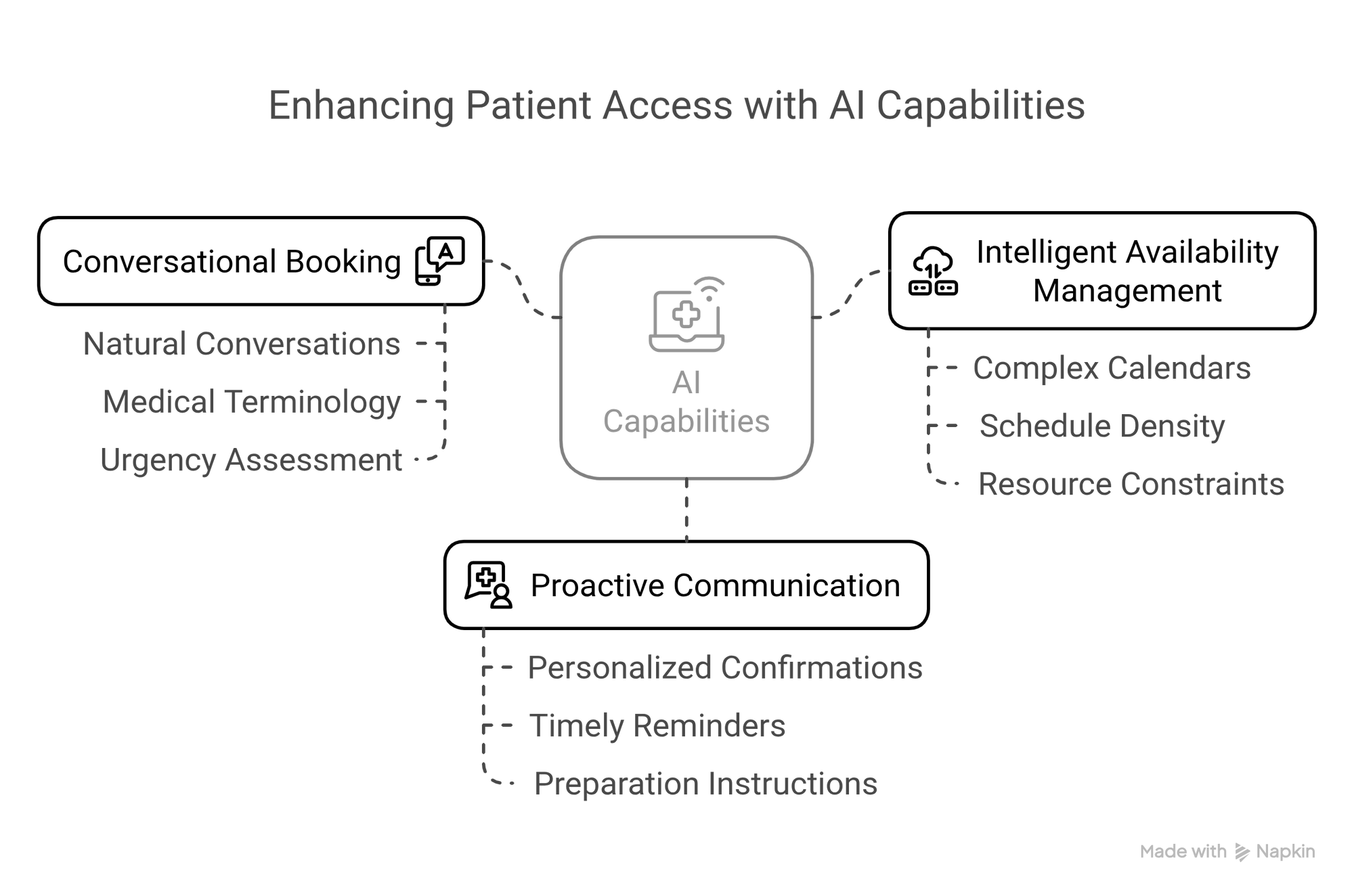
Intuitive Conversational Booking Experience
The AI chatbot transforms how patients initiate care:
- Conducts natural conversations about appointment needs.
- Understands medical terminology and patient descriptions.
- Asks appropriate follow-up questions to determine urgency and type.
- Matches patient needs to appropriate providers and appointment types.
- Offers alternatives when preferred times aren't available.
- Accommodates complex scheduling requirements.
This conversational approach eliminates friction in the booking process. Rather than navigating complex phone trees or filling out forms, patients simply describe their needs: "I've been having headaches for the past two weeks and need to see someone," or "I need a follow-up appointment for my diabetes management."
Primary care practices find that patients particularly appreciate the system's ability to understand urgency and suggest appropriate time frames.
When patients mention symptoms that are concerning, the system can prioritize access, while routine follow-ups might be scheduled further based on clinical protocols.
Intelligent Availability Management
Beyond basic calendar functions, the AI assistant optimizes provider schedules.
- Manages complex provider calendars with different appointment types.
- Balances schedule density with appropriate visit durations.
- Maintains buffers for urgent care needs.
- Adapts to provider preferences for appointment clustering.
- Optimizes patient flow to reduce waiting room congestion.
- Manages resource constraints like exam rooms or equipment.
This intelligent approach improves both access and efficiency. Multi-provider practices particularly value how the system balances workloads across the care team, ensuring fair distribution while respecting each provider's schedule preferences and capabilities.
Specialty clinics appreciate the system's ability to manage procedure scheduling, automatically allocating appropriate time blocks and ensuring necessary equipment will be available. This reduces the common problem of procedures running late due to booking or resource allocation errors.
Proactive Communication and Engagement
The system maintains ongoing patient communication to reduce no-shows and improve preparation.
- Sends personalized appointment confirmations across preferred channels.
- Delivers timely reminders with increasing frequency as appointments approach.
- Provides preparation instructions specific to appointment types.
- Enables easy rescheduling when conflicts arise.
- Collects pre-visit information to streamline check-in.
- Follows up after missed appointments to re-engage patients.
These communication capabilities significantly reduce no-show rates while improving visit efficiency. When patients receive appropriate preparation instructions from fasting requirements to necessary documentation, visits begin more promptly and proceed more efficiently.
Behavioral health practices report particularly strong benefits from automated engagement, with reminder systems reducing no-show rates substantially.
This improvement addresses a significant challenge in mental health care, where missed appointments represent both lost revenue and missed treatment opportunities.
Measurable Impact on Healthcare Operations
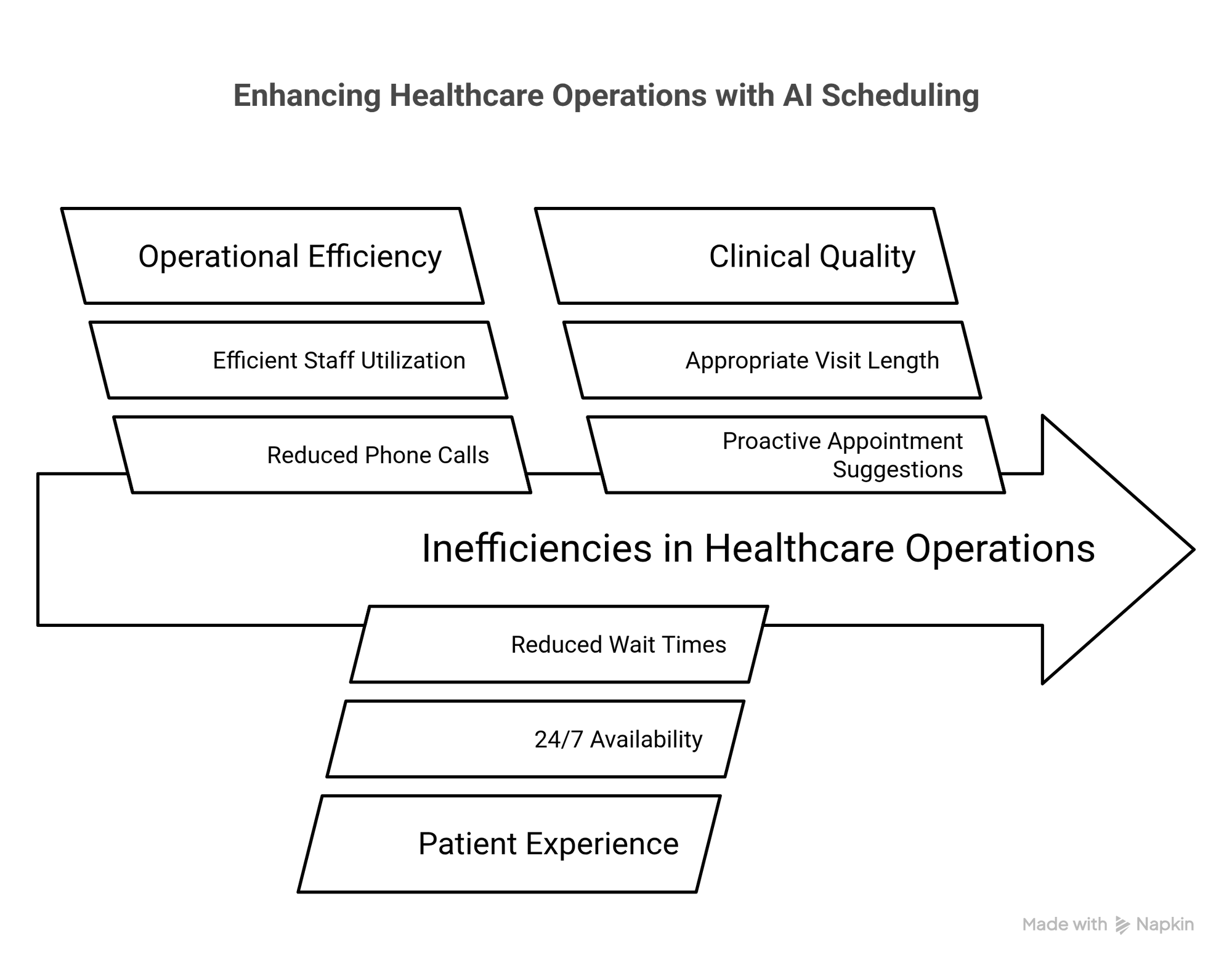
Operational Efficiency Through Automated Scheduling
The most immediate impact comes through administrative time savings. Healthcare organizations typically report
- Significant reduction in phone call volume for routine scheduling.
- Decreased time spent managing schedule changes and cancellations.
- More efficient use of administrative staff for higher-value activities.
- Improved provider schedule utilization.
- Reduced overtime costs for scheduling teams.
- More consistent application of scheduling protocols.
Medical groups have documented substantial productivity improvements after implementing AI scheduling.
When front desk staff can focus on in-person patient needs rather than answering phones, both practice efficiency and patient experience improve simultaneously.
Multispecialty clinics find that AI scheduling excels at managing complex department referral processes.
The system ensures appropriate preparation, authorization, and information transfer without requiring multiple calls between departments.
Enhanced Patient Experience Through Improved Access
Beyond operational benefits, AI scheduling transforms the patient experience:
- 24/7 appointment availability without staffing costs.
- Dramatically reduced wait times for scheduling assistance.
- More equitable access across different patient populations.
- Greater scheduling flexibility for working patients.
- Improved visit preparation through targeted instructions.
- Higher satisfaction with overall access to care.
Healthcare systems report substantial improvements in patient satisfaction scores related to access after implementation.
The ability to schedule appointments outside business hours particularly benefits working patients who previously struggled to call during limited phone hours.
Primary care practices note that older patients, initially expected to resist digital scheduling, often become enthusiastic adopters after experiencing the simplified booking process.
The conversational interface proves more intuitive than complex web forms for many seniors.
Clinical Quality Improvements Through Scheduling
Perhaps most significantly, intelligent scheduling creates clinical benefits:
- Appropriate visit length allocation based on medical needs.
- Reduced care gaps through proactive appointment suggestions.
- Better preparation leads to more productive visits.
- Decreased clinical schedule disruptions from booking errors.
- More appropriate urgent care triage and scheduling.
- Reduced care delays from scheduling bottlenecks.
Preventive care programs show particularly strong improvements with AI scheduling assistance.
The system can proactively identify patients due for screenings or follow-ups and suggest appropriate appointments, improving compliance with care guidelines.
Implementation Considerations for Healthcare Organizations
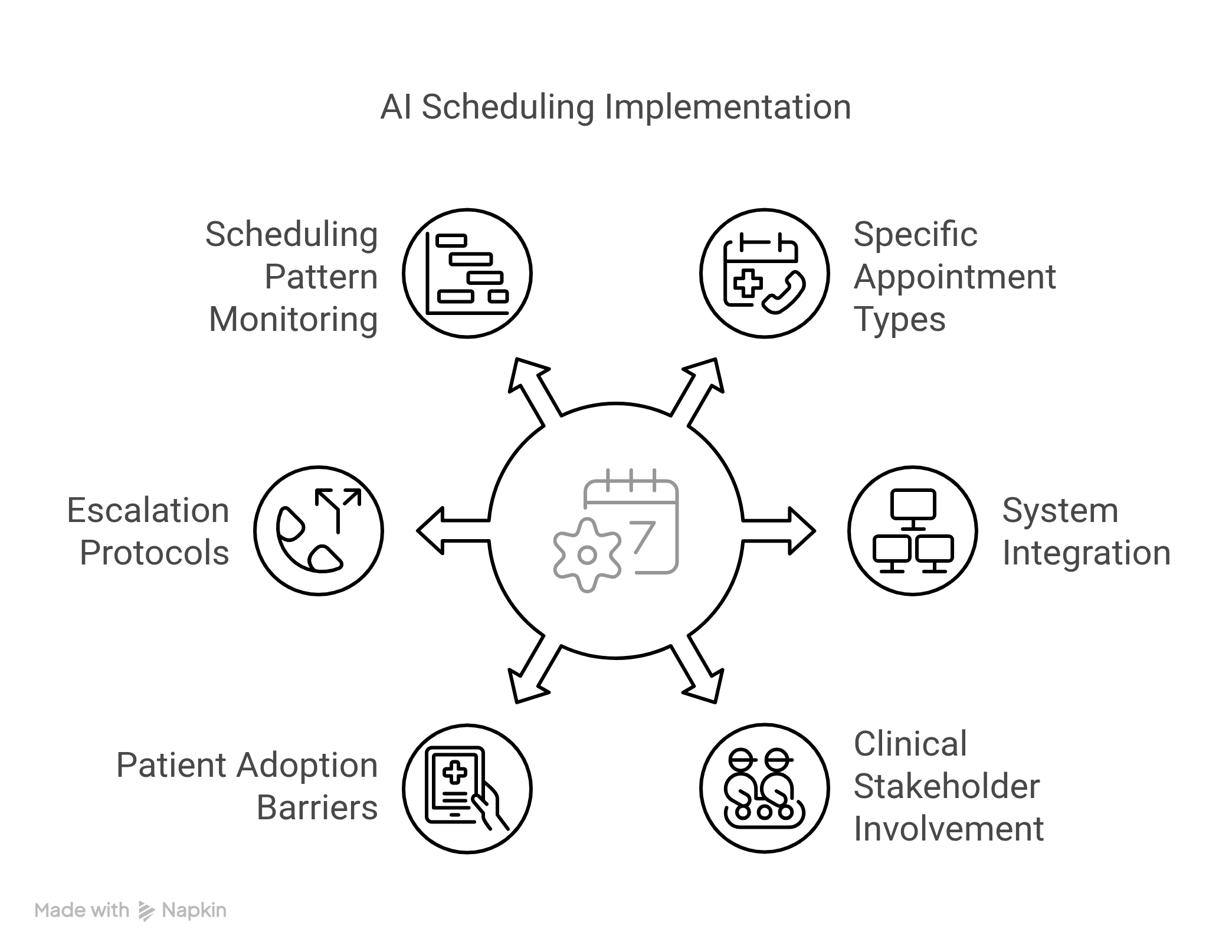
While benefits are compelling, successful implementation requires thoughtful planning.
- Start with specific appointment types - Begin with routine visits before expanding to complex procedures.
- Integrate with existing systems - Ensure seamless connection with practice management and EHR platforms.
- Involve clinical stakeholders - Get provider input on scheduling rules and preferences
- Address patient adoption barriers - Provide clear pathways for patients who are less comfortable with technology.
- Establish appropriate escalation protocols - Create processes for handling complex cases requiring human judgment.
- Monitor scheduling patterns - Analyze data to continuously refine scheduling algorithms and rules.
Organizations that follow these implementation practices typically see faster adoption and stronger results from their AI scheduling investments.
Future Development in Healthcare Scheduling
As these technologies continue to evolve, healthcare organizations can anticipate several promising enhancements.
- Predictive scheduling will identify potential no-shows before they occur, allowing proactive intervention.
- Transportation coordination will help patients arrange rides to appointments when needed.
- Social determinants awareness will factor access challenges into scheduling recommendations.
- Integrated telehealth options will offer appropriate virtual alternatives when suitable for clinical needs.
- Team-based scheduling optimization will coordinate multiple providers for complex care needs.
Healthcare leaders already implementing current-generation systems will be well-positioned to leverage these capabilities as they emerge.
Conclusion
AI-powered appointment scheduling represents a crucial advance in healthcare's ongoing effort to improve access while managing limited resources.
By combining intelligent automation with healthcare-specific knowledge, these systems transform what has traditionally been a frustrating bottleneck into a smooth entry point for patient care.
For healthcare organizations seeking to enhance patient experience while improving operational efficiency, AI scheduling offers a solution with benefits across multiple dimensions.
As staffing challenges persist and consumer expectations continue to rise, intelligent scheduling will increasingly become an essential capability for competitive healthcare providers.
If you are looking for integrating AI Agent in your system we can help you build and integrate AI in your existing system! Contact us today!