
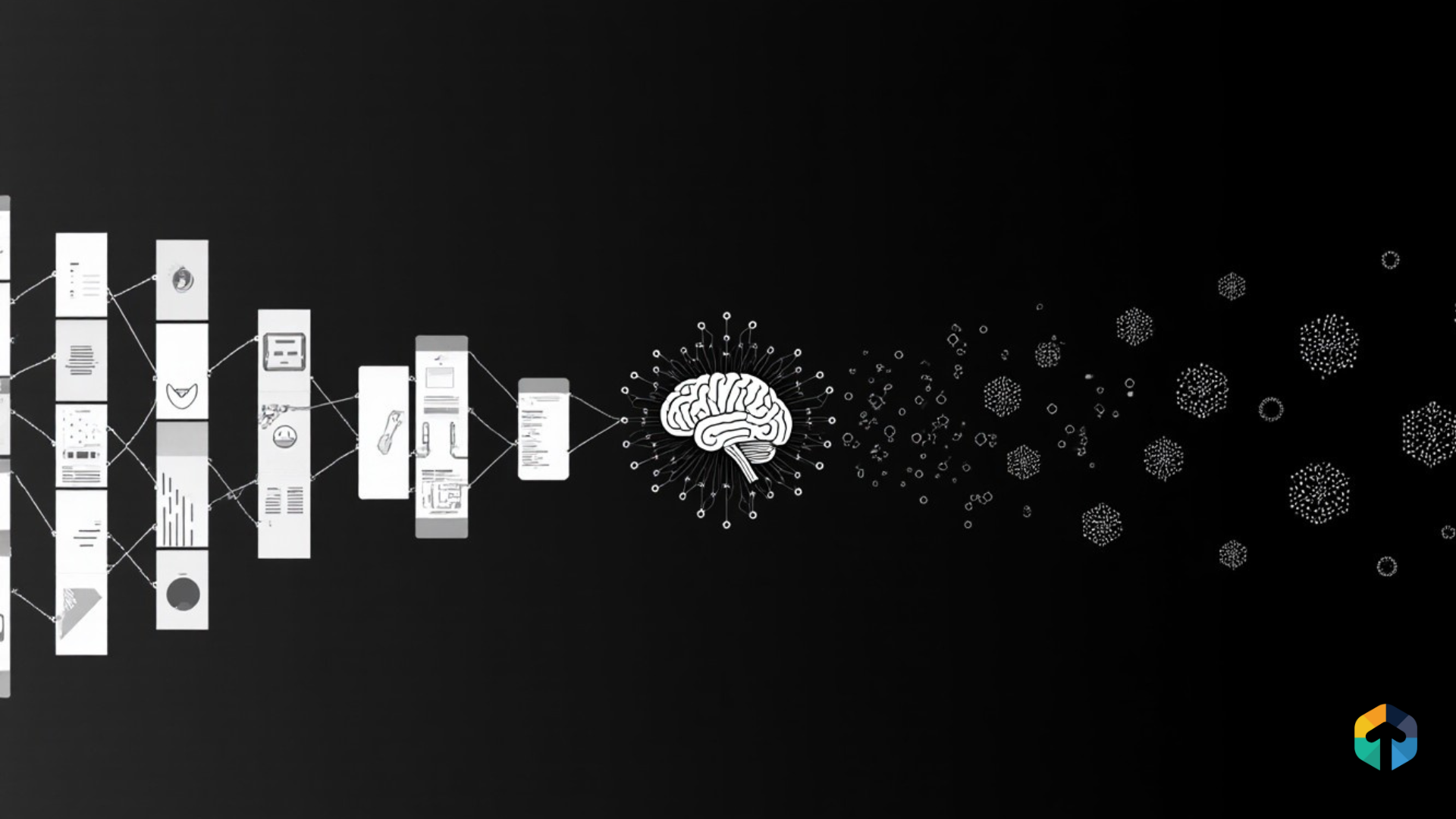
Remember when your first RPA bot felt revolutionary? Watching it process invoices while your team slept. No breaks, no errors, pure efficiency. Your CFO was thrilled with the ROI numbers.
Fast forward to today. That same bot breaks every time IT updates a vendor portal. Your exception queue keeps growing. The "simple" process you automated now needs three people managing exceptions. Meanwhile, your biggest competitor just launched a customer service that responds in seconds with surprising intelligence.
What changed?
The world moved on. While you were optimizing rule-based bots, leading companies started deploying something fundamentally different autonomous AI agents that think, learn, and adapt.
The gap between basic automation and intelligent automation is widening every quarter, and it's showing up in customer satisfaction scores, operational costs, and market share.
Gartner predicts that by 2026, 40% of enterprise applications will include task-specific AI agents, reflecting a rapid integration of agentic AI for workflow automation.
This isn't about abandoning what works. It's about understanding when good enough stops being good enough.
What is RPA, and Why Did it Become So Popular?
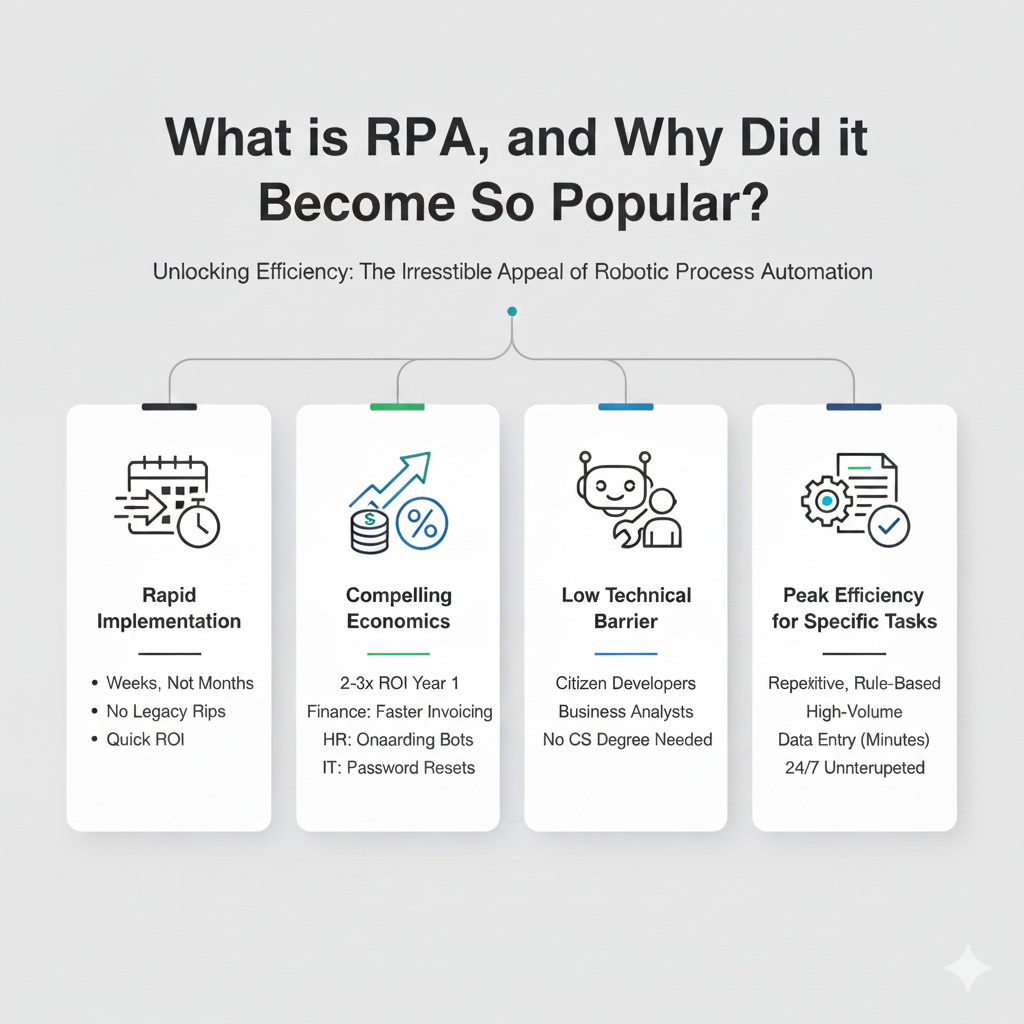
Robotic Process Automation transformed how businesses think about efficiency. The concept was straightforward software bots that mimic human actions on computers. Clicking buttons, copying data, filling forms, and moving information between systems.
The appeal was impossible to resist. Traditional enterprise software took months to implement. RPA bots went live in weeks. No ripping out legacy systems. No massive IT projects. You could show results before the budget cycle ended.
The economics worked beautifully. Companies reported returns ranging from double to triple their investment in the first year. Finance teams automated invoice processing and slashed processing time dramatically. HR departments deployed onboarding bots and cut administrative tasks in half. IT helpdesks automated password resets and watched ticket volumes plummet.
The technical barrier was manageable. Business analysts could learn RPA tools without a computer science degree. Citizen developers could build useful bots. The democratization of automation became a reality, not just marketing.
For repetitive, rule-based, high-volume tasks, RPA crushed expectations. Data entry that consumed human hours finished in minutes. Report generation that required manual compilation became push-button. System transfers that ate IT resources became automated workflows running around the clock.
Manufacturing led adoption, followed quickly by financial services, healthcare, and telecommunications. The technology jumped from early adopters to mainstream faster than most enterprise software in history. By recent counts, the vast majority of large enterprises had implemented or planned RPA deployments.
The wins were legitimate. Cost reduction showed up in quarterly financials. Efficiency gains were measurable and dramatic. Tasks that took humans hours are completed in minutes. Bots worked continuously without breaks, performing activities multiple times faster than human workers.
So why are leading companies now looking beyond RPA?
Limitations of RPA Automation
The same characteristics that made RPA successful for simple tasks become liabilities when automation needs evolve. Five fundamental limitations are forcing companies to rethink their automation strategies.
Can't Handle Unstructured Data
Most business data doesn't come in neat rows and columns. Customer emails. Invoice variations. Contract PDFs. Images. Feedback forms. Meeting notes. Support tickets written by frustrated customers at odd hours.
RPA bots see unstructured information as chaos they can't process. Built for structured data, Field A goes to Field B. RPA works brilliantly until you show it an email explaining a complex problem or an invoice that doesn't match the expected template.
The cost? Companies discover that handling exceptions consumes the majority of automation resources. You automated the straightforward cases and now manually manage everything that doesn't fit the mold.
Research shows only a small fraction of businesses effectively leverage their unstructured data, leaving massive value untapped.
While you're hiring people to read customer emails and process variable-format documents, competitors with AI agents are automating those processes completely.
Breaks with Every Change
RPA bots are hard-coded to follow specific interface elements and exact steps. When vendors update portals, will automation stop working? When internal systems get updates, the bots will break. When business needs require process adjustments, and they always do, you're looking at development projects.
The maintenance burden grows with every bot deployed. Studies show RPA maintenance can consume a quarter or more of total automation budgets. Developer time goes to fixing bots instead of building new capabilities. Business agility grinds to a halt because automation can't keep pace with necessary changes.
No Decision-Making Ability
When RPA encounters situations outside its programming, it stops. Throws an error. Adds tasks to exception queues. Waits for humans to decide what to do.
RPA follows if-then logic. If this field contains X, do Y. It can't reason, weigh options, or make judgment calls. It's automation without intelligence.
The cost? Human oversight for every exception. Operations that aren't truly continuous because edge cases need people. Customer service that can't genuinely self-serve because bots transfer anything complex to humans.
Growth is constrained because you can't scale operations without scaling headcount proportionally.
Complex Integration Challenges
RPA operates at the user interface level. Each system connection becomes fragile. Each integration point is a potential failure. Legacy systems transform from platforms into dependencies. You end up with complicated webs of point-to-point integrations that are difficult to manage and troubleshoot.
Implementation timelines stretch from promised weeks to actual months. IT resources get consumed managing integrations instead of building capabilities. System updates cascade through automation infrastructure, breaking multiple bots simultaneously. Technical debt compounds with every new bot.
Automating a process that touches six systems? That's six integration points, each requiring configuration, testing, and ongoing maintenance. One system change can break entire automated workflows.
Can't Learn or Improve
That bot you deployed two years ago performs exactly as it did on day one. It hasn't learned anything. It hasn't improved its approach. It can't adapt to new patterns or optimize based on outcomes.
RPA is static automation. No learning from experience. No pattern recognition. No continuous improvement. The only way it improves is through explicit human programming.
While your automation stays frozen, markets evolve. Customer expectations rise. Competitors improve. The gap between what your automation can do and what your business needs widens steadily.
Is Your RPA Maintenance Budget Out of Control?
Stop fixing broken bots every week. See how autonomous agents adapt automatically to changes.

What is Agentic AI?
Agentic AI represents a fundamental shift in how automation works. Rather than following prescribed steps, these systems pursue goals. Rather than breaking when conditions change, they adapt. Rather than staying static, they learn and improve.
Think of the difference this way: RPA is like giving someone detailed turn-by-turn directions. Agentic AI is like giving someone a destination and letting them figure out the best route, including adapting when roads are blocked or finding shortcuts that emerge.
These aren't simple chatbots or decision trees. Autonomous agents can understand natural language, process information from multiple sources, reason about complex situations, make contextual decisions, and coordinate with other agents to accomplish sophisticated tasks.
The technology combines several capabilities. Large language models enable understanding and generating human-like text. Vector databases provide long-term memory and context retention. Retrieval systems let agents access company knowledge and apply it to specific situations. Multi-agent orchestration allows specialized agents to collaborate on complex workflows.
Agentic AI Capabilities That Change Everything
Four capabilities distinguish autonomous agents from traditional automation, and each directly solves an RPA limitation.
Adaptive Learning
These systems learn from patterns, outcomes, and interactions. They recognize what works and what doesn't. They identify edge cases and adjust approaches. They improve continuously without explicit reprogramming.
An RPA bot that saves your company money this year will save roughly the same amount next year. An autonomous agent that delivers value this year might deliver significantly more next year as it optimizes, then even more the year after. The value compounds over time without additional development investment.
Customer service agents track which responses lead to resolution and which trigger escalation. Over months, they refine approaches, achieving higher first-contact resolution rates without anyone rewriting scripts.
Unstructured Data Processing
Autonomous agents understand emails, interpret documents, analyze images, and process natural language. They don't need data delivered in perfect formats. They work with information the way humans encounter it—messy, variable, context-dependent.
RPA touches perhaps a fraction of your data—the structured portion that fits templates. Agentic AI accesses all of it, including the unstructured information RPA can't handle.
Invoice processing systems can handle unlimited format variations. They understand that "Total Amount Due," "Amount Owed," and "Payment Required" all mean the same thing. They extract data from PDFs, images, scanned documents, and emails with varying layouts.
This is the difference between automating tasks within a process and automating entire processes. Competitors aren't just processing invoices faster—they're automating complete workflows from receipt through approval to payment, regardless of how information arrives.
Goal-Oriented Behavior
Instead of following prescribed steps, autonomous agents work toward defined outcomes. You specify what you want accomplished, not how. Agents figure out optimal paths dynamically. When circumstances change, they adjust automatically. When they encounter obstacles, they route around them.
Supply chain optimization agents manage inventory across locations, adjusting reorder points based on demand patterns, supplier reliability, seasonal trends, and multiple other factors. They don't follow static rules about when to reorder—they optimize continuously toward maintaining stock levels at minimum cost.
This approach handles complexity and variation without breaking. Systems optimize themselves. Processes adapt to changing conditions in real-time without reprogramming.
Autonomous Decision-Making
These systems evaluate options, weigh trade-offs, assess risk, and make judgments. They operate with contextual awareness and reasoning, not just rule-following.
Fraud detection systems don't just flag suspicious transactions—they assess contextual risk. Is this transaction out of pattern for this specific customer? Does the timing make sense given their history? Does the purchase fit their profile? Agents consider dozens of factors and make approval decisions confidently, only escalating genuinely ambiguous cases.
RPA flags exceptions for human review. Autonomous agents handle them, making thousands of intelligent decisions daily that would otherwise require human judgment.
Agentic AI vs Traditional Automation: Key Differences
Understanding the distinction between RPA and agentic AI clarifies why companies are making the transition.
RPA vs Agentic AI — Feature Comparison
| Feature | RPA | Agentic AI |
|---|---|---|
| Task Approach | Executes step-by-step scripts. | Pursues goals and adapts route dynamically. |
| Adaptability | Breaks with change; needs reprogramming. | Automatically adapts to changing conditions. |
| Data Handling | Handles only structured data. | Processes structured and unstructured data types. |
| Decision Capability | Rigid rules; escalates exceptions to humans. | Context-aware reasoning that resolves exceptions. |
| Learning & Improvement | Static — manual updates required. | Learns from data and self-optimizes over time. |
| Integration | Fragile, UI-level connections (screen scraping). | Robust API and data-layer integration. |
| Maintenance | High — ongoing fixes and scripting needed. | Minimal — agents self-tune and auto-correct. |
| Scalability | Complexity grows roughly linearly with scale. | Capabilities grow exponentially with agent networks. |
- Approach to task: RPA follows step-by-step instructions. Agents pursue objectives and determine optimal paths.
- Handling change: RPA breaks when processes change, requiring reprogramming. Agents adapt to new conditions automatically.
- Data requirements: RPA needs structured, formatted data. Agents process both structured and unstructured information.
- Decision-making: RPA executes predefined rules. Agents evaluate context and make judgments.
- Learning capability: RPA remains static unless reprogrammed. Agents improve continuously from experience.
- Integration method: RPA works at the user interface level with fragile connections. Agents integrate through APIs and data layers with resilient connections.
- Maintenance burden: RPA requires ongoing fixes and updates. Agents need minimal maintenance while self-optimizing.
- Exception handling: RPA escalates exceptions to humans. Agents resolve exceptions using reasoning and context.
- Scalability: RPA scaling increases complexity linearly. Agent scaling increases capability exponentially.
The fundamental difference? RPA automates tasks. Agentic AI automates outcomes.
Real-World Agentic AI Examples (Verified)
Let's look at what companies are actually achieving with autonomous agents in production-verified case studies with real results.
1. Mercedes-Benz: Conversational
Mercedes-Benz integrated the MBUX Virtual Assistant into its vehicles as an autonomous AI agent that goes far beyond basic voice commands.
The system provides personalized conversational responses about navigation, points of interest, and recommendations. Users can ask natural questions like "Could you guide me to the nearest fine-dining restaurant?" and seamlessly follow up with "Does the restaurant have good reviews?"
What makes this agentic? The assistant maintains conversation context, understands intent, accesses multiple data sources, and provides intelligent recommendations—not just executing preprogrammed responses. It's automation with reasoning, adapting to driver needs in real-time. Source
2. General Electric: Predix Platform
General Electric deploys AI agents across industrial equipment through its Predix platform, transforming how manufacturing handles maintenance.
The results speak for themselves: 99.5% uptime rates and 30% reduction in maintenance costs. These agents don't just monitor equipment they predict failures weeks in advance, autonomously schedule repairs during optimal maintenance windows, and coordinate across multiple manufacturing systems to ensure maintenance doesn't create production bottlenecks.
This multi-system integration means agents understand the broader production context. They know when downtime would be least disruptive, which repair teams are available, and how to balance maintenance needs against production schedules all without human coordination. Source
3. Power Design: HelpBot
Power Design implemented HelpBot, an autonomous IT service agent that fundamentally changed their helpdesk operations.
The measurable impact? Over 1,000 hours of complex tasks automated. But the real transformation goes deeper.
HelpBot provides autonomous self-service users get instant responses without waiting for the IT team's availability. The agent integrates with various systems to pull necessary data and proactively resolve issues rather than just reacting to them. Most impressively, it handles complex tasks far beyond simple password resets by using reasoning and integrating data sources across departments.
This gives Power Design's team more time for strategic work while users get faster, more intelligent support around the clock. Source
4. Mayo Clinic: AI diagnosing disease with exceptional accuracy
Mayo Clinic is deploying multiple AI diagnostic agents in production, transforming how doctors detect and treat disease.
Their StateViewer system identifies nine different types of dementia with 88% accuracy. But accuracy alone isn't the full story. The system enables clinicians to interpret brain scans nearly twice as fast and with up to three times greater accuracy than standard workflows.
The broader Digital Pathology platform leverages 20 million digital slide images linked to 10 million patient records. Their Atlas foundation model, developed with Aignostics, was trained on 1.2 million histopathology whole-slide images.
In complex diagnostic cases, these AI agents are reducing diagnostic time by 60% while improving accuracy. The impact? Earlier disease detection, faster treatment decisions, and better patient outcomes, all from autonomous systems working alongside physicians. Source
5. Large international bank: Modernizing 400 legacy systems
A major international bank faced a massive challenge modernizing a legacy core system consisting of 400 pieces of software. Traditional approaches would take years and massive resources.
Their solution? Deploy an AI agent workforce to automate complex business processes requiring autonomy, planning, memory, and integration capabilities. The agents handle sophisticated workflows that previously required extensive human expertise and judgment.
The bank is shifting from reactive to proactive operations. Instead of responding to problems after they occur, agents monitor continuously, identify patterns, predict issues, and take preventive action all autonomously.
This represents the future of financial operations: intelligent systems handling complexity at scales impossible for traditional automation. Source
Ready to Move Beyond Basic RPA?
Learn how companies like GE and Mayo Clinic achieved 99.5% uptime and 60% faster operations with AI agents.
Five Signs It's Time to Move Beyond Basic RPA
How do you know when it's time to evolve your automation strategy? Watch for these warning signs.
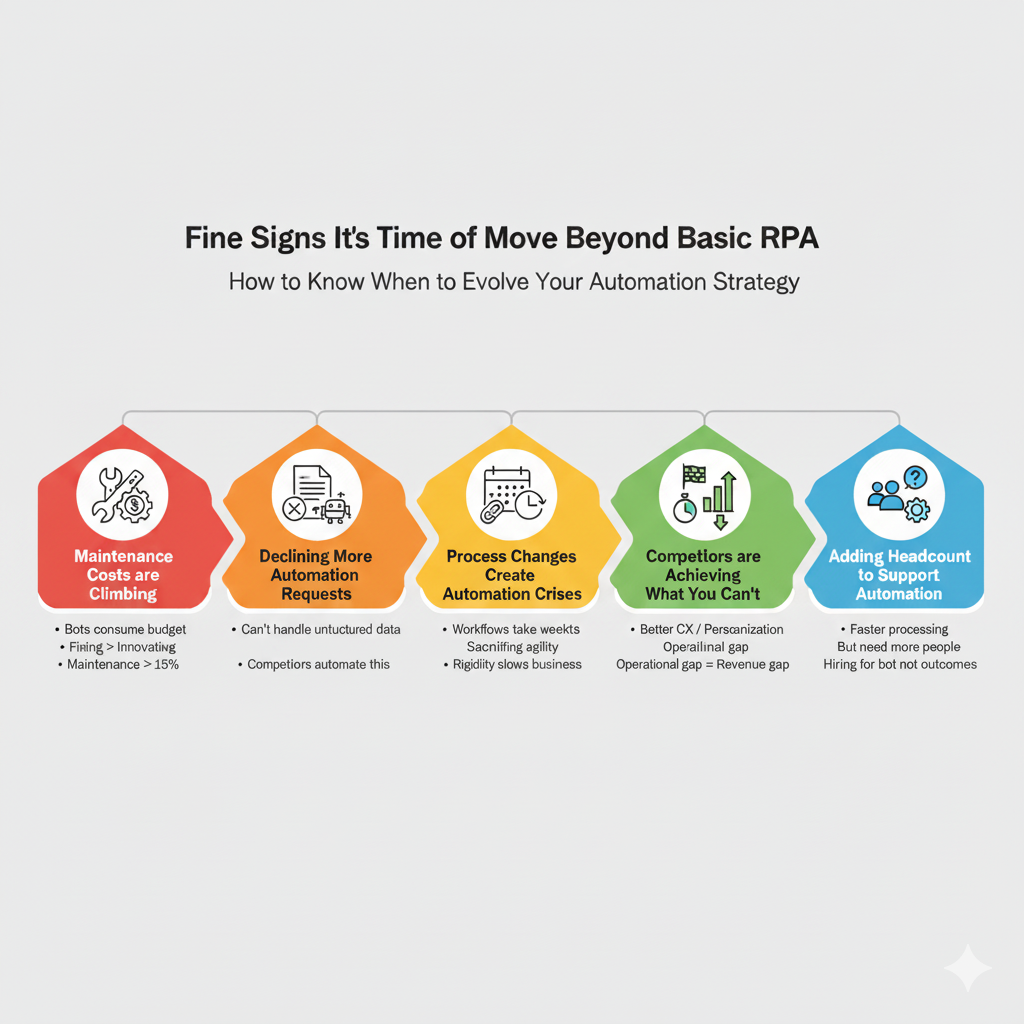
Your Maintenance Costs are Climbing.
When you're spending a significant portion of automation budget on fixing bots, updating workflows for system changes, and managing technical debt, you're maintaining the past instead of building the future.
Calculate your true maintenance-to-innovation ratio. What percentage of automation resources go to keeping existing bots running versus deploying new capabilities? If maintenance is consuming more than fifteen percent, your automation strategy is becoming a cost center rather than a competitive advantage.
You're Declining More Automation Requests Than You're Accepting
Marketing wants to automate customer feedback analysis. RPA can't handle unstructured text. Sales wants intelligent lead scoring, but RPA can't make those judgments. Operations wants exception handling, but automated RPA can only escalate to humans.
When your list of "can't automate" processes grows faster than successful deployments, your automation ceiling is becoming your competitive ceiling. Competitors with AI agents are automating exactly what your RPA can't touch.
Process Changes Create Automation Crises.
Business needs to adjust their workflow for a better customer experience. IT responds that updating automation will take weeks and significant resources. By the time bots are reprogrammed, market opportunities have passed.
If process changes consistently require multi-week projects, you're sacrificing business agility to automation rigidity. Goal-oriented agents adapt to process changes without reprogramming, maintaining agility while automation scales.
Competitors are Achieving What You Can't
Losing deals because competitors offer same-day processing while you need three days? Seeing customer satisfaction scores slip because competitors handle complex requests without transfers? Hearing that competitors personalize at scale while you segment broadly?
When operational performance becomes a competitive differentiator and you're on the wrong side, the automation gap becomes a revenue gap. Superior automation enables superior customer experiences in ways customers notice and value.
You're Adding Headcount to Support Automation
Your exception handling team is larger now than before automation. You're hiring staff to manage bot maintenance. Department headcount stayed flat or grew despite successful RPA deployment.
This paradox signals you've automated tasks but not outcomes. You made specific actions faster without reducing the overall work required. True automation should reduce headcount needs, not increase them. Autonomous agents designed for end-to-end process ownership deliver actual efficiency gains, not just task acceleration.
If two or more of these signs describe your situation, you're already behind companies that started their agentic AI journey months ago.
The Future Isn't RPA vs Agents, It's Intelligent Orchestration at Scale
The winning strategy isn't choosing between RPA and autonomous agents. It's orchestrating both intelligently.
Your existing RPA investments have value. Bots handling routine data transfers and standard reports are doing exactly what they should. The question isn't whether to abandon RPA it's how to complement it with capabilities that transcend its limitations.
Think of automation like a well-designed organization. Different roles require different capabilities. RPA excels at repetitive, stable, high-volume tasks that don't require judgment. Data transfers between systems. Report generation on schedules. Standard notifications. Simple approvals following clear rules.
Autonomous agents excel at complex, variable, judgment-required work. Customer communications require context. Document analysis with format variations. Risk assessment with multiple factors. Process optimization requires trade-off decisions. Anything involving unstructured data or changing conditions.
Companies successful with this evolution typically work with experienced partners who've guided multiple transitions. Those trying to figure everything out alone spend significantly more time and money making preventable mistakes.
Stop Maintaining Yesterday's Automation
Book your free RPA assessment. We'll show you where autonomous agents can cut costs and boost performance.
Conclusion
RPA delivered genuine value by automating repetitive, rule-based tasks with impressive efficiency and quick returns. But it's hit fundamental limitations that can't be overcome through incremental improvements.
Autonomous agents represent a categorical shift, not an incremental upgrade. Systems that learn, adapt, reason, and act independently are transforming what automation means for business operations.
The smart path forward isn't abandoning what works. It complements RPA's strengths with agentic AI capabilities that transcend its limitations. Orchestrating both technologies strategically delivers results neither can achieve alone.
If you are looking to implement Agentic AI in your system or planing to automate your process we can help you built a strategy and help you implement custom automate with AI. Contact us today!