
You're about to start a new software project. Your team sits down for the kick-off meeting, and someone asks: Do we need an SRS document or an SDD document?
Half the room says SRS. The other half says SDD. Someone mentions they're the same thing. Another person insists you need both.
Everyone's confused, and you haven't written a single line of code yet.
If this sounds familiar, you're not alone. The difference between a software design document and a software requirement specification trips up even experienced development teams. Both documents sound similar. Both are critical for successful projects. But mix them up, and you'll waste weeks building the wrong thing.
Let's clear up the confusion once and for all.
What Does SRS Stand For?
SDD stands for **Software Design Document**. You'll also hear it called:
- Software Design Description (the IEEE standard term).
- Technical Design Document (TDD), though this can cause confusion with Test-Driven Development.
- System Design Document.
- Architecture Design Document (for high-level architecture focus).
The SDD document's full form varies by industry. Medical device companies often use "Software Design Specification" to align with FDA guidance. Defense contractors typically follow IEEE standards and use "Software Design Description."
What matters more than the name is what it contains: your technical blueprint for building the software. The SDD translates business requirements into architecture decisions, technology choices, and implementation details that developers can execute.
What Does SDD Stand For?
SDD stands for **Software Design Document**. You'll also hear it called:
- Software Design Description (the IEEE standard term).
- Technical Design Document (TDD), though this can cause confusion with Test-Driven Development.
- Architecture Design Document (for high-level architecture focus).
The full form of the SDD document varies by industry. Medical device companies often use "Software Design Specification" to align with FDA guidance. Defense contractors typically follow IEEE standards and use "Software Design Description."
What matters more than the name is what it contains: your technical blueprint for building the software. The SDD translates business requirements into architecture decisions, technology choices, and implementation details that developers can execute.
What is a Software Requirements Specification (SRS)?
A Software Requirement Specification or SRS document is exactly what it sounds like: a detailed specification of what your software needs to do.
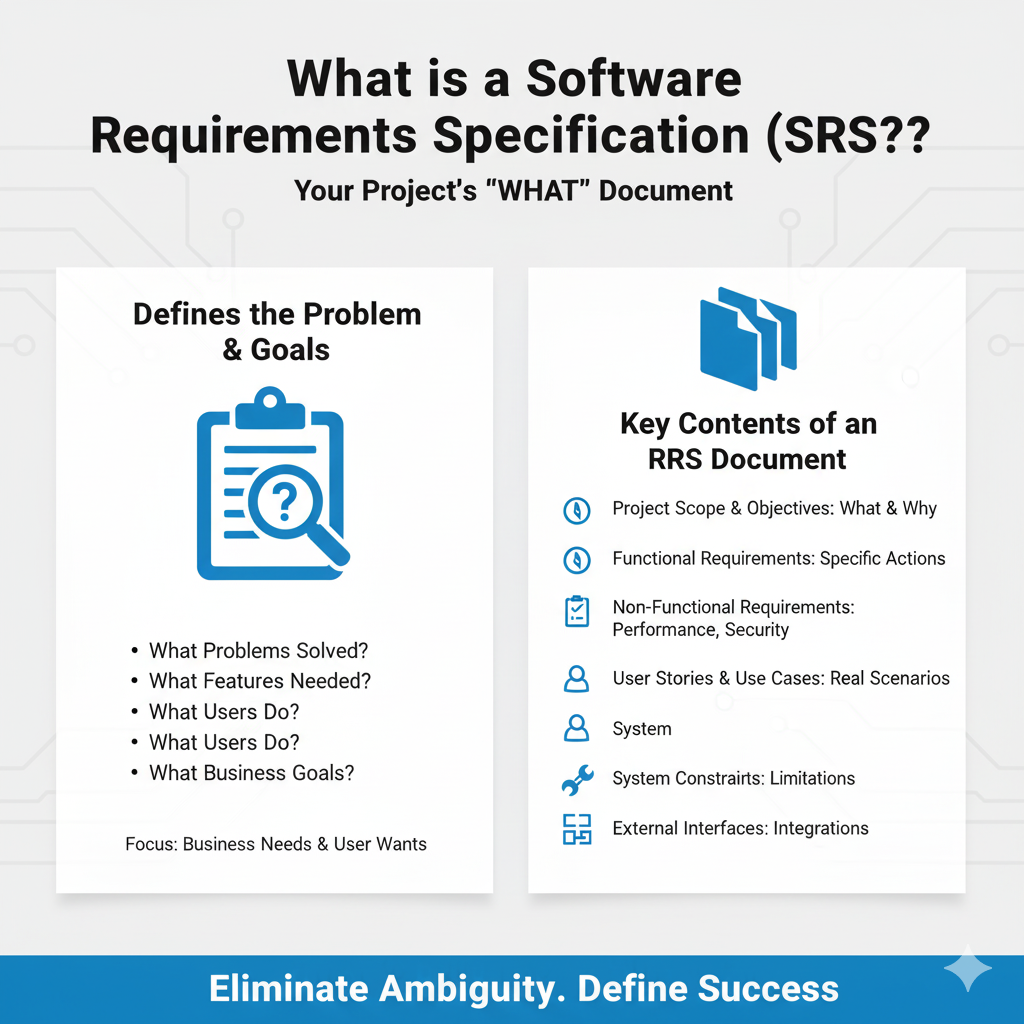
Think of it as your project's what document. It answers questions like:
- What problems does this software solve?
- What features does it need?
- What should users be able to do?
- What business goals does it support?
The SRS document doesn't care about how you'll build these features or what technology you'll use. It only cares about defining requirements clearly so that all developers, stakeholders, and clients understand what the finished product looks like.
What Goes into an SRS Document?
A comprehensive software requirements document typically includes:
- Project scope and objectives: What you're building and why. This keeps everyone focused on the actual problem you're solving, not feature creep that sounds cool but serves no purpose.
- Functional requirements: The specific things your software must do. Users can create an account, the System sends password reset emails, and the Dashboard displays real-time analytics. These are concrete, testable requirements.
- Non-functional requirements: How well the software must perform. Response times, security standards, scalability needs, and uptime requirements. These often get forgotten but matter just as much as features.
- User stories and use cases: Real scenarios showing how people will actually use your software. Not theoretical possibilities, actual workflows from real user research.
- System constraints: Technical limitations, budget constraints, timeline restrictions, and regulatory requirements. The stuff that determines what's actually possible versus what would be nice to have.
- External interfaces: How your software interacts with other systems, APIs, databases, or hardware. Critical for integration planning.
The goal of an SRS document is to eliminate ambiguity. When someone reads your SRS, they should know exactly what you're building and how to verify it works correctly.
What is a Software Design Document (SDD)?
A Software Design Document or SDD document is your project's how-to document. It describes how you'll actually build what the SRS defines.
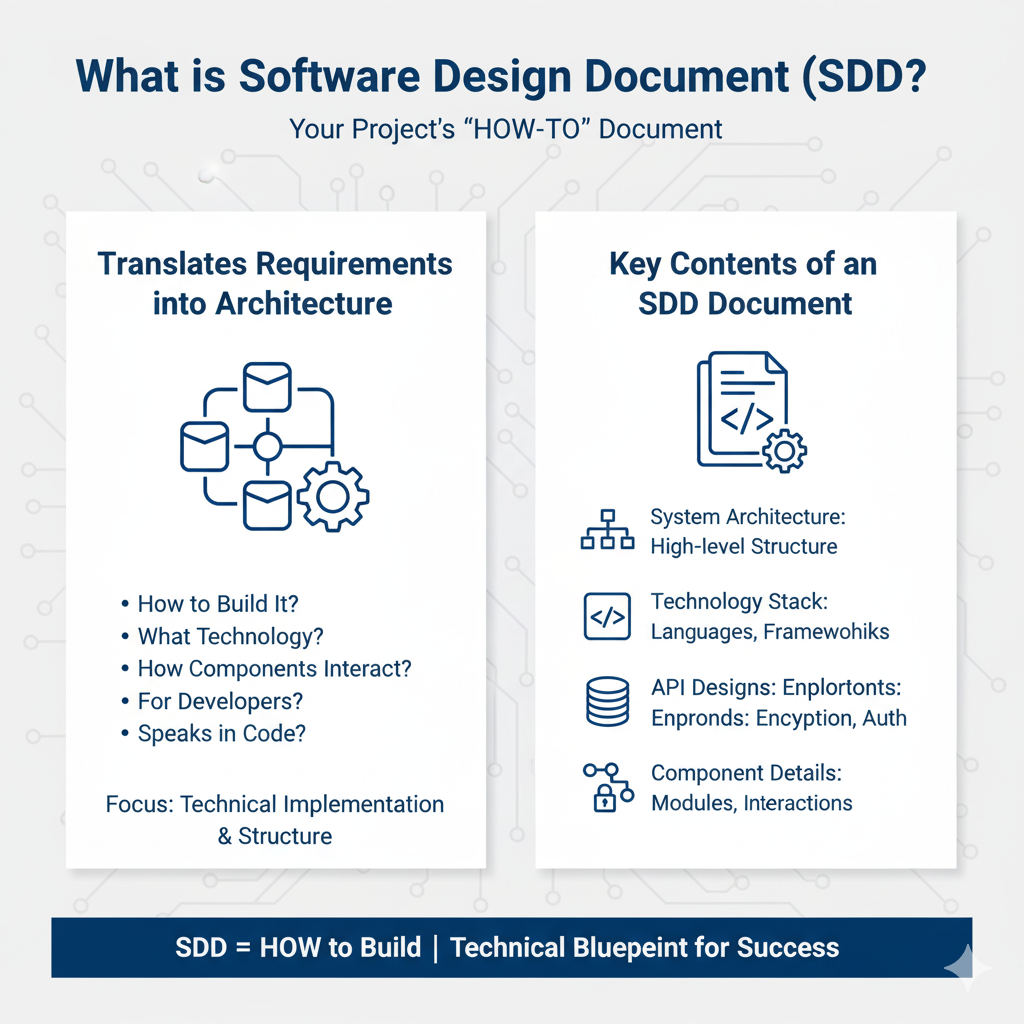
If the SRS is the blueprint showing what rooms your house needs, the SDD is the construction plan showing how to build those rooms, what materials, what structure, and what techniques.
The software design document translates business requirements into technical architecture. It's primarily for developers, not business stakeholders. It speaks in code, not concept.
What Goes into an SDD Document?
A thorough software design specification typically includes:
- System architecture: The high-level structure of your software. What components exist? How do they communicate? What's the data flow? This is your 30,000-foot view before diving into details.
- Technology stack decisions: What programming languages, frameworks, databases, and tools you'll use. Not just naming them, but explaining why these choices make sense for your requirements.
- Data models and database schema: How you'll structure and store information. Entity relationships, table designs, and data types. This determines how efficiently your app can access and manipulate data.
- API designs: Endpoints, request/response formats, authentication methods. How do different parts of your system (and external systems) communicate?
- Security implementation: Not just do we make it secure, but we also implement specific mechanisms. How you'll handle authentication, authorization, data encryption, and input validation. The actual technical approach to security requirements from the SRS.
- Component details: Breaking down each major feature into technical components. What modules exist? What does each module do? How do they interact?
The software design document gives developers everything they need to start coding without making it up as they go.
Struggling to Define Clear Requirements?
Our business analysts help you capture requirements that developers understand and stakeholders approve setting your project up for success from day one.

What Are the Key Difference Between SDD and SRS?
The SDD vs SRS debate really comes down to perspective. They serve different purposes at different project stages for different audiences.
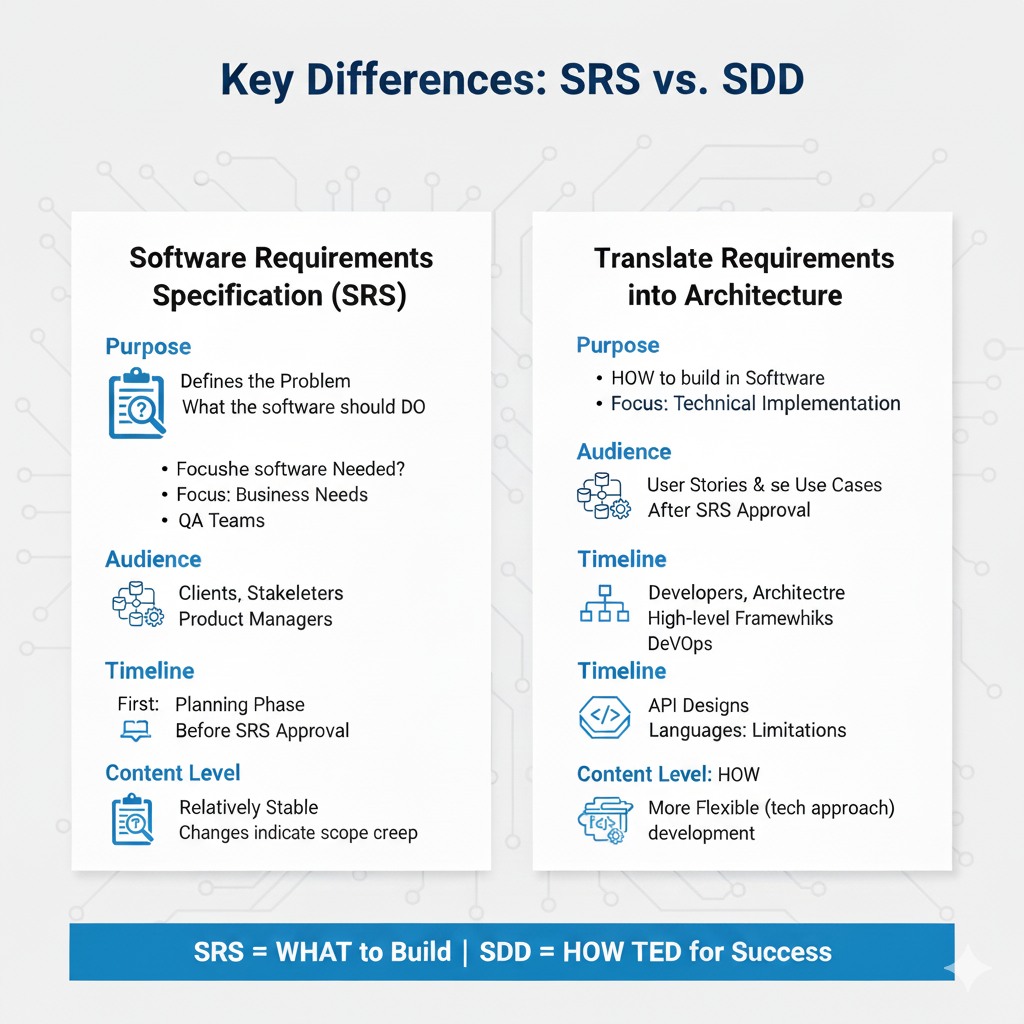
Purpose and Focus
The software requirement specification focuses on business needs and user requirements. It's written in language that non-technical stakeholders can understand. The system shall allow users to upload files up to 10MB is an SRS statement.
The software design document focuses on technical implementation. It's written for developers who need to build the system. File uploads will use multipart/form-data POST requests to the /api/upload endpoint, with virus scanning via ClamAV before saving to AWS S3 is an SDD statement.
One defines the problem. The other defines the solution.
Audience
Your SRS document needs to make sense to:
- Product managers who define requirements.
- Business stakeholders who approve the project.
- QA teams that verify it works correctly.
- Clients or users who requested the features.
- Developers (yes, they read it too).
Your SDD document is primarily for:
- Software developers are building the system.
- Technical architects reviewing the approach.
- DevOps teams are setting up infrastructure.
- Future maintainers who need to understand how it works.
Non-technical people shouldn't need to read your SDD. If they do, you're probably mixing concerts.
Timeline
You write the software requirements document first, during the planning and analysis phase. You can't design a solution until you understand the problem you're solving.
You write the software design specification after the SRS is approved, during the design phase. You're translating requirements into actionable technical plans.
Trying to write your SDD before your SRS is like drawing construction blueprints before deciding what kind of building you're constructing.
Content and Detail Level
SRS content describes requirements at a functional level:
- Users must be able to reset forgotten passwords.
- The system must support 10,000 concurrent users.
- Reports must generate within 5 seconds.
SDD content describes implementation at a technical level:
- Password reset flow uses JWT tokens with a 1-hour expiration, sent via SendGrid API.
- The load balancer distributes requests across 5 EC2 instances with auto-scaling.
- The report uses Redis caching with a 15-minute TTL to meet performance requirements.
The SRS says what? The SDD says how
Flexibility and Changes
Software requirement specifications should be relatively stable. Frequent requirement changes usually indicate poor planning or scope creep. When requirements do change, it's typically because business needs have evolved.
Software design documents can be more flexible during development. You might discover better technical approaches, find that your initial architecture doesn't scale, or realize a different database structure makes more sense. These are implementation details that don't change what you're building, just how.
When Do You Need an SDD vs an SRS?
The honest answer? Most projects need both. But the size and complexity of each depend on your project.
Small Projects and MVPs
For a simple MVP or small internal tool, you might get away with a lightweight SRS document, maybe just a few pages of key requirements and user stories.
Your software design document might be equally brief as a quick architecture diagram and some notes about your tech stack and data model.
Medium-Size Projects
Most typical software projects need comprehensive versions of both documents. Your software requirements specification should thoroughly define functional and non-functional requirements, use cases, and acceptance criteria.
Your SDD document should detail your system architecture, key components, data models, and major technical decisions. Not every line of code, but enough that developers understand the overall approach.
Large Enterprise Projects
Complex systems with multiple teams, regulatory requirements, or mission-critical functions need extremely detailed documentation.
Your SRS becomes an extensive document covering every requirement, edge case, compliance need, and integration point. It's the contract defining project success.
Your software design specification becomes equally detailed, possibly split into multiple documents covering different subsystems. Every component, interface, and integration gets documented.
Agile and Iterative Development
Agile teams often struggle with traditional SDD and SRS approaches. The documentation feels too rigid for iterative development.
The solution isn't skipping documentation, it's adapting it. Write your software requirements document as user stories in your backlog. Keep your software design document as living documentation that evolves with your codebase.
You still need to define requirements and make conscious technical decisions. You just do it in smaller chunks that match your sprints.
How to Create an Effective SRS Document?
Writing a good software requirement specification requires balancing detail with readability. Too vague, and developers won't know what to build. Too detailed, and no one will read it.
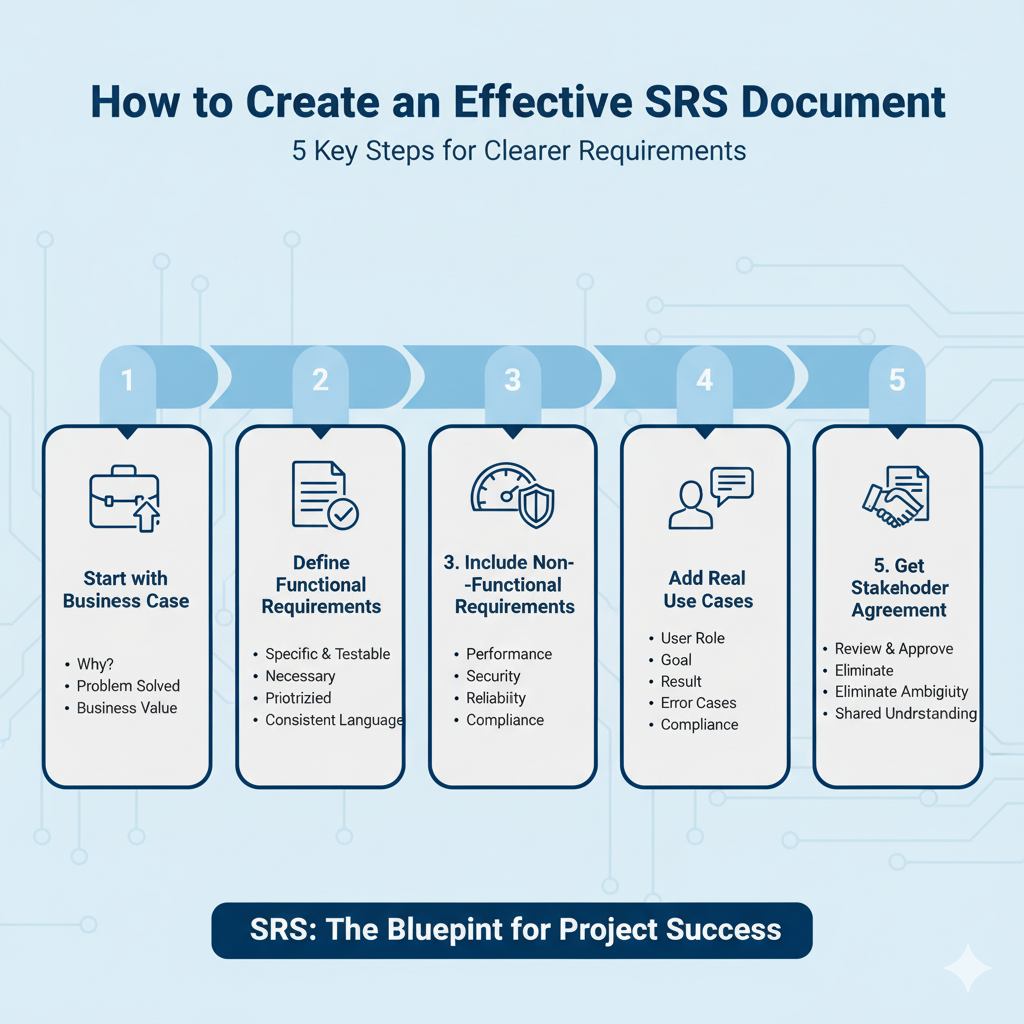
Start with the Business Case.
Before listing requirements, explain why this project exists. What problem are you solving? What business value does it create? Who benefits?
This context helps everyone make better decisions later. When discussing trade-offs or clarifying ambiguous requirements, you can always return to the core business goals.
Define a Clear Functional Requirement
Each functional requirement should be:
- Specific and unambiguous.
- Testable (you can verify if it's implemented correctly).
- Necessary (it supports a real user need or business goal).
- Prioritized (you know what's critical versus nice-to-have)
Use consistent language. The system shall... or Users must be able to... keeps things clear.
Don't Forget Non-Functional Requirements
Non-functional requirements often determine project success, but get ignored in requirements documents. Define your needs for.
- Performance (response times, throughput).
- Security (authentication, authorization, data protection).
- Scalability (how many users, how much data).
- Reliability (uptime, error rates).
- Maintainability (how easy it is to fix and enhance).
- Compliance (regulatory requirements).
These drive major technical decisions in your software design document later:
Include Real Use Cases
Abstract requirements confuse people. Concrete scenarios clarify them. For each major feature, describe.
- Who is using it (specific user role).
- What they're trying to accomplish.
- What steps do they take?
- What they see as a result.
- What can go wrong?
This makes requirements real and testable.
Get Stakeholder Agreement
Your SRS document should be a contract that everyone agrees to. Developers know what they're building. Product managers know what they'll get. Stakeholders know what they're paying for.
Review it with everyone who has a stake in the project. Address questions and concerns. Make sure nothing critical got missed.
Need Expert Technical Architecture?
Our solution architects design robust, maintainable systems that meet your requirements while avoiding technical debt.
How to Write a Comprehensive SDD Document?
A good software design document gives developers confidence. They understand the system architecture, know why decisions were made, and have a reference when questions arise.
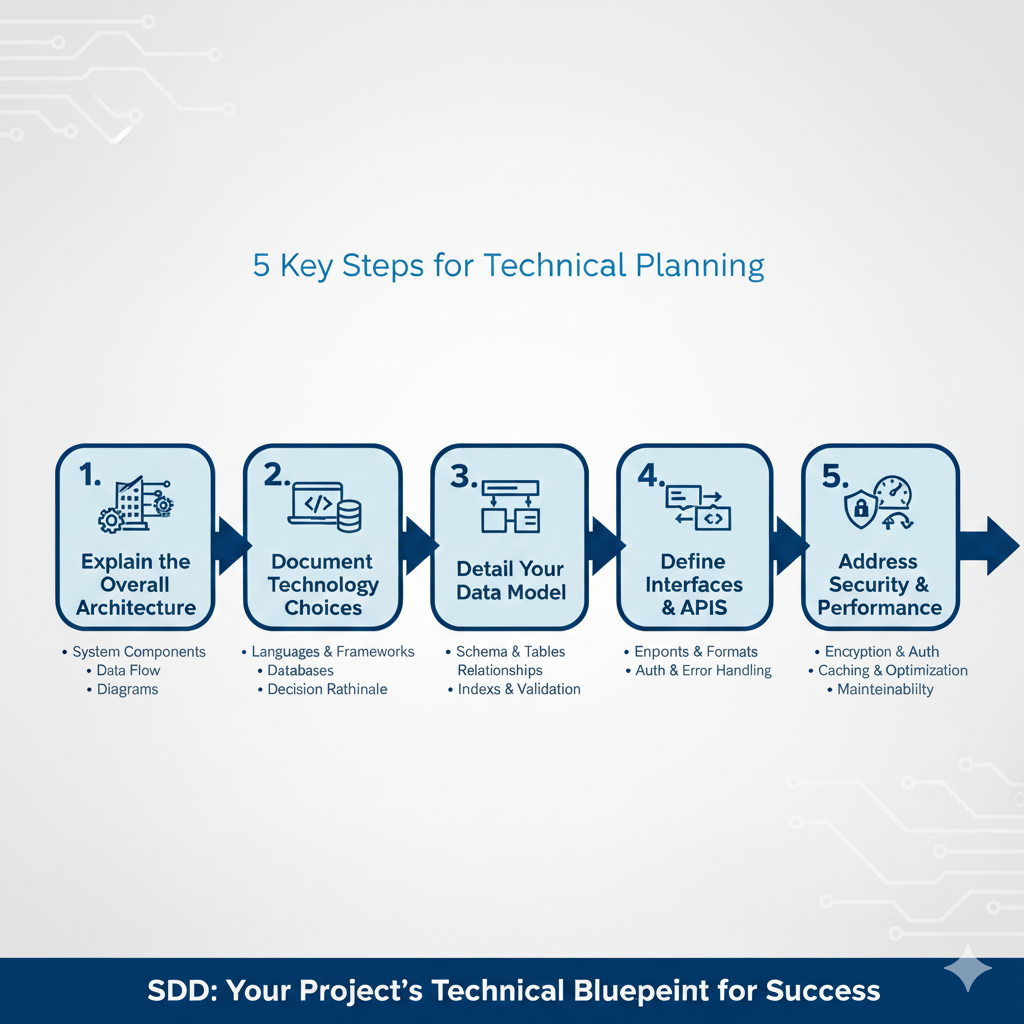
Explain the Overall Architecture.
Start with the big picture. What are the major components of your system? How do they interact? What's the data flow?
Use diagrams. A well-drawn architecture diagram communicates more than pages of text. Show your layers (presentation, business logic, data), major services or modules, and how they connect.
Document Technology Choices
Don't just list your tech stack. Explain why you chose each piece.
We're using PostgreSQL instead of MongoDB because our data is highly relational and we need ACID transactions for financial records. This helps future developers understand the reasoning and make good decisions about changes.
Detail Your Data Model
Your database schema and data structures need clear documentation. Show:
- Entity relationships.
- Table Structure.
- Key fields and their purposes.
- Constraints and validations.
- Indexes for performance
This prevents developers from misunderstanding data structures and creating bugs or performance problems.
Define Interfaces and APIs
If different components communicate through APIs, document them thoroughly for each endpoint.
- Purpose and use case.
- Request format and parameters.
- Response format and status codes.
- Authentication requirements.
- Error handling.
Good API documentation prevents miscommunication between teams and makes integration smoother.
Address Security and Performance
Explain how you're implementing security requirements from the SRS document. Not just do we encrypt data, but also what encryption algorithms, key management approaches, and authentication mechanisms.
Similarly, document performance strategies. How are you achieving the response times required? Caching? Database optimization? CDN usage?
Keep it maintainable
Your software design specification isn't a one-time deliverable. It's living documentation that should evolve with your codebase.
When you make significant architectural changes during development, update the SDD. Future developers (including yourself in six months) will thank you.
SRS Document Example
Here's what a real functional requirement looks like in an SRS document:
Sample Functional Requirement

FR-001: User Password Reset**

Description: The system shall allow registered users to reset their forgotten passwords through email verification.

Acceptance Criteria:
1. User clicks "Forgot Password" on the login page
2. User enters their registered email address
3. System sends a password reset link within 30 seconds
4. Reset link expires after 60 minutes
5. User creates a new password meeting security requirements
6. System confirms password change and redirects to login

Priority: High

Dependencies: Email service integration (FR-012)

---

Sample Non-Functional Requirement

NFR-003: Password Reset Performance

Description:

The password reset email shall be delivered within 30 seconds of request submission under normal load conditions.

Measurement: 95th percentile delivery time measured over a 7-day rolling window.

Rationale: User research shows abandonment increases significantly when email delivery exceeds 60 seconds.

---

Notice how these requirements focus on *what* happens, not *how* it's implemented. There's no mention of JWT tokens, SendGrid, or database schema. Those details belong in your SDD document.
SDD Document Example
## SDD Document Example

Here's how the same password reset feature looks in an SDD document:

### Sample Technical Design

Component: Password Reset Service

Technology Stack:
- Backend: Node.js with Express
- Email Provider: SendGrid API
- Token Generation: JWT with RS256 signing
- Database: PostgreSQL for user records

Architecture:
[User Browser] → [API Gateway] → [Auth Service] → [Email Service]
↓
[PostgreSQL DB]

Implementation Details:

1. Token Generation
   - Generate JWT containing user ID and timestamp
   - Sign with RS256 private key
   - Set expiration to 3600 seconds (1 hour)
   - Store token hash in the password_reset_tokens table

2. Email Delivery
   - Use SendGrid transactional email API
   - Template ID: d-abc123 (Password Reset Template)
   - Implement retry logic: 3 attempts with exponential backoff
   - Log delivery status to the monitoring service

3. Password Update
   - Validate JWT signature and expiration
   - Hash new password with bcrypt (cost factor 12)
   - Update the users table in a single transaction
   - Invalidate all existing sessions for the user
   - Delete used token from password_reset_tokens

API Endpoint:

POST /api/auth/reset-password
Request: { email: string }
Response: { success: boolean, message: string }
Status Codes: 200 (success), 400 (invalid email), 429 (rate limited)

---

See the difference? The SDD specifies exactly *how* to implement what the SRS defines. Developers can read this and start coding without guessing at implementation details.
Can You Use SDD and SRS Together?
Not only can you use both, but you should.
The software requirement specification and software design document complement each other. They're two parts of a complete project foundation.
How They Work Together
Your SRS document defines the requirements. Your SDD document shows how you'll meet those requirements. There should be clear traceability between them.
For each major requirement in your SRS, your SDD should explain the technical approach. For each design decision in your SDD, you should be able to point back to the requirement it satisfies.
Most Successful Projects Follow This Pattern
- Gather requirements from stakeholders, users, and business analysts.
- Write the SRS documenting all requirements clearly.
- Get SRS approval from stakeholders.
- Design the solution based on approved requirements.
- Write the SDD documenting your technical approach.
- Review the SDD with the technical team and architects.
- Begin development using both documents as a reference.
- Update documents when requirements or designs change.
Avoiding Documentation Overhead
Yes, writing thorough SDD and SRS documents takes time. But it's time that pays off.
Unclear requirements lead to building the wrong thing. Poor design leads to technical debt and difficult maintenance. Both problems cost far more than writing good documentation up front.
The key is writing enough documentation to provide clarity without creating a burden. Your documents should be references people actually use, not lengthy artifacts no one reads.
Stop Wasting Time on Unclear Documentation
Our team creates comprehensive, clear documentation that keeps your project on track from requirements to deployment.
Conclusion
The difference between a Software Requirements Specification and a Software Design Document comes down to one question: what vs how.
Your SRS document captures what you're building. It defines requirements, features, user needs, and success criteria. Write it first. Get stakeholder approval. Make sure everyone agrees on the destination before you start the journey.
Your SDD document captures how you'll build it. It defines architecture, technology choices, data models, and implementation details. Write it after requirements are locked. Give your developers a clear technical roadmap.
For most projects, the pattern is straightforward
- Gather requirements from stakeholders.
- Document them in your SRS.
- Get approval from everyone who matters.
- Design the technical solution.
- Document it in your SDD.
- Start development with confidence.
Skip the SRS, and you risk building the wrong thing. Skip the SDD, and you risk building the right thing poorly.
Need help with your software documentation? Our team creates comprehensive SRS and SDD documents that keep projects on track from requirements to deployment.
[Talk to Our Team] Get expert help with your software documentation.