
The future of education is happening right now. With artificial intelligence in education growing from a $2.5 billion market in 2022 to an expected $6 billion by 2025, we're witnessing the biggest transformation in learning since the invention of the printing press (AIPRM, 2024). Educational technology 2025 trends show that AI implementation in schools is accelerating faster than anyone predicted.
What changed everything? The pandemic forced schools to go digital fast, but AI in education was already gaining speed. Today, 86% of students use AI globally for studies, and 60% of teachers use AI for lesson planning (Digital Education Council and Education week 2025). This isn't just a trend - it's the new reality of how we teach and learn with educational technology 2025 innovations.
Why is 2025 the pivotal year for educational AI? The technology finally caught up to what educators need. AI tools are now simple enough for any teacher to use, smart enough to personalize learning truly, and affordable enough for schools to implement.
This guide covers six key AI transformations reshaping education: personalized learning, teacher evolution, smart learning environments, data-driven decisions, assessment revolution, and workforce preparation.
Each represents a massive shift in how education works - and how your institution can thrive in the AI age. Will AI replace teachers in the future? How will AI change education by 2025? We'll answer these critical questions about the future trends in educational technology.
Quick answer: The future of education is increasingly AI-powered and personalized, blending online and in-person learning, adaptive content, and data-driven support. AI helps automate grading and administration and tailor learning, while teachers shift toward mentoring and higher-order skills.
AI Personalized Learning, Helping Students Where They Are
The "average learner" doesn't exist. Every student learns differently, at their own pace, with unique strengths and challenges. Traditional education tried to fit everyone into the same box.
AI in education changes that forever. Adaptive learning platforms and intelligent tutoring systems are revolutionizing how we deliver personalized learning experiences.
What are the Future Benefits of AI for Students?
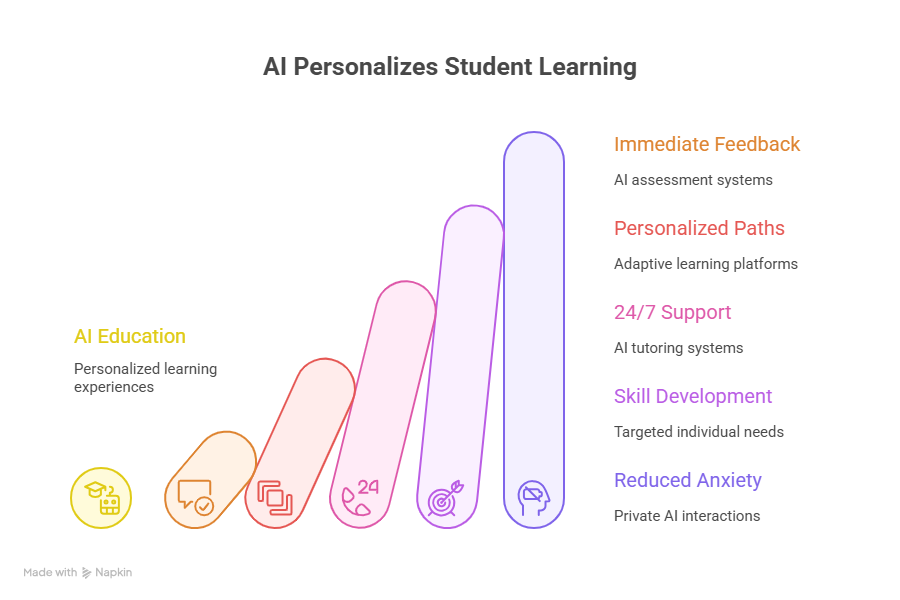
The future benefits of AI for students are transformative and far-reaching. AI tutoring systems provide 24/7 personalized support, immediate feedback, and adaptive learning paths that adjust to each student's pace and learning style.
Students gain access to educational data analytics that help them understand their own learning patterns and areas for improvement.
Benefits:
- Immediate feedback through AI assessment systems.
- Personalized learning paths via adaptive learning platforms.
- 24/7 support from AI tutoring systems and AI chatbots for education.
- Targeted skill development based on individual needs.
- Reduced learning anxiety through private, judgment-free AI interactions.
How Does AI Impact Education in Terms of Learning Outcomes?
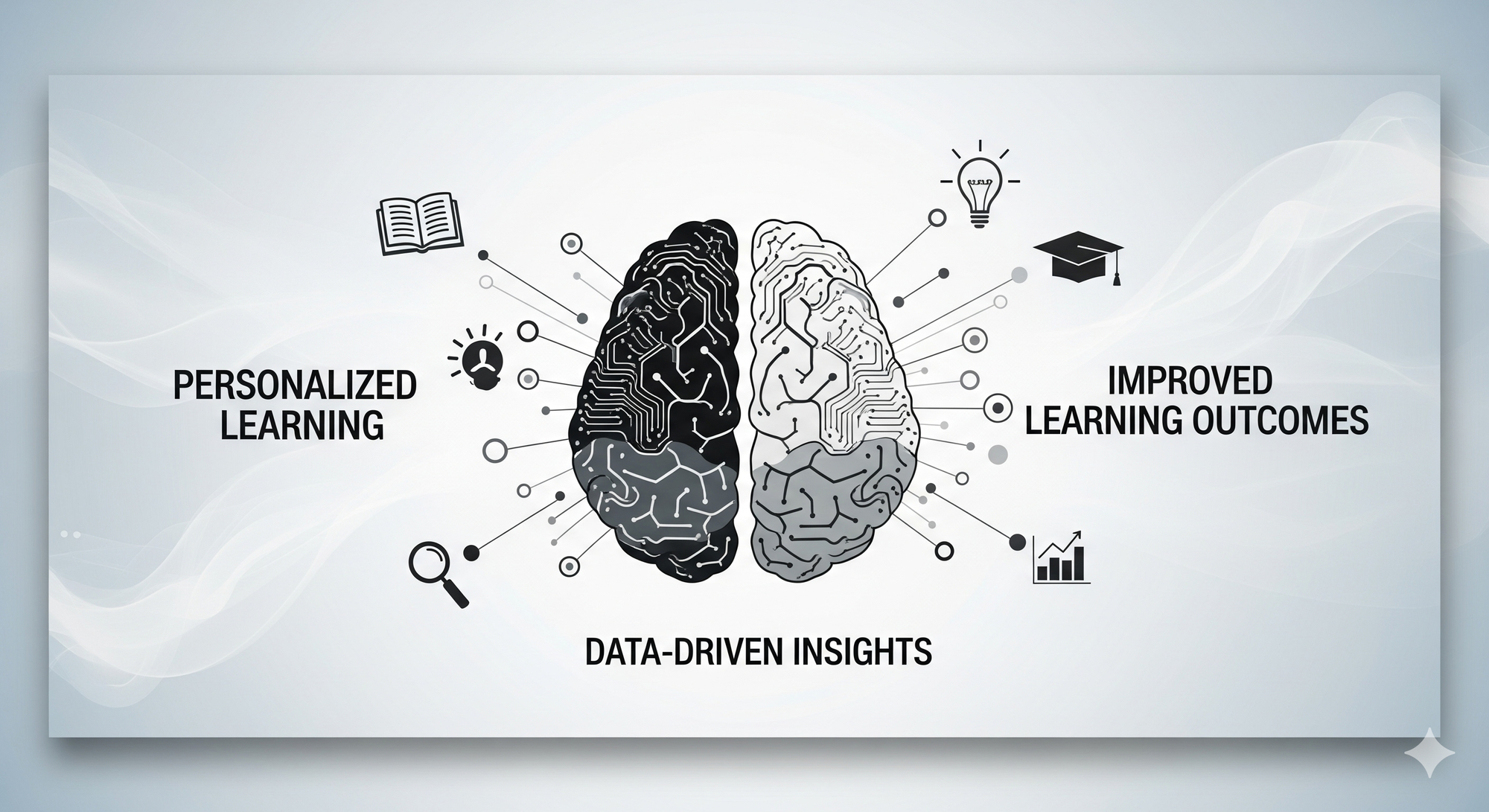
Personalized learning with AI means each student gets exactly what they need, when they need it. Instead of one teacher trying to manage 30 different learning styles, AI tutoring systems handle the individualization while teachers focus on what humans do best - inspire, guide, and connect.
Educational data analytics power these systems to understand each student's unique learning patterns.
Here's how AI enables true 1:1 learning at scale. Adaptive learning platforms like Carnegie Learning's MATHia analyse how each student solves problems, where they struggle, and what helps them succeed.
The AI then adjusts difficulty, provides targeted hints, and creates custom practice problems in real-time. Machine learning in education processes thousands of data points to optimize each student's learning path.
The impact on learning outcomes is remarkable. Research shows 62% of students improved test results when using AI-powered educational content (Knewton, 2024). More importantly, AI in education helps close equity gaps by ensuring every student - regardless of background or ability - gets the support they need to succeed.
Google's Practice Sets in Google Classroom take this further with AI-driven assessment capabilities. Students get instant feedback on assignments, celebratory animations for correct answers, and personalized video explanations for concepts they don't understand.
What used to take teachers hours of grading and feedback now happens instantly, leaving more time for meaningful instruction.
What Personalized Learning Looks Like in Practice:
- A student struggling with fractions gets extra visual examples and step-by-step guidance through intelligent tutoring systems.
- An advanced learner automatically receives challenging problems to stay engaged via adaptive learning platforms.
- English language learners get vocabulary support built into every assignment using AI tools.
- Student with learning disabilities access content through their preferred format with AI assistance.
Implementation considerations for schools are straightforward but important. AI implementation in schools requires careful planning and phased rollouts. Start with one subject area, train teachers on the platform, and gradually expand.
The key is choosing AI education software that integrates with your existing systems and aligns with your curriculum standards. Educational AI consulting can help schools navigate this transition effectively.
From Classroom Chaos to AI Clarity
Struggling with outdated teaching methods? Let's chat about how AI can solve your biggest education challenges without replacing your teachers.

The Evolving Role of AI in Education for 2025
Let's address the big fear first: AI will not replace teachers. Will AI replace teachers in the future? The answer is absolutely not. In fact, artificial intelligence in education makes teachers more important than ever.
But their role is changing from "sage on the stage" to "guide on the side" - and AI makes this transformation possible at scale.
What is the Role of AI in Education in 2025?
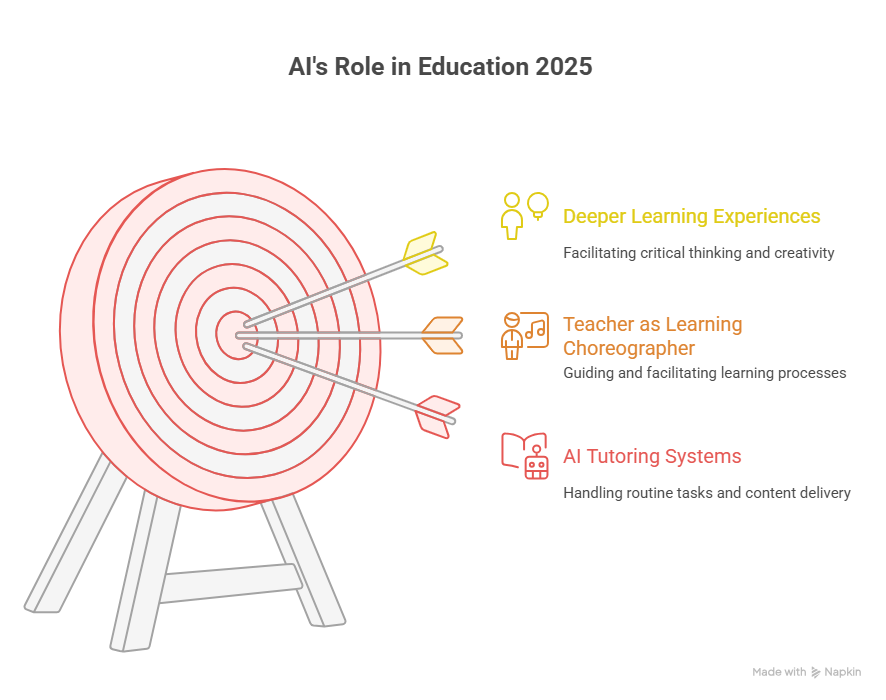
The role of AI in education in 2025 is fundamentally supportive and enhancing. AI tutoring systems handle routine tasks like grading and content delivery, while teachers focus on critical thinking, creativity, problem-solving, and social-emotional learning.
Educational technology 2025 enables this division of labor that plays to the strengths of both artificial and human intelligence.
The new teacher role is a learning choreographer, not a knowledge gatekeeper. In the past, teachers spent most of their time delivering information.
Today, with AI handling routine tasks, teachers can focus on the uniquely human skills that matter most. Educational technology 2025 enables teachers to become facilitators of deeper learning experiences.
What Is the Impact of AI on Education Systems?
How does AI save teachers time? Studies show AI can free up 13+ hours per week by automating grading, creating assignments, generating lesson plans, and handling administrative tasks (McKinsey)
That's almost half a workday returned to teachers every single week. AI education software handles the routine work while teachers focus on building relationships with students.
But it's not just about time savings. AI gives teachers enhanced diagnostic capabilities they never had before. Instead of waiting for a test to see who's struggling, AI provides real-time insights into student understanding through educational data analytics.
Teachers can spot misconceptions immediately and adjust instruction on the fly using data from adaptive learning platforms.
Professional development for the AI age looks different, too. Teachers need digital literacy skills, an understanding of how machine learning in education works, and training on new pedagogical approaches.
The good news? Many AI education tools are designed to be intuitive, requiring minimal technical expertise. Educational AI consulting services help schools train their teachers effectively.
"The power of technology in education is changing learning experiences, changing the role and nature of educators. Your work in knowledge transmission is no longer relevant. You have to instead become a great coach, a great mentor, a social worker, and a career advisor," explains Andreas Schleicher, Director for Education and Skills at OECD.
This evolution isn't optional - it's happening whether schools plan for it or not. Teachers who embrace AI tools and intelligent tutoring systems report higher job satisfaction, better student outcomes, and more time for what drew them to teaching in the first place: making a difference in students' lives. School district AI integration programs are helping teachers adapt to these changes.
Smart Learning Environments: Beyond the Traditional Classroom
The classroom of 2025 doesn't look like the classroom of 1925. Smart learning environments powered by AI are creating flexible, adaptive spaces that respond to student needs in real-time. Educational technology 2025 is transforming physical and virtual learning spaces through AI integration.
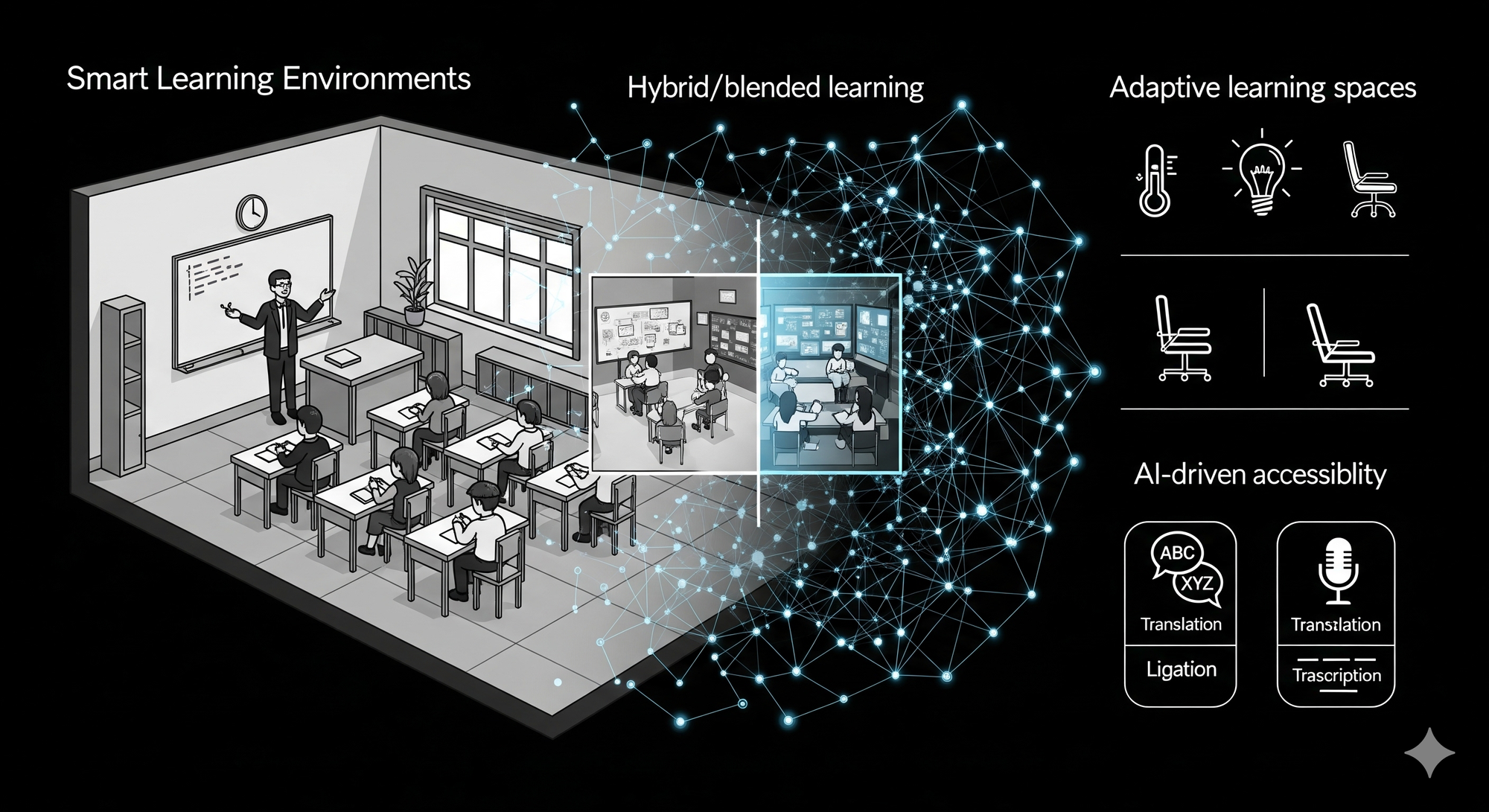
Hybrid and blended learning models are now standard, not experimental. AI orchestrates seamless transitions between in-person and online learning, ensuring continuity regardless of where students are.
The technology tracks progress across all platforms, providing teachers with complete visibility into student engagement and performance. Smart classrooms use AI to optimize the entire learning experience. Popular examples would be Docebo and 360Learning.
Adaptive learning spaces use AI to optimize everything from lighting and temperature to seating arrangements and content delivery. Some schools are experimenting with AI that adjusts classroom conditions based on student attention levels and learning analytics.
Machine learning in education analyzes environmental factors that impact student performance.
AI-driven accessibility tools are game-changers for inclusive education. Real-time transcription, language translation, text-to-speech, and visual recognition help students with disabilities access learning in ways never before possible.
AI doesn't just accommodate different learners, it empowers them through intelligent tutoring systems and adaptive learning platforms.
Case Study: AI Implementation Success Stories
Case studies show the impact of AI implementation in schools. At Curtin University in Australia, 50 traditional classrooms were converted to "collaborative learning spaces" with AI-powered cameras, screens, and flexible seating.
The result? 83% of courses now use flipped learning approaches, and student engagement increased significantly through smart classroom technology.
Infrastructure requirements are more manageable than many schools expect. Cloud-based AI education software requires reliable internet and basic devices, but doesn't need massive on-site servers or complex IT management.
The AI does the heavy lifting remotely. Educational AI consulting helps schools assess their infrastructure needs and plan effective implementations.
Source:- Here
Data-Driven Education: Making Informed Decisions at Scale
The evidence-based education movement is accelerating thanks to AI's ability to process learning analytics and provide actionable insights. Educational data analytics powered by machine learning in education are transforming how educators make decisions.
Instead of making choices based on hunches, educators now have data to guide every decision through AI education software.
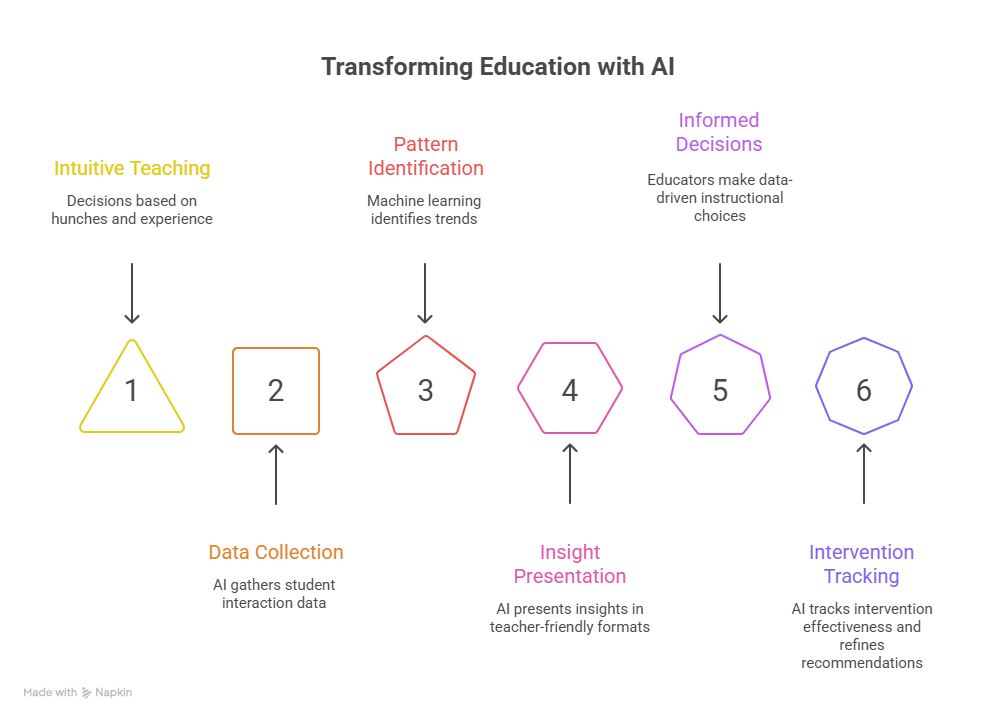
AI processes massive amounts of information - student responses, time on task, error patterns, engagement levels, and identifies trends humans could never spot. This isn't just about test scores. AI analyzes how students learn, what motivates them, and where they need support.
Adaptive learning platforms continuously collect and analyse this data to improve educational outcomes.
Real-time feedback loops transform teaching and learning. Rather than waiting weeks for assessment results, teachers get immediate insights into student understanding through AI-driven assessment systems.
AI alerts educators when students are struggling, suggests interventions, and tracks progress over time using intelligent tutoring systems.
The Learning Analytics Pipeline
How AI Transforms Educational Data
- AI collects data from student interaction across all platforms and smart classrooms.
- Machine learning algorithms identify patterns and predict outcomes using educational data analytics.
- Dashboards present insights in teacher-friendly formats through AI education software.
- Educators make data-informed decisions about instruction based on AI analysis.
- AI tracks the effectiveness of interventions and refines recommendations through adaptive learning platforms.
Privacy, security, and ethical considerations are paramount when implementing educational technology 2025 solutions. Educational AI systems must protect student data, ensure algorithmic fairness, and maintain transparency about how decisions are made.
Schools need clear policies for data governance and AI ethics. Educational AI consulting services help institutions develop these policies.
Building data literacy among educators is crucial for successful AI implementation in schools. Teachers don't need to become data scientists, but they should understand what the AI is telling them and how to act on those insights.
Professional development programs now include training on interpreting learning analytics and making data-driven instructional decisions using AI tools.
Smart Schools Start Here
See how forward-thinking institutions are using AI to boost student outcomes by 62%. Book a call to explore what's possible for your school.
Assessment Revolution: Moving Beyond One-Size-Fits-All Testing
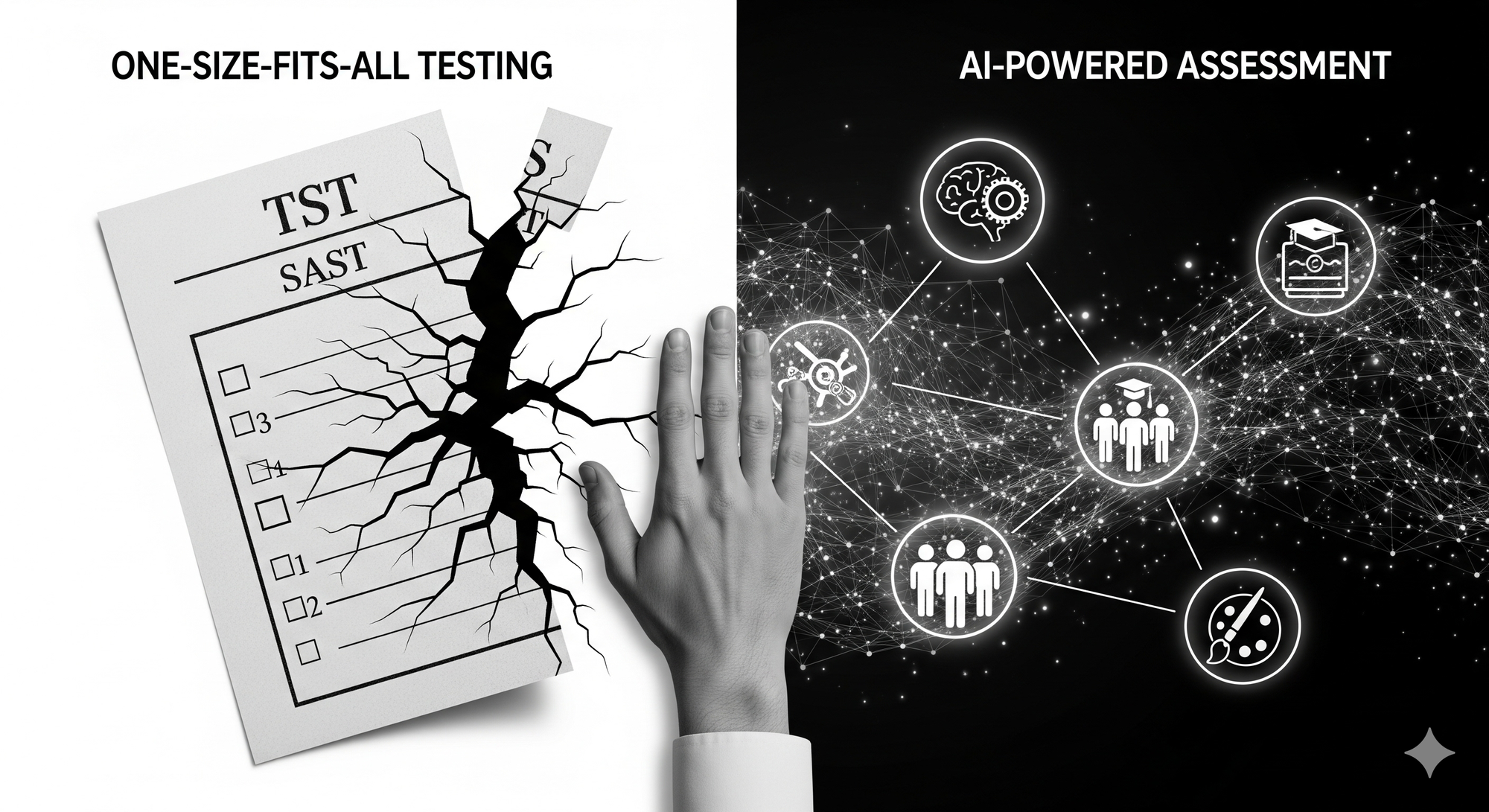
Traditional standardized testing captures a snapshot of student knowledge at one moment in time. AI-powered assessment provides a complete picture of learning over time, measuring not just what students know but how they think and solve problems. AI-driven assessment systems are revolutionizing how we evaluate student progress.
The limitations of current assessment systems are clear. High-stakes testing creates anxiety, narrows curriculum focus, and fails to measure critical 21st-century skills like creativity, collaboration, and critical thinking.
AI in education offers better alternatives through adaptive learning platforms and intelligent tutoring systems.
AI-Powered Formative Assessment
AI-powered formative assessment tools provide continuous feedback throughout the learning process. Instead of waiting for end-of-unit tests, teachers get real-time insights into student understanding through educational data analytics.
Students receive immediate feedback through AI tutoring systems, allowing them to adjust their learning in the moment. Smart classrooms enable this continuous assessment seamlessly. Popular Examples would be Gradescope, Knewton Alta, and DreamBox.
The shift toward AI-enhanced assessment isn't just about better measurement - it's about better learning. When assessment becomes part of the learning process rather than separate from it, students engage more deeply and achieve better outcomes.
Benefits of AI in education for students include immediate feedback, personalized challenges, and recognition of diverse learning strengths.
Preparing for Tomorrow's Workforce: AI and 21st Century Skills.
The World Economic Forum identifies the top 5 skills for 2025: analytical thinking and innovation, active learning and learning strategies, complex problem-solving, critical thinking and analysis, and creativity, originality, and initiative.
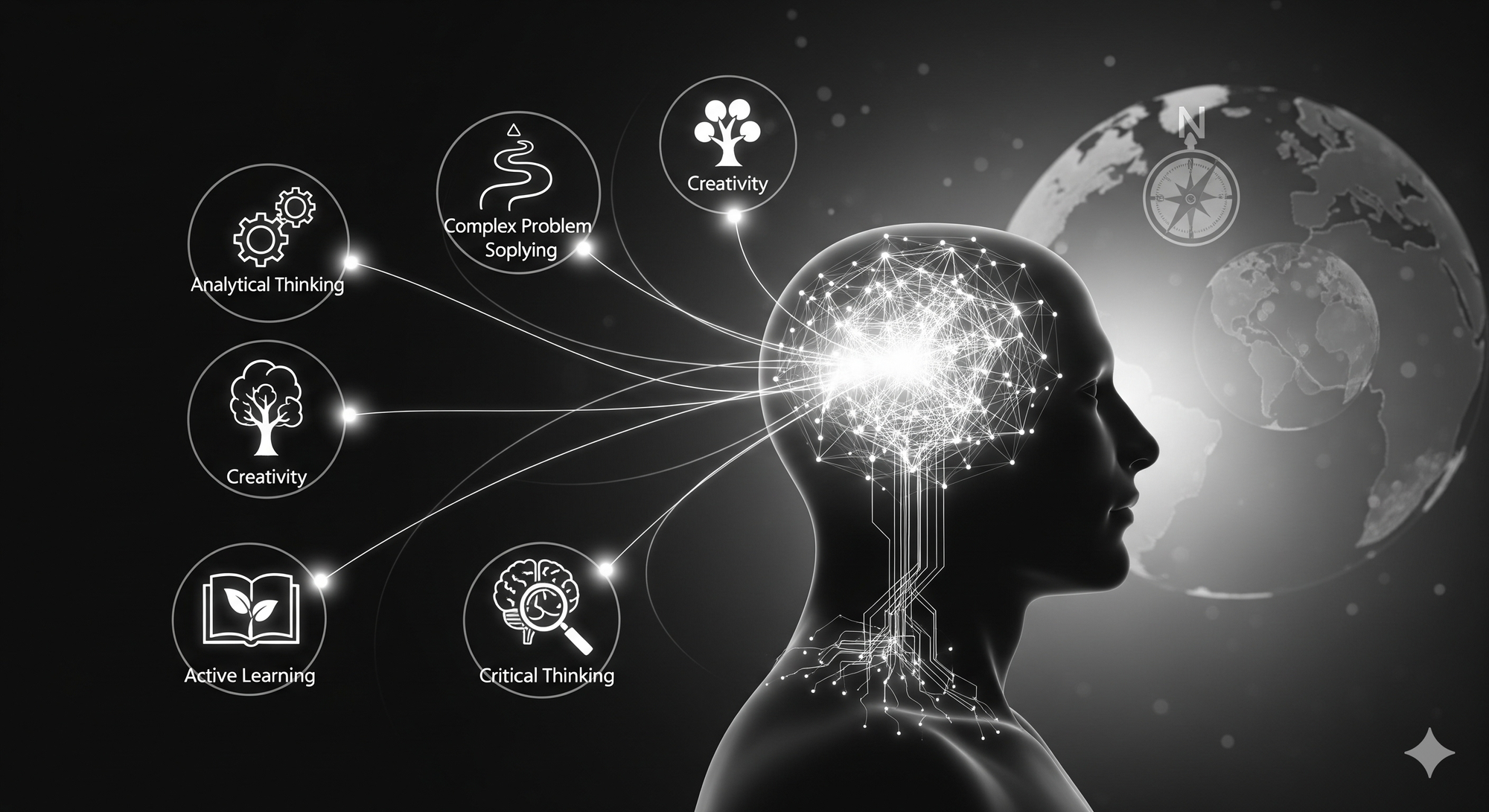
Every one of these skills is enhanced by AI in education through adaptive learning platforms and intelligent tutoring systems.
AI helps develop critical thinking by presenting students with complex, real-world problems that require analysis and reasoning. Instead of memorizing facts, students learn to evaluate information, consider multiple perspectives, and make evidence-based decisions using AI tools.
Machine learning in education provides personalized challenges that build these essential skills.
Global Problem-Solving and Lifelong Learning
Global problem-solving capabilities are essential in our interconnected world. AI enables students to collaborate across borders, access diverse perspectives, and work on challenges that affect communities worldwide.
Virtual exchange programs and AI-powered translation tools break down geographical and language barriers. Smart classrooms connect students globally for collaborative projects.
Lifelong learning mindset cultivation starts early through educational technology 2025 innovations. AI teaches students that learning never stops by adapting to their changing needs and interests.
Students learn to be self-directed learners, using AI tutoring systems to explore topics deeply and pursue their passions. Educational data analytics track their growth and suggest new learning paths.
The goal isn't just to prepare students for jobs that exist today, but to develop the adaptability and skills they'll need for jobs that haven't been invented yet.
AI in education makes this possible by personalizing learning paths and fostering the human skills that will always be in demand. How will AI change education by 2025? By ensuring every student develops both tech.
Third Rock Techkno is actively participating in international education exhibitions such as GESS Dubai,DIDAC India and BETT UK, focusing on innovative educational technologies and global trends.
Stop Falling Behind - Start Leading Ahead
Your competitors are already implementing AI in education. Don't let your students pay the price for waiting. Let's build your AI strategy today.
Conclusion
The future of education is artificial intelligence-enhanced, human-centred, and available today. From personalized learning that meets every student where they are to AI-powered assessment that measures what matters most, the transformation is already underway through educational technology 2025 innovations. AI implementation in schools is no longer a question of "if" but "when" and "how."
Ready to explore how AI can transform your educational institution? Our team specializes in educational AI consulting and AI education software implementation services, helping schools and universities navigate this exciting transition while keeping student success at the centre of everything we do.
From school district AI integration to university AI technology adoption, we provide comprehensive support for institutions ready to embrace future trends in educational technology and unlock the full potential of AI in education. Contact us today!
Planning EdTech software? See our EdTech and education software development services, and explore how personalized learning paths work plus our education technology solutions.