

Introduction
In today's fast-paced digital landscape, businesses face mounting pressure to innovate quickly while managing limited IT resources. According to Gartner, by 2025, 70% of new applications developed by enterprises will use low-code or no-code technologies, up from less than 25% in 2020. This staggering growth reflects a fundamental shift in how organizations approach software development.
As an IT veteran who's witnessed the evolution from traditional coding to today's visual development environments, I can confidently say that low-code development represents one of the most significant paradigm shifts in enterprise application development of the past decade. It's not just another industry buzzword—it's a transformative approach that's redefining how businesses deliver digital solutions through business process automation and IT modernization.
What Is Low-Code Development?
Low-code development is a software development approach that enables the creation of applications through graphical user interfaces and configuration instead of traditional hand-coded programming. At its core, low-code leverages visual development capabilities that allow both professional developers and business users to drag and drop components, define workflows, and create functional applications with minimal hand coding.
The concept emerged as a response to several persistent challenges in traditional software development:
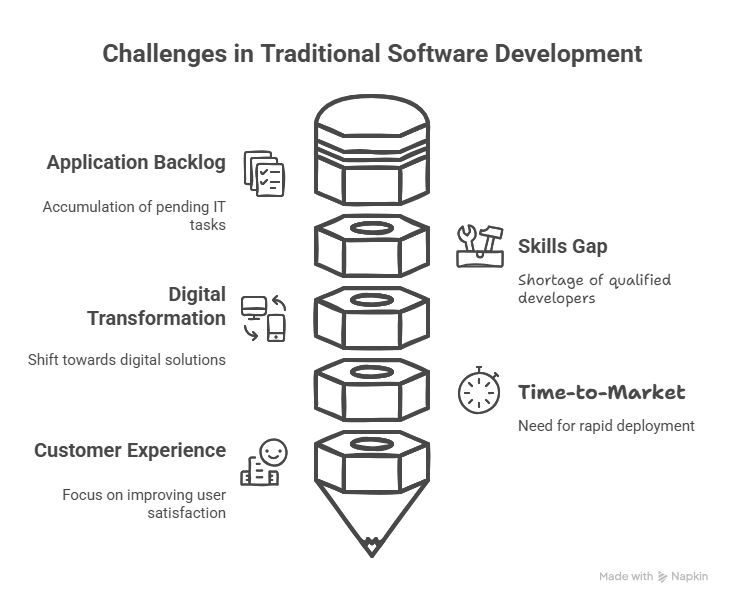
Unlike conventional development, which requires extensive coding skills and technical expertise in programming languages and frameworks, low-code platforms abstract much of this complexity behind intuitive interfaces. This democratization of development capabilities enables a broader range of professionals—including business analysts and citizen developers without deep technical background—to participate in the app development process.
According to Forrester Research, the low-code market is expected to grow to $21.2 billion by 2022, representing a compound annual growth rate of approximately 40%. This explosive growth underscores the business value that organizations are deriving from these software solutions.
Low-Code vs. No-Code vs. Traditional Development
To fully appreciate the unique position that low-code development platforms occupy in the software development spectrum, it's essential to understand how they compare to both traditional development approaches and no-code alternatives.
Aspect | Traditional Development | Low-Code Development | No-Code Development |
|---|---|---|---|
Development Approach | Professional developers writing code from scratch | Visual development with drag and drop functionality + some coding | Completely visual development with no coding required |
Required Expertise | Deep technical expertise in programming languages | Technical knowledge with less coding skills | Little to no technical background needed |
Development Cycle | Long development cycles with multiple phases | Accelerated application development lifecycle | Extremely rapid application development for simpler applications |
Customization | High customization capabilities with custom code | Balance between ease of use and custom solutions | Limited customization options |
Learning Curve | Steep learning curve for non-developers | Moderate learning curve accessible to business analysts | Very shallow learning curve for business users |
Target Users | Professional developers with coding knowledge | Both professional developers and tech-savvy business users | Primarily non-technical users |
Best For | Complex, highly customized applications and custom solutions | Enterprise applications requiring some custom code | Straightforward, department-level low-code apps |
The key differentiator between low-code and no-code platforms lies in their flexibility and target users. While no-code platforms prioritize absolute simplicity at the expense of customization, low-code environments strike a balance by offering substantial acceleration of the development process while retaining the ability to extend applications with custom code when necessary. This is where the low-code vs. traditional development comparison becomes particularly relevant for enterprises weighing their options.
"Low-code gives the best of both worlds. We get the speed advantages of visual development while maintaining the escape hatch of custom coding when we need to solve business problems. This flexibility has been crucial for our enterprise-wide adoption."
Read More : High Code vs. Low Code vs. No Code: Choose the Best One For Your Project
Key Features of Low-Code Platforms
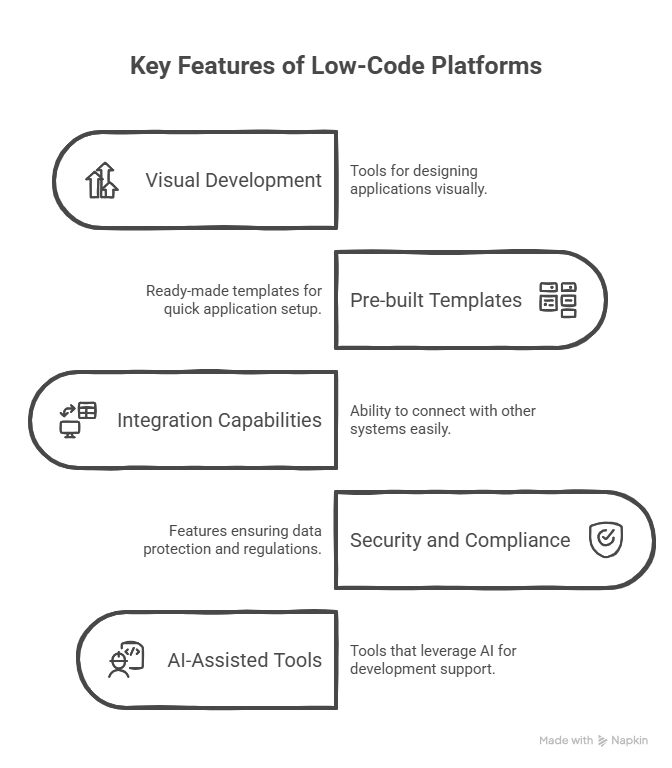
The most robust low-code application platforms share several essential capabilities that enable their transformative impact on application development processes:
Visual Development Tools and Model-Driven Design
At the heart of every low-code environment is a visual development environment that enables developers to design applications through graphical interfaces rather than writing code. These environments typically include:
- Drag and drop interfaces for UI design
- Visual workflow and process builders for business processes
- WYSIWYG (What You See Is What You Get) editors
- Data models and entity relationship modeling tools
This visual nature translates business requirements directly into functional applications through models rather than traditional code. The platform automatically generates the necessary code behind the scenes based on these visual models.
Pre-built Templates and Reusable Components
Low-code development tools accelerate development through extensive libraries of:
- Industry-specific application templates
- Pre-configured page layouts
- UI component collections
- Business logic modules
- Process templates to automate repetitive tasks
These pre-built elements eliminate the need to build common functionality from scratch, allowing development teams to assemble applications from existing components and customize them as needed using drag and drop features.
Integration Capabilities
Enterprise applications rarely exist in isolation, making integration capabilities critical for low-code success. Leading low-code platforms offer:
- API management tools and API integrations
- Pre-built connectors to common enterprise systems
- Database integration options
- Cloud service connections for cloud-based development
- Support for modern integration standards (REST, SOAP, OData)
These integration capabilities enable low-code applications to seamlessly connect with existing IT infrastructure and legacy systems, extending their utility across the enterprise and enabling effective workflow automation.
Built-in Security, Compliance, and Governance
Enterprise-grade low-code development platforms incorporate robust security features:
- Role-based access control
- Data encryption capabilities
- Authentication mechanisms
- Compliance monitoring
- Governance frameworks for application security
- Version control for the application development lifecycle
These built-in tools ensure that applications developed on low-code platforms maintain enterprise security standards without requiring developers to implement these features manually.
AI-Assisted Development Tools
The latest generation of low-code platforms leverages artificial intelligence to further accelerate the development process:
- Intelligent suggestions for application design
- Automated testing generation
- Natural language processing for requirements
- Code quality analysis
- Predictive analytics and performance optimization recommendations
For example, Oracle's APEX platform now includes AI capabilities that can transform natural language descriptions into application components, as detailed in Oracle's official documentation, while OutSystems' AI Co-pilot assists developers by suggesting optimizations and identifying potential issues before they become problems.
Your Next Big Step in Low-Code Development
Build innovative solutions with our expert team. Let's innovate together!

Benefits of Low-Code Development
The adoption of low-code tools offers organizations numerous advantages that directly address some of the most pressing challenges in enterprise application development:
Accelerated Application Development and Deployment
Perhaps the most compelling benefit of low-code development is the dramatic acceleration of the application lifecycle. According to a Forrester Total Economic Impact study, low-code development can:
Metric | Improvement |
|---|---|
Development time | Reduced by 50-90% using drag and drop functionality |
Deployment time | Cut by up to 80% with built-in tools |
Overall application lifecycle management | Decreased by 60-80% compared to traditional code |
This acceleration enables organizations to develop apps and respond more quickly to market changes, customer needs, and competitive pressures with fewer resources.
Enhanced Collaboration Between IT and Business Teams
Low-code platforms bridge the traditional gap between business stakeholders and IT teams by:
- Providing a common visual language that both technical and non-technical users can understand
- Enabling business users to directly participate in the development process
- Facilitating iterative development with rapid feedback cycles
- Supporting real-time collaboration tools where different stakeholders can contribute
This collaborative approach ensures that applications more closely align with business requirements and reduces the communication friction that often plagues traditional development projects.
Reduction in Development Costs and Resource Utilization
The economic impact of low-code adoption can be substantial:
- Lower developer resource requirements for each project
- Reduced training costs due to simplified development approaches
- Decreased maintenance expenses through standardization
- Lower technical debt accumulation
- More efficient use of professional developers with coding skills
A 2020 study found that organizations using low-code application platforms achieved an average three-year ROI of 509% and broke even on their investment in less than six months.
Increased Agility in Responding to Market Changes
In today's volatile business environment, the ability to pivot quickly in response to changing conditions is invaluable. Low-code development enhances organizational agility by:
- Enabling rapid application updates and modifications
- Supporting iterative development approaches
- Facilitating continuous improvement in business applications
- Reducing the cost and risk of experimentation
- Allowing for quick deployment of new features to solve business problems
This agility can provide a significant competitive advantage, particularly in industries experiencing rapid digital transformation.
Common Use Cases for Low-Code Platforms
While low-code platforms can theoretically be used for a wide range of applications, certain use cases have emerged as particularly well-suited to this approach:
Use Case | Description | Examples |
|---|---|---|
Internal Business Applications | Applications that support internal operations and automate repetitive tasks | HR systems, employee onboarding, inventory management, asset tracking, internal service portals |
Customer-Facing Applications | Web applications used directly by customers | Self-service portals, mobile apps, booking systems, feedback mechanisms, partner portals |
Legacy System Modernization | Updating or extending outdated systems without a complete rewrite | Modern interfaces for legacy systems, integration layers, gradual replacement of legacy functionality, capability extensions |
Workflow Automation | Process-oriented applications for business processes | Approval workflows, document management, compliance procedures, customer onboarding journeys, supply chain processes |
These applications typically require moderate complexity and integration with existing systems, making them ideal candidates for low-code development. The visual nature of low-code tools makes them particularly effective for business applications that need to be built and modified quickly.
According to a report by Reuters, companies like Philips have used low-code development platforms to create customer-facing applications that previously would have required months of traditional development. These applications are critical for customer experience enhancement, a top priority for forward-thinking organizations undertaking digital transformation.
Challenges and Considerations
Despite their substantial benefits, low-code platforms are not without challenges and limitations that organizations should consider:
- Customization Limitations: Some highly specialized functionality for mission-critical applications may be difficult to implement, and performance optimization options may be more limited than with hand-coded solutions.
- Vendor Lock-in Risk: Custom applications built on proprietary code platforms may be difficult to migrate, and organizations can become vulnerable to vendor pricing changes.
- Security and Compliance Concerns: Citizen developers may not fully understand security implications, and integration with existing security infrastructure requires careful planning.
- Quality Management Challenges: Rapid application development may tempt teams to shortcut proper testing, and the ease of building applications can lead to proliferation without proper oversight through project management.
Organizations should carefully evaluate whether their unique requirements for business applications can be satisfied within the constraints of their chosen low-code development platform.
Future Trends in Low-Code Development
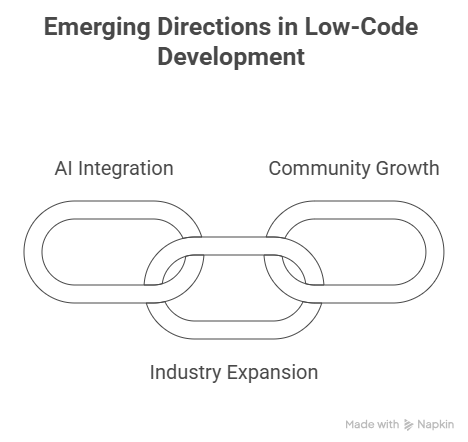
The low-code landscape continues to evolve rapidly, with several emerging trends poised to shape its future:
- AI Integration: AI-assisted development that suggests optimal design patterns, automated testing generation, and natural language interfaces that further democratize application development for non-technical users.
- Industry Expansion: Adoption of low-code tools spreading to healthcare organizations, financial services firms, manufacturing companies, and public sector organizations to solve business problems with custom apps.
- Community Growth: Growing marketplaces of components and templates, expanding developer communities sharing best practices, and emergence of open-source low-code initiatives.
This community growth enhances the value proposition of low-code platforms by providing resources, knowledge sharing, and expanded capabilities beyond what vendors alone can offer.
Getting Started with Low-Code Development
For organizations considering low-code adoption, a structured approach can help ensure success:
Assessing Organizational Needs and Identifying Suitable Use Cases
Begin with a careful evaluation of your organization's application landscape:
- Identify application backlogs that could benefit from accelerated development
- Look for repetitive tasks and development patterns that could be standardized
- Consider where business user involvement would improve application outcomes
- Evaluate technical debt in legacy systems that could be addressed through modernization
The most successful low-code initiatives typically start with clearly defined use cases that offer high business value with moderate complexity.
Selecting the Right Low-Code Platform
Platform selection should be driven by your specific evaluation criteria:
- Evaluate the technical fit with your existing development environment
- Consider the skills and preferences of your development teams
- Assess the total cost of ownership, including licensing, training, and maintenance
- Examine the vendor's track record and future roadmap
- Test the platform with a proof-of-concept using real-world scenarios
Take the time to conduct a thorough evaluation, as switching low-code platforms later can be costly and disruptive.
Best Practices for Implementation
Implementation Strategy | Key Elements | Benefits |
|---|---|---|
Establish Center of Excellence | Standards documentation, mentoring team, best practices for low-code development | Consistency across projects, knowledge sharing |
Implement Governance | Security features, development standards, review processes | Risk reduction, quality control, compliance |
Provide Comprehensive Training | Role-specific education for both professional developers and business users, hands-on workshops, ongoing support | Faster adoption, higher quality applications |
Start Small, Scale Gradually | Pilot projects, measured expansion, iterative development process | Reduced risk, ability to adjust approach, early wins |
Focus on Reusability | Component libraries, templates, shared services | Development efficiency, application consistency |
Organizations that approach low-code implementation strategically are more likely to realize its full benefits while avoiding common pitfalls.
Conclusion
Low-code development represents a fundamental shift in how organizations approach application creation, offering a path to greater agility, collaboration, and efficiency. By dramatically accelerating development cycles and democratizing participation in the creation process, low-code platforms enable businesses to respond more effectively to rapidly changing market conditions and customer expectations.
As digital transformation initiatives continue to drive demand for more applications with constrained resources, low-code development platforms have evolved from an interesting alternative to a strategic imperative for many organizations. Those that successfully integrate low-code approaches into their software development strategy gain a powerful competitive advantage in today's digital economy.
The most successful organizations will be those that thoughtfully evaluate their needs, select appropriate low-code tools, and implement governance structures that balance speed and quality. By embracing low-code development while addressing its challenges, these organizations position themselves to thrive in an increasingly digital future.
Ready to Transform Your Application Development?
If you're considering low-code development for your organization, start by identifying one or two high-value use cases where traditional development has created bottlenecks. Request demos from several low-code platforms to compare their capabilities against your specific requirements, and consider implementing a proof-of-concept project to evaluate real-world performance.
For personalized guidance on selecting and implementing the right low-code solution for your business, contact our team of digital transformation experts. We'll help you navigate the platform landscape and develop a strategy that aligns with your unique organizational needs. Contact Us Today