
MBZUAI, a university that did not exist seven years ago, now sits at #10 worldwide on CSRankings for core AI disciplines. That single fact says more about UAE universities and AI education in the GCC than any strategy document. The country built a dedicated AI university from scratch, stacked more than 44 AI academic programs across its higher education system, and topped Coursera's 2025 AI Maturity Index for the Arab world.
This guide is written for school leaders, not university applicants. If you run a school or school group anywhere in the GCC, your students will apply to these universities, your graduates will compete with their alumni, and your board will eventually ask why your curriculum does not connect to any of it. Below: the rankings that matter, the AI degree programs on offer in 2026, and the specific moves K-12 leaders should make now.
Published on June 4, 2026 · Last updated on June 4, 2026 · By Krunal Shah, Co-Founder, Third Rock Techkno
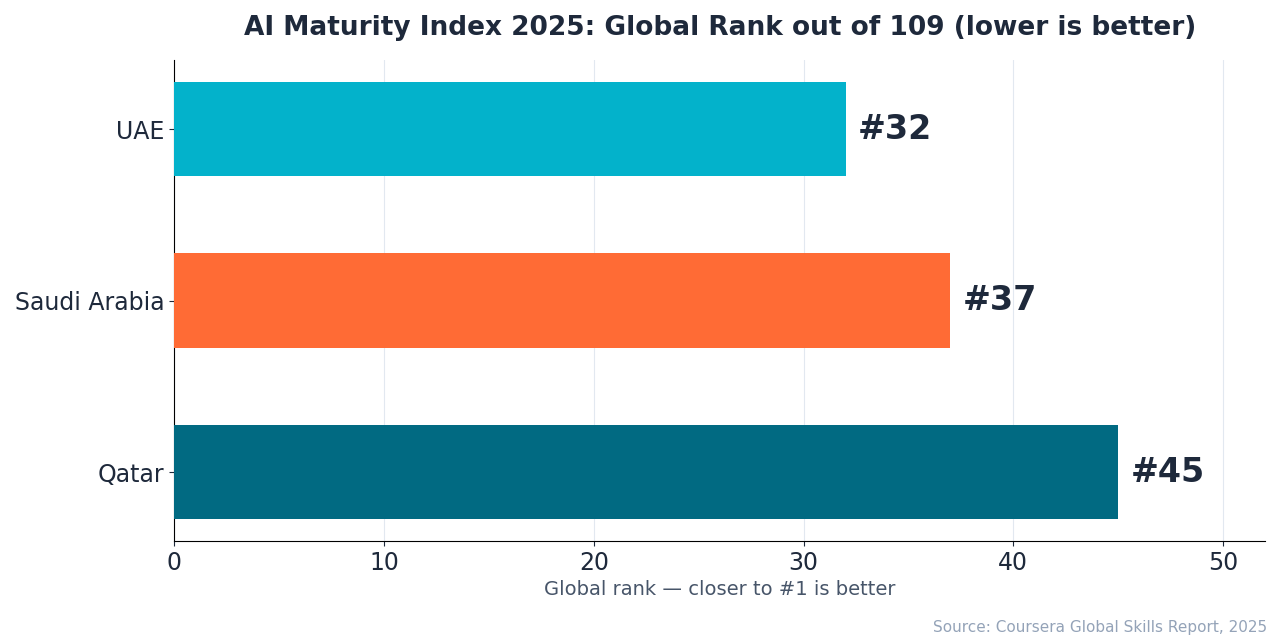
- The UAE ranks #1 in the Arab world and 32nd of 109 countries on Coursera's 2025 AI Maturity Index. Saudi Arabia sits at 37th and Qatar at 45th.
- MBZUAI ranks #10 globally on CSRankings across AI, computer vision, machine learning, and NLP, ahead of Georgia Tech and Imperial College London.
- UAE higher education offers 44+ AI-specific academic programs, from a BSc in Robotics and AI at Khalifa University to 13 graduate programs at MBZUAI.
- A mandatory K-12 AI curriculum launched in 2025-26 means every UAE public school student now arrives at university with formal AI schooling on their transcript, a baseline that deepens with every intake from here.
- For school leaders, the practical question is articulation: which universities your graduates feed into, and whether your curriculum prepares them for it.
Quick answer
UAE universities are integrating AI across teaching, research and operations — from AI-assisted learning to smart admissions. This guide covers how GCC higher-ed institutions are adopting AI in 2026, the leading initiatives, and what it means for students and staff.
Why the UAE pulled ahead of every other GCC country in AI education
The UAE appointed the world's first Minister of State for Artificial Intelligence in 2017 and published its National AI Strategy 2031 the same year. Nine years later the results show up in third-party data, not just government press releases.
Coursera's 2025 Global Skills Report placed the UAE 32nd of 109 countries on its AI Maturity Index, first among Arab states. The National's coverage of the report notes Saudi Arabia placed 37th and Qatar 45th. The same report recorded a 344% year-on-year jump in GenAI course enrollments from UAE learners, beating both the regional and global averages.
Two structural decisions separate UAE universities and AI education policy from the rest of the GCC. First, it built infrastructure before demanding outcomes: the Stargate UAE project, a 1-gigawatt compute cluster inside the 5-gigawatt UAE-US AI Campus in Abu Dhabi, delivers its first 200-megawatt phase in Q3 2026 with OpenAI, Oracle, NVIDIA, Cisco, and G42 as partners. Students graduating into that market have local compute, local labs, and local employers.
Second, it made AI schooling compulsory from age four. From the 2025-26 academic year, every UAE public school student from kindergarten to Grade 12 studies AI through a national curriculum delivered by more than 1,000 trained teachers. Universities in the UAE are no longer recruiting AI novices. They are recruiting students with up to 13 years of formal AI instruction. No other GCC state can say that yet.
UAE AI university rankings: which numbers actually matter
School leaders comparing universities usually reach for QS or Times Higher Education tables. For AI specifically, that is the wrong instrument. QS leans heavily on reputation surveys, which lag reality by years for young institutions. CSRankings counts faculty publications at top-tier AI venues, places like NeurIPS and CVPR, so it measures current research output rather than accumulated brand.
On that measure, the UAE AI university rankings picture for 2026 looks like this:
- MBZUAI (Abu Dhabi) ranks #10 globally on CSRankings across its core specializations: AI, computer vision, machine learning, natural language processing, robotics, and computational biology. That places it ahead of the University of Michigan, Georgia Tech, Imperial College London, and the University of Tokyo in those fields. It was also named among the top 50 organizations advancing the AI frontier at NeurIPS 2025.
- Khalifa University (Abu Dhabi) runs a dedicated AI and Intelligent Systems Institute covering AI, robotics, cybersecurity, and big data, alongside its engineering-led degree portfolio.
- United Arab Emirates University (Al Ain) expanded its AI research agenda in 2025 with new degree programs and an institution-wide AI minor, and made AI a graduation requirement for every student from Fall 2025-26, per UAEU's August 2025 announcement. Its scholars published 1,000+ peer-reviewed AI studies in Scopus over five years.
The practical read for schools: when a parent asks "which UAE university is best for AI education," the honest answer depends on the student. Research-track students should look at publication-based rankings. Students heading for applied engineering or business roles should weigh program design and industry placement instead, which the next section maps.
Our team at Third Rock Techkno builds AI and EdTech platforms for schools and education businesses across the GCC. Talk to us →
AI degree programs offered in UAE universities: the 2026 map
The UAE Artificial Intelligence Office maintains an official register of AI degrees available in the UAE, and the count now exceeds 44 programs. The ones school leaders ask us about most:
- MBZUAI: a BSc in Artificial Intelligence launched in March 2025 with Engineering and Business specializations, admitted through the Common App, plus 13 master's and PhD programs spanning machine learning, computer vision, NLP, robotics, and statistics and data science. Its Master in Applied AI targets working professionals.
- Khalifa University: a BSc in Robotics and Artificial Intelligence built around designing and deploying robotic and intelligent systems, plus MSc routes with AI specializations.
- United Arab Emirates University: a Bachelor of Data Analytics and Artificial Intelligence, a Bachelor of Statistics and Data Analytics, and a campus-wide AI minor open to non-CS majors.
- Zayed University (Abu Dhabi and Dubai): a BSc in Information Technology with an AI and Data Analytics specialization aimed at applied business problems.
- University of Wollongong in Dubai: an AI master's program launched to address the regional AI talent gap, positioned for career-switchers.
Which one fits the graduates your school produces? A quick decision guide:
One caution for counselors: program names change fast in this market. The UAE AI Office register added multiple programs in 2025 alone, so verify the current list each admissions cycle rather than reusing last year's guidance sheet.
How UAE universities are integrating AI in curriculum, from kindergarten to PhD
The most underreported part of the UAE story is that AI education at the university level no longer starts at zero. The Cabinet approved a mandatory AI curriculum in May 2025, and from the 2025-26 academic year it runs in every public school, kindergarten through Grade 12, inside existing Computing, Creative Design, and Innovation timetable slots.
The national curriculum covers seven areas: foundational AI concepts, data and algorithms, software applications, ethical awareness, real-world applications, innovation and project design, and policies and community engagement. Younger students get dedicated classes every two weeks; secondary students get weekly sessions. The Ministry of Education also published its Safe and Responsible Use of AI in Classrooms 2026 guide, which bans generative AI for students under 13 and forbids undisclosed AI use in assessment, per the official UAE government education portal.
That K-12 layer changes what universities build on top. The pipeline now looks like this:
For school leaders outside the UAE public system, including private and international schools across the GCC, this is the benchmark your students will be measured against at admission. A Grade 12 applicant with no AI coursework is now competing with applicants who have studied data, algorithms, and AI ethics since kindergarten.
Our team at Third Rock Techkno builds AI curriculum tools and school automation systems for education clients in the GCC and beyond. Talk to us →
What we've seen at TRT: the readiness gap between schools and AI-first universities
Third Rock Techkno builds AI products for education businesses, including custom AI development services for schools and EdTech platforms serving the GCC. School groups we work with in the UAE keep asking a version of the same question: our students will face AI-literate admissions in two or three years, what do we change now?
Three gaps come up in nearly every engagement:
- No evidence trail. Students do AI-adjacent work in class, but nothing captures it. Universities increasingly want portfolios of projects, and most school systems cannot produce one per student without manual effort.
- Teacher confidence lags policy. The UAE trained 1,000+ public school teachers for the national rollout. Private and international schools have no equivalent program, so AI instruction quality varies wildly between classrooms in the same school.
- Admin systems eat the budget. Leadership wants AI in learning, but staff time is locked up in admissions paperwork and parent communication. The schools that moved fastest automated those workflows first, then reinvested the hours. We covered the mechanics in our guide to automating school workflows with AI in the UAE.
"The schools that win the next admissions cycle are not the ones teaching the most AI theory. They are the ones that can show a university exactly what each student built with it."— TRT EdTech delivery team, internal review of GCC school engagements, 2026
When clients ask us whether to start with curriculum tools or back-office automation, we start with one diagnostic: where do your teachers lose the most hours? In most GCC schools the answer is administration, not instruction, which is why workflow automation usually comes first. One school group we advised began with a single workflow, admissions document intake, precisely because it was the heaviest drain on front-office hours; the AI instruction conversation only became realistic once that time came back. Our breakdown of the UAE's mandatory K-12 AI curriculum covers the instruction side in detail.
What school leaders should do before the 2027 intake
AI education across UAE universities is moving on an annual cadence: new programs each cycle, new rankings each spring. Schools that wait for stability will wait forever. A workable sequence:
- Map your articulation targets. Pick the three UAE universities your graduates most plausibly feed into, and pull their current AI program admission expectations from the UAE AI Office register.
- Audit your curriculum against the seven national AI strands. Even private schools outside the mandate benchmark well against concepts, data, applications, ethics, real-world use, project design, and policy.
- Build a student AI portfolio system. Every AI-related project a student completes should land in an exportable record a university admissions office can read.
- Fund teacher upskilling before tooling. A trained teacher with basic tools outperforms an untrained teacher with premium software. Budget accordingly.
- Pilot one university partnership this year. A single articulation conversation, campus visit program, or dual-credit pilot teaches you more than a year of internal planning.
None of these require waiting for a ministry circular. All five are within a school director's existing authority and budget cycle.
The rankings will change. The direction won't.
MBZUAI's exact CSRankings position will move. The program count will pass 50. What will not change is the structure the UAE has built: compulsory AI schooling feeding 44+ university programs feeding a local AI industry with gigawatt-scale compute. That loop is why UAE universities lead GCC AI education in 2026, and why the gap with neighbours is more likely to widen than close.
For school leaders, the single most useful next step is the smallest one: open the UAE AI Office's degree register, shortlist three programs your current Grade 10 cohort could target, and work backward from their admission expectations. Your 2027 applicants are already in your classrooms.