
Single Page Applications (SPA) have taken the development world by storm. And why wouldn’t they? They have managed to capture the attention of business owners for all the right reasons. SPAs augment site speed, deliver exceptional user experiences and help build seamless, engaging, and robust web apps.
In today’s fast-paced environment, where customer attention is fleeting by the second, where site visitors aren’t patient enough to stick around for a page to load, it’s important for businesses to think in a direction that is beneficial for themselves and also piques the interest of the audience. SPAs are written using JavaScript frameworks such as Ember.js, Backbone.js, Knockout.js, and AngularJS. Among the four, Angular web development wins the lottery and is quite the popular choice when it comes to building Single Page Applications.
Wondering why AngularJS is the better choice for your web development needs? Or thinking about why you should go with SPA using angular? As the best Angular development company, we can help you find the answers to that. But before we jump on the Angular frameworks bandwagon, let’s gain an insight into what exactly a Single Page Application is and when should you choose to develop one for your business?
What Is a Single Page Application in Angular?
A Single Page Application or SPA is a type of web application that keeps on interacting with a user by dynamically reloading particular page elements without loading entire new pages from the server. They are instrumental in saving load time, hence they upsurge the page speed and the overall experience of the user.
Popular angular SPA examples include Netflix, Facebook, Whatsapp Web, Flickr, Gmail, PhotoShop, Twitter, Trello, and so on. Just a single page gets dynamically modified as the user continuously interacts with page elements.
Also Read: Single-Page Apps vs Multi-Page Apps: What To Choose For Web Development
Benefits of Single Page Applications
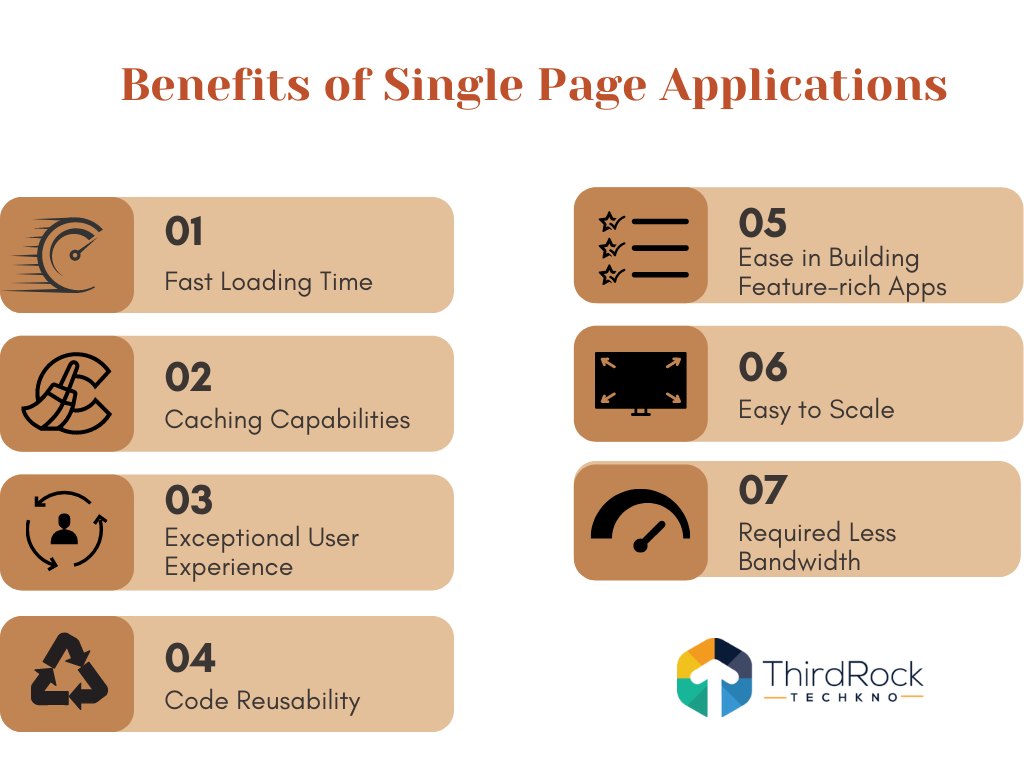
1. Fast Loading Time
Traditional web pages take double the time to load a page. With customers’ low patience appetite and even lower attention spans, this could have a substantial effect on online businesses and their sales. On the other hand, SPAs load a page at lightning-fast speed on the first request itself.
2. Better Caching
Caching is another significant benefit for Single page applications. SPAs can cache any local data effectively. SPAs request data from the server only once and can then store all the data upon initial download. They can be accessed in offline mode or even when a user has a poor internet connection.
3. Exceptional User Experience
SPAs deliver a user experience unlike any other. Customers do not need to wait for a new page to load just like how they experience on a desktop or a mobile app. This is because only the content alters and not the entire page.
4. Code Reusability
SPAs make the development of mobile applications a lot simplified, as developers have the convenience to reuse the same backend code for both web applications and mobile applications. In addition to that, debugging Single Page Applications through Chrome allows one to closely monitor and analyze network operations and page elements.
5. Ease in Building Feature-rich Apps
Single Page Applications have the scope to include advanced features into a web application. Traditional web apps on the other hand require a complete page reload which makes it difficult to include essential features.
6. Easy to Scale
SPAs make developments hassle-free, allowing developers to scale apps with ease in order to keep up with the ever-changing demands of the customer and the requirements of businesses.
7. Required Less Bandwidth
SPAs are quick and easy to load since the pages are loaded only one. This means SPAs consume less data bandwidth and work especially well even in areas of poor infrastructure and slow internet connections.
While SPAs may have a ton of benefits, how can you decide if developing one is what your business needs? It’s important to understand that customer expectations from UI are rapidly increasing. The best way to thrive in today’s ultra-competitive space is by being customer-centric and listening to what your customers want.
If your product is facing troubles with user experience, it’s time you consider moving with the tide and trends of the latest technology. Believe it or not, bringing AngularJS onboard further unlocks all the features of SPA. This new-age framework with all its dynamic elements makes all the difference your business might be on the lookout for.
Also Read: Why Use Angular For Web Development in 2021: Top Features & Benefits

What is AngularJS & What Makes It So Popular?
First Introduced in 2009, AngularJS, Google’s brainchild, is defined as the structural framework for creating dynamic web apps. It is referred to as Superheroic JavaScript MVW Framework by its developers and creators, wherein MVW stands for Model-View-Whatever, wherein the Whatever stands for “whatever works for you”.
Attributes that contribute to making AngularJS highly popular include its ability to create lighter and faster apps, ensuring great performance, easy maintenance, and immense flexibility due to its MVW architecture.
AngularJS is best used in building interactive, modern, and dynamic Single Page Applications (SPA) with the help of its compelling features including two-way data binding, RESTful API handling, templates directives, deep linking, server-side communication, modularization, AJAX handling, and dependency injection.
With Angular, there is no dependence on third-party libraries to develop dynamic web applications. According to its co-creator Miško Hevery, “Rather than writing everything inside of JavaScript and then having a bunch of templates to generate the UI, AngularJS lets you write a lot of it in HTML, and HTML drives the assembly of the application.” What this means is developers can use HTML as a template language to express the components of the application. Its popularity also has much to do with its ease and ability to enable markup directly to the HTML.
And there is no doubt about the fact that business owners benefit from this too since the cost of creating the web page is shifted to the end-user like it is with any client-side framework. Hence this turns out to be a win-win situation for all, wherein the users experience brisk wait times during requests and gain a fluid interaction experience. On the other hand, Angular’s lightweight framework allows businesses to reduce their footprints on the web servers thereby promising faster load time.

How AngularJS helps to build the best Single Page Application?
Now that we are aware of the benefits of SPAs and the features of AngularJS, its easier to understand why they are a perfect fit together. AngularJS is undoubtedly the best building companion for single page applications. From faster development to seamless data management and long term maintainability, using AngularJS as a client-side framework enriches user functionalities for single page apps. There are several attributes of the AngularJS framework, which when leveraged can be used to build responsive and fast loading SPAs. Let us go through some of these:
Cross-Platform Compliant
Just like that extrovert, friendly person who gels with all, an AngularJS framework is compatible with every platform and works well on them all. This ensures high performance for any AngularJS Single Page App since the framework is known for its progressive and modern architecture, abundant flexibility, and zero-stop installation.
Quick Load Time
As stated before, applications made with AngularJS have faster load time. All credit goes to the component router feature of AngularJS which makes the delivery of automatic code-spilling possible. Through this feature users only need load the code that was requested for their view.
Superior Performance
One of the most significant problems businesses face is the performance issues of their applications. Common problems like minor delays could wreak havoc and even make your SPA unresponsive or broken, thereby losing potential customers or driving them away forever. Keeping in mind the performance factor is crucial when it comes to making a decision about the Single Page Application framework. No framework could promise exceptional performance, unlike AngularJS.
Offers Fantastic UI Support
An immersive user experience and an unmatched user interface are what you get when you for AngularJS Single Page Applications. When you’re building sites with the aim of capturing the customer’s attention quickly, with flashy UI elements and responsive load time, there is no better option than this framework. No wonder organizations including Domino’s, PayPal, Hawaiian Airlines, Mercedes-Benz, and Getty Images choose the likes of AngularJS for their enterprises.
Powerful Features
Apps built on AngularJs are lightweight and require fewer lines of code that would otherwise have been required from a developer? What makes this possible? AngularJs data binding feature eliminates the need for lines and lines of code thereby delivering impressive speed and performance. In addition to that, it also possesses a robust testing feature that makes the testing of the entire Single Page Application possible. It also flags issues and concerns when any link has been broken.
Flexibility
With AngularJS by your side, building a Single Page Application becomes a cake-walk. Quick, easy, interactive, user-centric, and hassle-free ensuring high performance all without the need of spending hours writing a great deal of code.
Easy Maintenance
Going with AngularJS for developing a Single Page Application today will not only benefit you in the present but will also be of huge significance in the future. A well-built framework like AngularJS offers easy maintenance to help you easily look after your app years later as well.
Ready to elevate your web application with Angular expertise? Hire our experienced Angular developer today and take your project to the next level.
Conclusion
AngularJS is one of the most robust and powerful frameworks there is. Single Page Applications developed with AngularJS are like a match made in heaven that is sure to reduce your operating costs and create a fluid experience for your users. An agile framework like AngularJS is best suited for businesses looking to create SPAs in a highly competitive environment. With its advanced features and many benefits, it comes as no surprise as to why so many big businesses opt for it. Looking for an Angular web development services partner? Here at Third Rock Techkno, we hold the power of working with leading technologies and crafting customized solutions for our clients from varied industries. Let us help you create a dynamic AngularJS Single Page Application for your business.
Krunal Shah
Krunal Shah is the CTO and Co-founder at Third Rock Techkno. With extensive experience gained over a decade, Krunal helps his clients build software solutions that stand out in the industry and are lighter on the pocket.
 | Let's connect!