
To succeed in the present day business environment, companies need to cover all aspects of app development completely. Since the competition in the modern world is so fierce, you can’t afford to be complacent.
Now to develop a good product, you need strong and efficient technologies to support it. JavaScript over the years has remained one of the leading client-side programming languages. With constant evolution, JavaScript has become a major cross-platform app development tool along with being used in web frontend development.
But, if you think that the usage of JavaScript ends here, you are wrong. Lately it is being used with Node.js and has brought a paradigm shift in web development.
Now, Node.js’ advantages are immense and very diverse. But before that, we need to understand the basics of the framework and then take things forward.
So, here we go!
What is Node.js?
Node.js is a runtime environment whose main purpose is to execute JavaScript on the server-side. It was originally written in 2009 and has made a huge impact ever since. The interest level in the runtime environment rose to its peak in 2017 and has been high ever since. The level of benefits of Node.js can be understood from the fact that market leaders Walmart, Netflix, etc. use it.
One of the prime reasons behind the popularity of Node.js is that it helps in the development of real-time network applications. In addition, since it is open-source, it is easily accessible as well. With Node.js. the developers have access to the event-driven I/O APIs. The cross-platform app development runtime environment can also JavaScript code through Google’s JavaScript V8 engine.
Hiring Nodejs Developers? Here’s Everything You Should Know
Read MoreNow after looking at the basics of Node.js, we head straight to Node.js’ pros and cons.
Advantages of Node.js
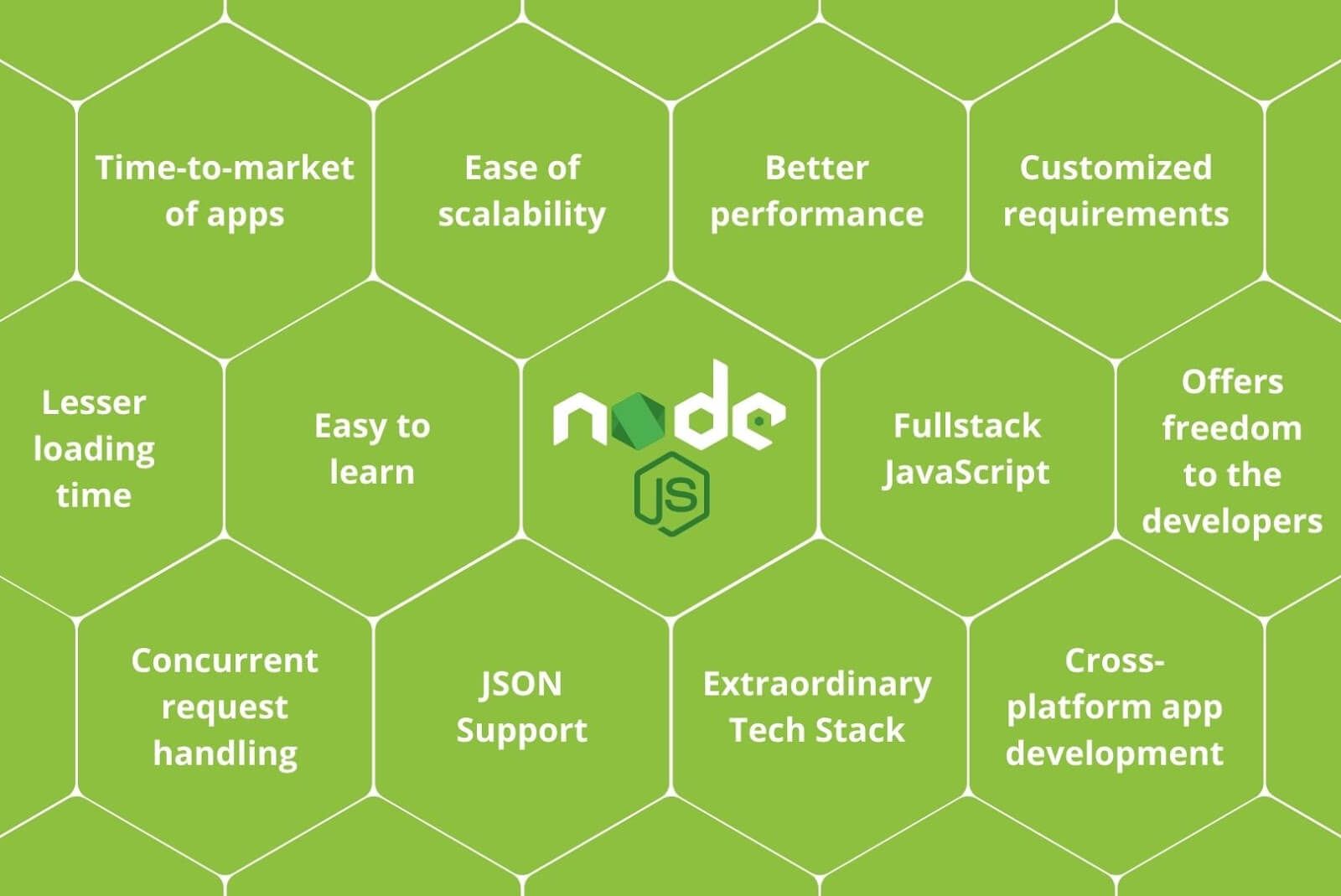
After its launch, Node.js was realized as an exciting software in the JavaScript realm. Thus, we have listed some of the leading benefits of Node.js for the betterment of our readers.
Ease of scalability
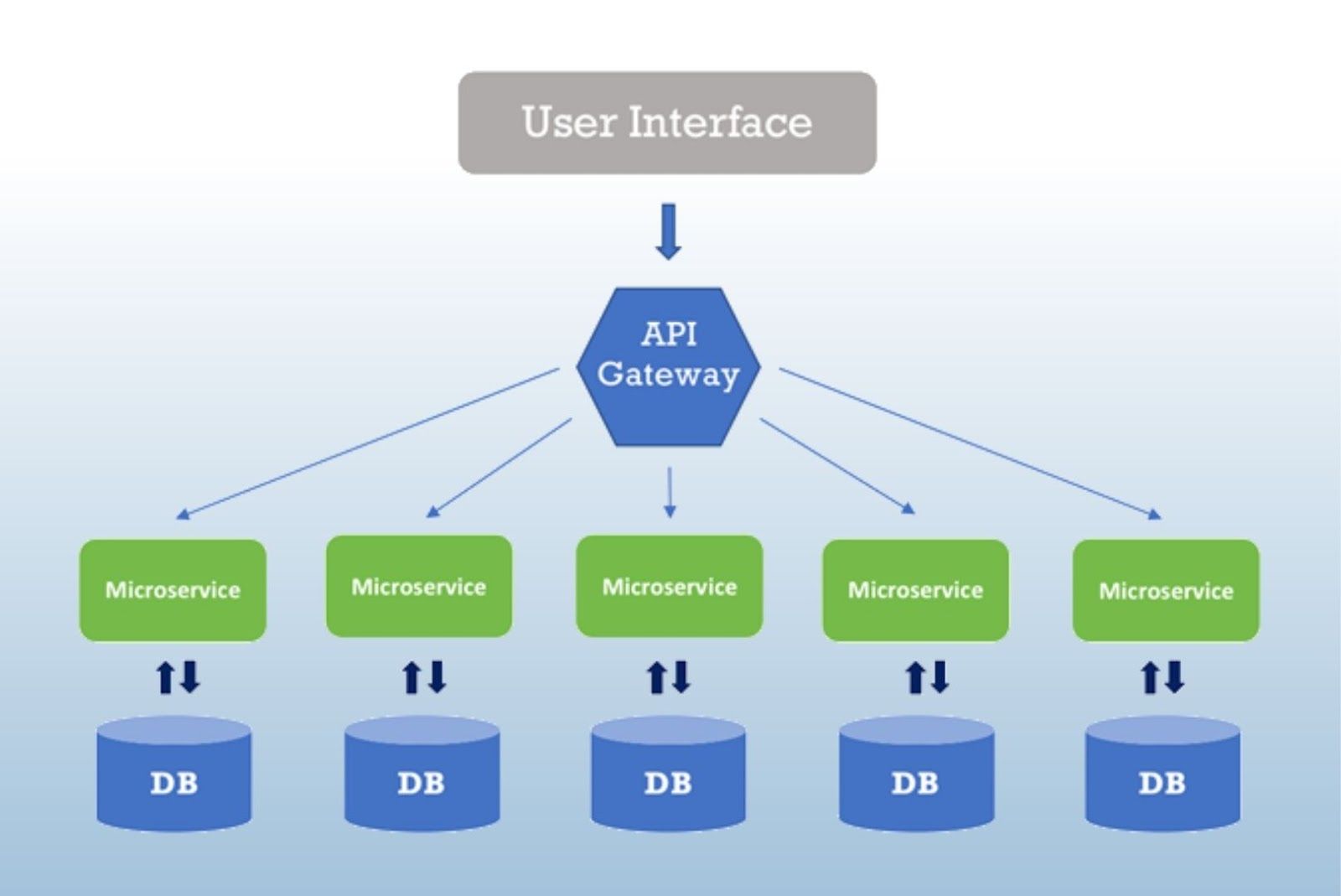
Node.js has been regarded as a viable solution when it comes to developing scalable applications. The cross-platform runtime environment has a cluster module and facilitates load balancing. Moreover, Node.js has a non-blocking event loop mechanism that enables servers to work seamlessly.
If you want your modern apps to work up and down as per the requirement, Node.js is the best platform. In addition, it enhances the overall performance of the web applications and uses fewer resources as well.
During the vertical scaling of the web application, Node.js allows adding extra resources to the single nodes. These extra resources are added to the existing system only.
Node.js is known for better performance

Since Node,js is open-source, it has a large developers’ community. The community is very active and ever-evolving and contributes to its development and betterment. In fact, one of Node.js’ advantages is that the developers always get the support of JavaScript programmers. They provide easy solutions and ready-made answers in GitHub.
As the developers have extensive support from the community, it is easier for them to solve even the difficult problems. Besides, JavaScript has NPM which is the biggest package manager that offers numerous tools for web development. In addition, the vibrant community of the Node.js developers is supported by giants such as Netflix, Google, Amazon, etc. Because of the acceptance of the tech giants, technology has grown and a bright future ahead.
List of companies using Node.js is not limited to the above-mentioned tech giants. Market leaders such as PayPal, Uber, Zendesk, Trello, Medium, Microsoft and more use Node.js extensively.
6 Types of Applications You Can Build With Node.js
Read MoreCost-efficient with full-stack JavaScript

With Node.js, the developers can write codes in both frontend and backend in a hassle-free way. This is because it gives a chance to write server-side code in JavaScript to the developers. Thus, there is no need to hire two resource teams for the company which saves the overall cost of development.
Besides this, it makes the process of the total web development faster without compromising on the quality. Another benefit of Node.js with full-stack JS is that you don’t have to hire separate developers for the frontend and backend. Thus, even the budding start-ups can use Node.js efficiently.
Extraordinary Tech Stack
Having a robust technology stack is one of the main reasons why Node.js has become a standalone name worldwide. When you use Node.js for backend, you automatically get all the advantages of full-stack JavaScript development. Some of the top Node.js’ advantages are:
- High performance and speed
- Enhanced overall productivity and better efficiency
- A plethora of free tools for the developers to choose from
- Feature of code sharing and reuse
- Ease of communication and knowledge sharing within the team
Apart from the above-mentioned advantages, with Node.js, the entire development team becomes more flexible. As a result, you will get faster and more reliable software. Moreover, code reuse also helps in creating new levels of abstraction by wrapping frontend and backend into modules.
What is MEAN Stack? MEAN Stack Components and Benefits
Read MoreJSON Support

Unlike PHP or Ruby on Rails, Node.js does not convert within the binary models to use JSON format for communication. This feature becomes beneficial to the developers when they need to build RESTful APIs for NoSQL database support. MongoDB in MEAN Stack is a prime example of the advantage of this feature.
With the help of JSON support, Node.js also fosters seamless communication with the main data transfer standards. This is considered as one of the major benefits of Node.js.
Easy to learn
The developers don’t need to do the hard drills in order to become accustomed to Node.js. As it is based on JavaScript, the developers don’t need to write more codes for website development. There is no doubt about the fact that JavaScript is a universal language especially when it comes to frontend development.
Moreover, since JavaScript is so popular, most of the front-end developers hold a strong hand in it. Thus, when they start using Node.js for the backend, it becomes very easy for them. As the adaptation rate is high, it has a positive impact on the overall web development time.
Managing the time-to-market of apps
‘Time is the most precious thing’ and looking at the current market scenario, we couldn’t agree more. ‘Time-to-market’ is one of the essential benchmarks for the development team as it helps in gauging their overall performance.
One of the main benefits of Node.js is that it is lightweight. Because of this, it allows the developers to increase the speed of the web development process. Moreover, the team gets ready-to-use codes and libraries from GitHub that automatically saves a lot of coding time.
Moreover, it is easier for the development team to manage the codes as Node.js offers server-side and client-side in JavaScript. As compared to its peers, developers face lesser roadblocks in managing the codes in Node.js. Also, the developers can get feedback from the production to execution. This helps immensely in shortening the overall app’s time to market.
Best for customized requirements
Constant evolution is inevitable, especially if you wish to stay afloat in this cut-throat competitive scenario. But it is very difficult for businesses to evolve constantly. Thus, if you are wishing to explore the industry dimensions or increase the user base, Node.js can be your best ally.
It is highly preferred for developing customized web apps for rapidly growing industries. It has a built-in API which is used for developing DNS servers and HTTP.
Several leading organizations such as PayPal have experienced a change in fortune after using Node.js. PayPal experienced 200ms faster response time after replacing Java with Node.js and JavaScript.
Preferred for cross-platform app development
Cross-platform apps are as necessary as ‘oxygen for life’ if you wish to expand your user base. One of Node.js’ advantages is that the developers can use NW.js and Electron to develop real-time cross-platform apps. Moreover, here developers don’t need to write different sets of codes for different platforms as well.
Also, if your development team doesn’t have in-depth knowledge in Objective-C, C#, you don’t need to worry. With Node.js, it is still possible to build native applications without the knowledge of the above-mentioned languages. In addition, it is possible for the developers to use more Google tools to write codes or debug.
Best Node.js Frameworks For Efficient Web Development
Read MoreConcurrent request handling
It is simpler for Node.js to handle thousands of concurrent requests at once. Because of this benefit of Node.js, it is highly used in complex and large web applications where the number of visitors are more. Moreover, while handling the requests, there is minimal overhead on a single process in Node.js.
Lesser loading time
One of the biggest benefits of Node.js is that the caching module reduces the overall loading time. Thus, the developers can breathe easily and execute their work in a hassle-free way.
The perks of having a caching module are enormous. For example, whenever the first module of the web app gets a request, it gets directly cached in the in-app memory. Thus, because of this, the user gets access to the web-pages within a few microseconds without waiting much.
Increase in App’s overall performance
When you have a complex application that has to deal with multiple to and fro requests, it impacts its performance. Moreover, as the competition in the modern world is too stiff, you cannot have an application that is unable to handle loads of requests.
In this situation, the businesses can get high results from Node.js’ advantages. Node.js has a single-threaded event-loop model that renders non-blocking asynchronous architecture. Because of the architecture, there is no need to create more threads by using extra resources.
With lesser threads, the responsive time gets a positive push. Thus, the applications become capable of handling multiple requests at the same time.
Offers freedom to the developers
One of the major benefits of Node.js is that it offers freedom of development to the developers. Unlike its peers such as Ruby on Rails, Node.js doesn’t impose strict guidelines. Thus, the developers are allowed to begin anything from scratch while continuing the app development process.
Disadvantages of Node.js
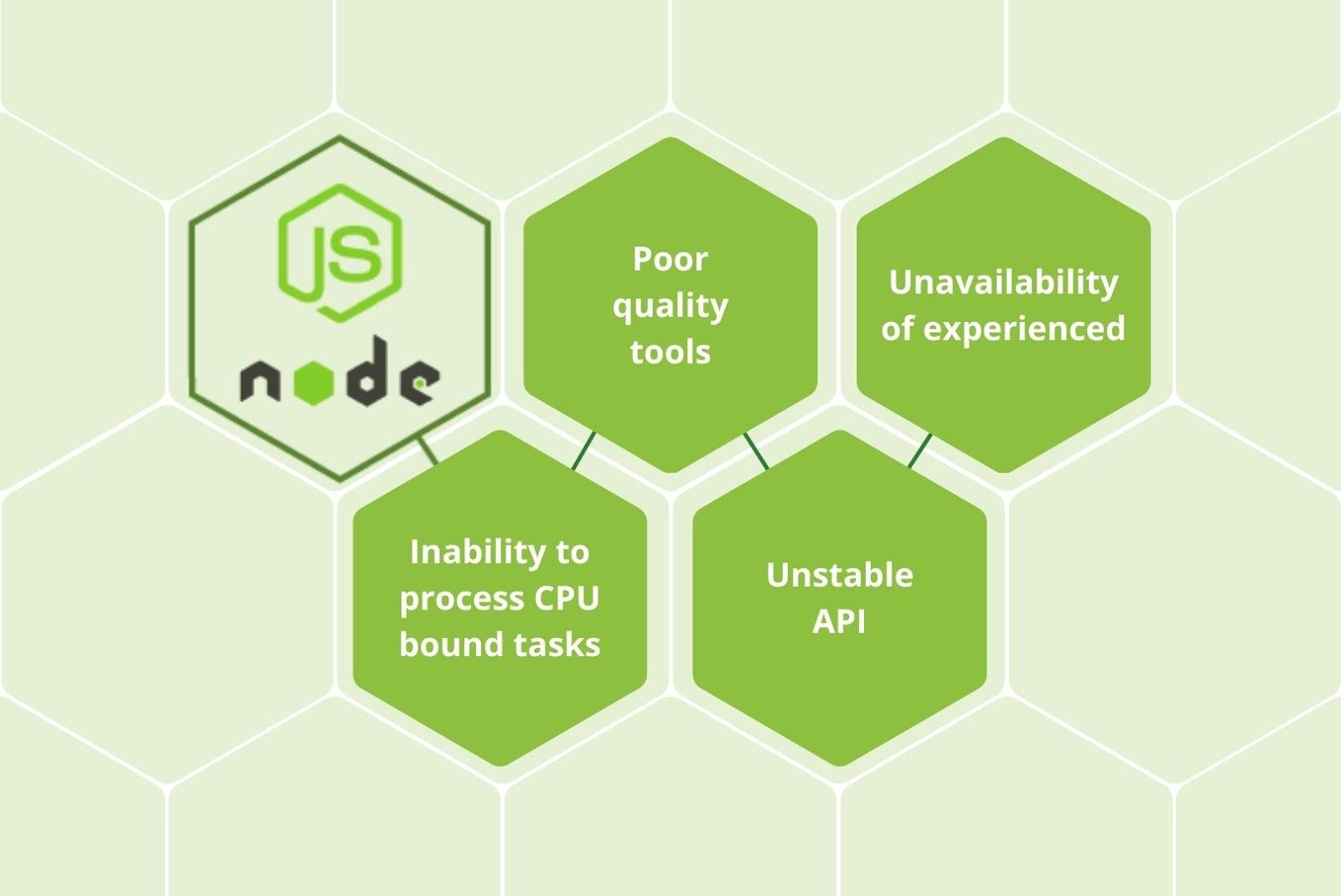
After the high-flying advantages, it is important to learn the cons of Node.js as well. Below are the disadvantages of Node.js.
Inability to process CPU bound tasks
One of the biggest disadvantages of Node.js is that it is unable to perform heavy computation tasks. Node.js is capable of executing JavaScript code on a single thread basis. But the problem occurs when Node.js is asked to do a CPU bound task.
For example, whenever a heavy request comes, Node.js will first process it and then answer the other requests. Because of this, the entire processing system becomes slow which causes a delay in the event loop. This is the reason why Node.js is not preferred for heavy computation.
Poor quality tools
The modules of Node.js are quite stable and mature. But there is a myriad of tools in the NPM registry that are of poor quality. In addition, the NPM registry itself is not well-structured to offer tools based on their quality and rating.
The open-source nature of Node.js has a major role to play in defining the quality of the tools. On one hand, the quality of the Node.js technology is closely monitored by contributors such as Joyent. Now as far as the rest of the tools are concerned, there are high chances that they might lack in quality.
Unstable API
Another major disadvantage of Node.js is that it has frequent API changes that are backward incompatible. Now because of their incompatibility, their instability leads to heavy code changes. Moreover, continuous change of codes becomes necessary as match the sync with the latest version,
Unavailability of experienced Node.js developers
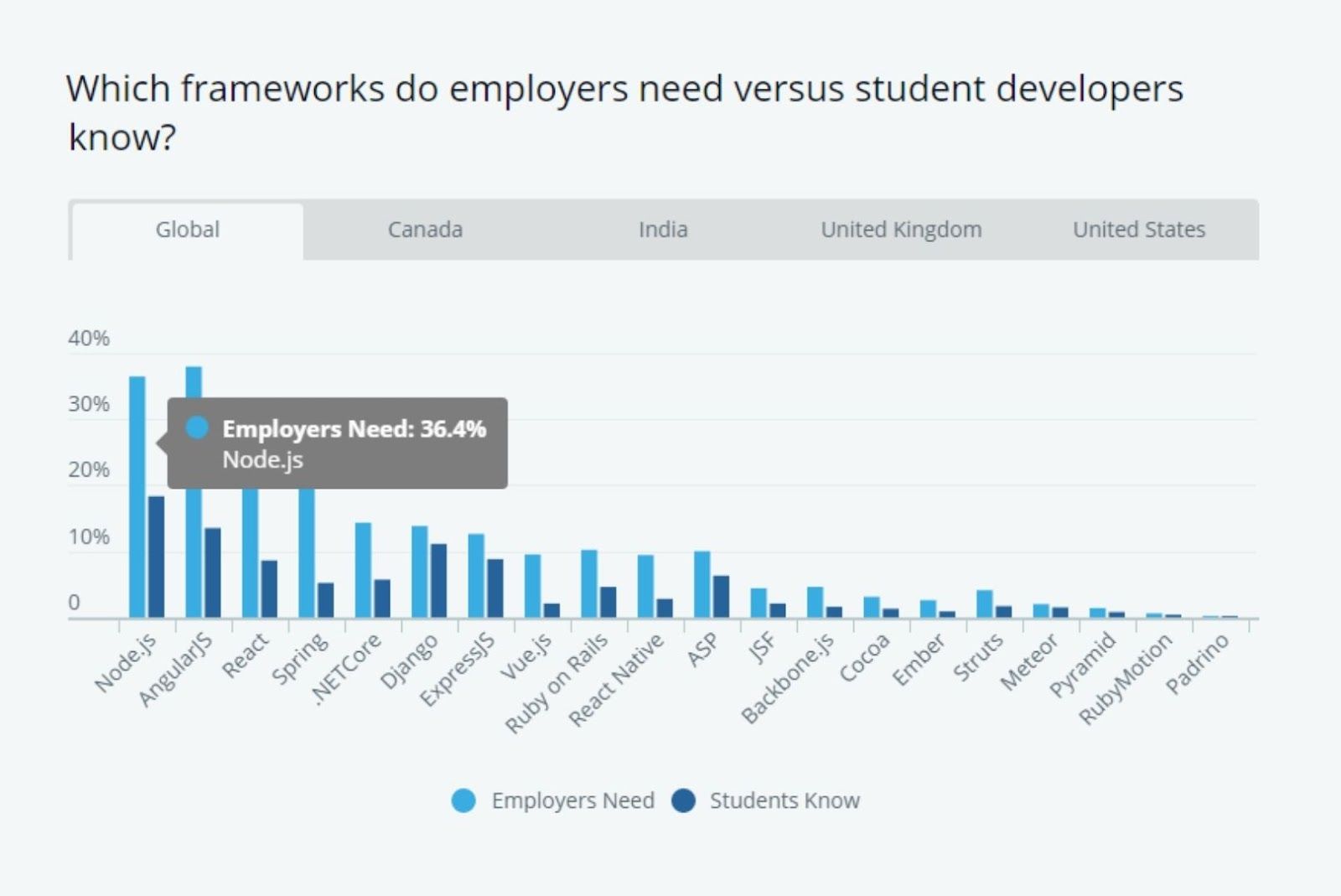
The potential demand of the Node.js developers is growing every year, but there are not enough experienced developers available. Moreover, businesses need to understand that not all JavaScript developers are Node.js developers. Because, to master JavaScript, the developers require to have knowledge about backend development.
Thus, despite millions of JavaScript developers, it is tough to find a skilled Node.js developer. That is why businesses these days are looking to outsource their Node.js development projects.
Conclusion
It is crystal clear that the benefits of Node.js are more than its disadvantages. Moreover, while understanding the pros and cons of Node.js, businesses also need to define their requirements as well. Also, it is also necessary to contact a leading Node.js development company to leverage the full benefits of the technology.
Moreover, as Node.js has JavaScript, it is used for both frontend and backend servers. Node.js has all the ingredients to take your business to newer heights, but it should be used correctly.
Looking For Expert Guidance on Your Dream Project?
Our diverse team of industry leading veterans can help you build the most viable solution.
Schedule a free consultation callKrunal Shah
Krunal Shah is the CTO and Co-founder at Third Rock Techkno. With extensive experience gained over a decade, Krunal helps his clients build software solutions that stand out in the industry and are lighter on the pocket.
 | Let's connect!