
Selecting the right headless CMS is a critical decision that impacts your organization's content strategy, development efficiency, and market agility. Strapi and Contentful stand as leading contenders in the enterprise headless CMS market, each offering distinct approaches to content management challenges.
A CMS software allows users to create, manage, and modify digital content without technical knowledge. It's commonly used for websites and blogging platforms to publish content efficiently.
Strapi and Contentful are two popular choices for managing content in modern web development. As headless content management systems (CMS), they offer flexibility and power for creating and delivering digital experiences. This comparison will help you understand the differences between Strapi and Contentful, allowing you to choose the best CMS for your needs.
Now, let's analyze their advantages and disadvantages to assist you in selecting the ideal solution for your organization.
What is Headless CMS?
Before we delve into these platforms, let's establish the context. A headless CMS decouples the content management (back-end) from the content delivery (front-end). Envision a control room where you construct your content using an intuitive interface, then link it to the expansive realm of your website through a versatile and robust API.
This separation provides unparalleled adaptability and scalability, allowing your content to seamlessly integrate across various platforms, devices, or channels, positioning it as an ideal conductor for contemporary websites and omnichannel content distribution.
What is Strapi CMS?
Strapi is a leading open-source headless CMS that is built on JavaScript, specifically using the Node.js framework. It provides developers with a flexible and customizable environment to manage content and build applications.
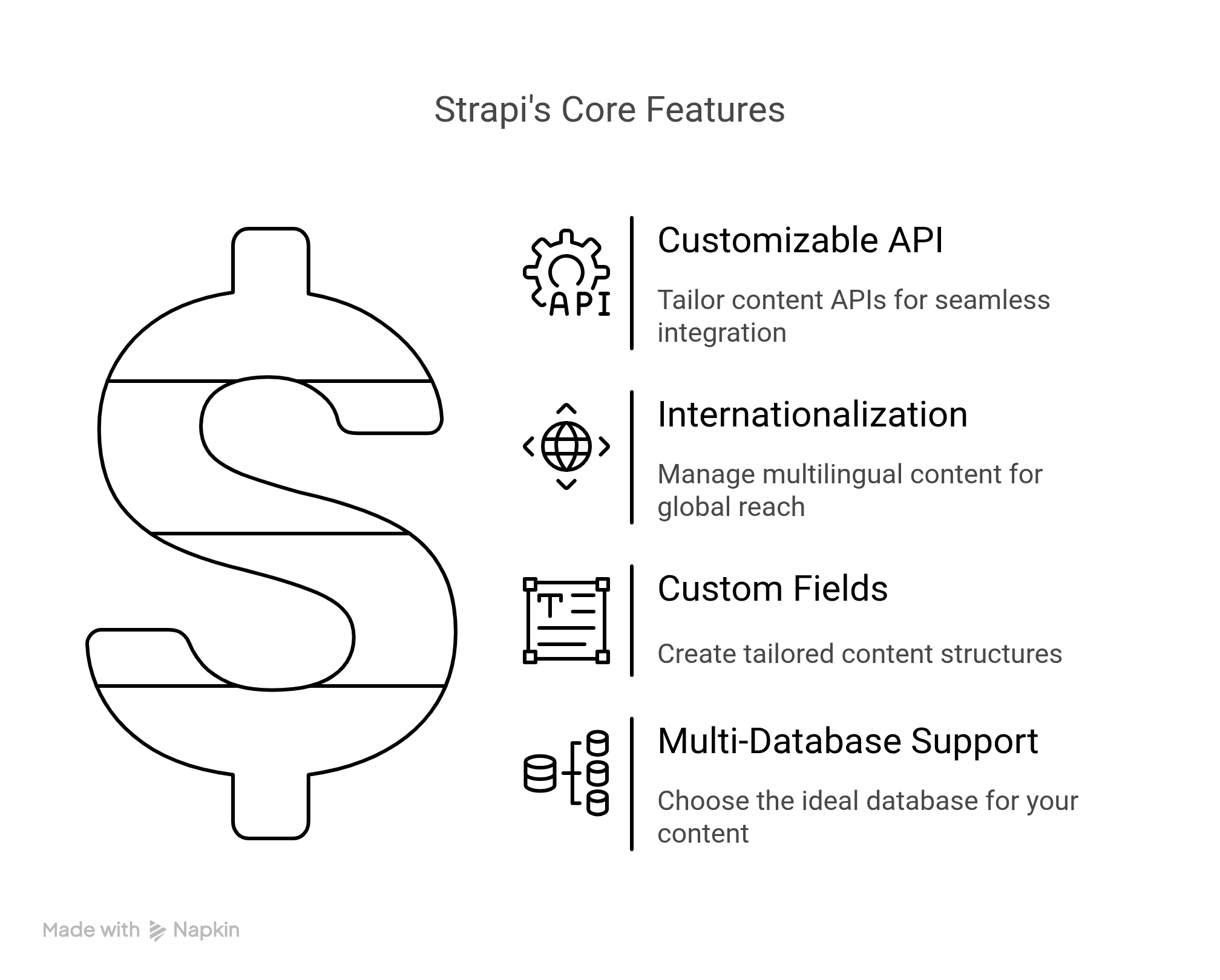
One of the key features of Strapi is its customizable API, which allows developers to tailor the content API to their specific needs, ensuring seamless integration with various front-end frameworks and technologies.
The platform also offers custom fields, allowing for the creation of tailored content structures, and multi-database support, enabling the use of different databases for different use cases.
Intuitive Features
- Customizable API: Engineer custom APIs that align with your website's unique operational flow. Visualize forging an exclusive connection between your content and the user interface, facilitating smooth integration.
- Internationalization: Broadcast to a global audience! Effortlessly administer multilingual content, ensuring a cohesive and universal user experience across different regions.
- Custom Fields: Create tailored tools for your content. Design bespoke fields to match your particular content needs, akin to developing a sophisticated software function or a user-friendly interface.
- Multi-Database Support: Choose the perfect stage for your data. Pick from various databases like PostgreSQL or MongoDB to find the ideal platform for your content.
Pros and Cons of Strapi
Let's look at some of the pros and cons so that you can have a better idea.
Pros
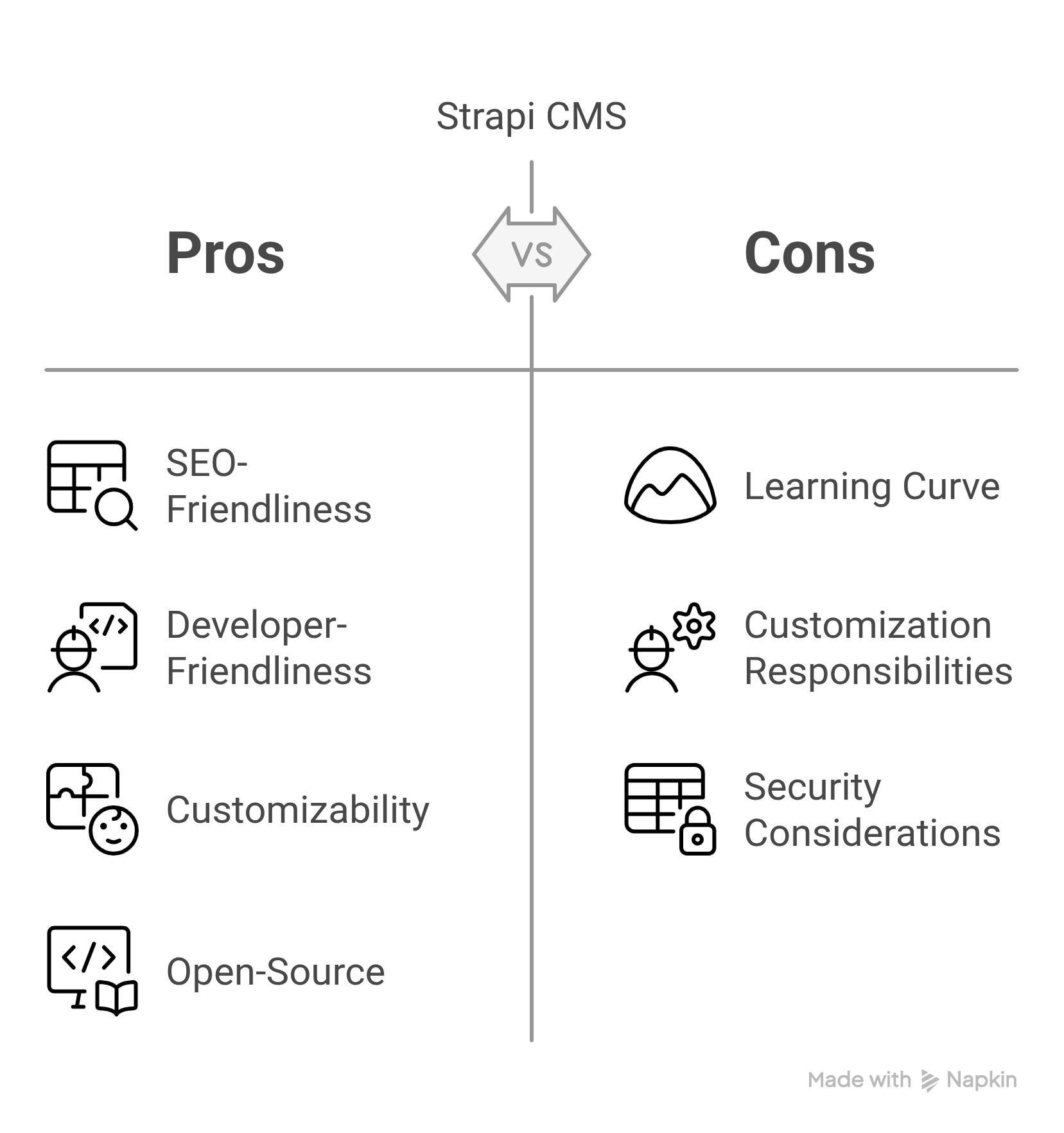
- SEO-Friendliness: Strapi is designed with SEO in mind, providing features and plugins that help optimize content for search engines, thus improving the visibility of web content.
- Developer-Friendliness: The platform offers extensive documentation, a supportive community, and a customizable environment, making it a favorable choice for developers.
- Customizability: Strapi's customizable API and support for custom fields allow for a high degree of flexibility in content management and application development.
- Open-Source: Being open-source, Strapi offers transparency, a collaborative community, and the potential for cost savings compared to proprietary solutions.
Cons
- Steeper Learning Curve: Understanding APIs might require technical expertise, like mastering a new Language.
- Customization Responsibilities: Building complex functionalities relies on developer skills, demanding the conductor's full attention.
- Security Considerations: Open-source nature necessitates robust security measures, like safeguarding your backstage from unwanted intrusions.
See How Strapi Can Improve Your Digital Experience
Request our case studies to learn how businesses like yours have successfully implemented custom Strapi solutions.

Strapi Use Cases
- E-Commerce
Strapi delivers exceptional value for e-commerce businesses seeking complete control over their product content architecture. Its open-source nature allows for deep customization of product catalogs, attribute relationships, and integration with inventory systems.
Key Benefits of E-Commerce
- Create custom product content models with unlimited attributes and relationships.
- Implement specialized pricing structures and promotion workflows.
- Build seamless integrations with existing inventory and ERP systems.
- Develop custom plugins for specific marketplace requirements.
- Control infrastructure costs as your product catalog scales.
2. Mobile Applications
For businesses building content-driven mobile applications, Strapi's API-first architecture provides the perfect foundation. Its lightweight content delivery and flexible authentication options make it ideal for mobile-first strategies.
Key Benefits of Mobile Applications
- Implement native authentication flows for mobile users.
- Create device-specific content variations.
- Build custom mobile-optimized APIs.
- Deploy edge-cached content for enhanced mobile performance.
- Implement offline content synchronization strategies.
3. Corporate Sites
Enterprise organizations seeking a robust yet flexible solution for corporate websites find Strapi's customization capabilities perfectly suited for complex stakeholder requirements and governance models.
Key Benefits for Corporate Sites
- Implement custom approval workflows for different departments.
- Create role-based access controls matching the organizational structure.
- Develop specialized content models for investor relations, careers, and media.
- Integrate with existing enterprise authentication systems.
- Maintain brand consistency across distributed content teams
Read Also : Strapi vs Sanity: Choose the Right Headless CMS
Pricing for Strapi
There are two categories when it comes to pricing: self-hosted and cloud.
We will start with Self-hosted first.
Pricing
| Community | Enterprise | Pro | Team |
|---|---|---|---|
| Free - forever | Flexible pricing | $99/month | $499/month |
|
|
|
|
Let's dive deep into Cloud Strapi for you.
Cloud Plan Pricing
| Pro | Team |
|---|---|
| Free - Forever | Flexible Pricing |
|
|
What is Contenful Headless CMS?
Contentful is a prominent headless Content Management System (CMS) that enables organizations to manage and deliver content across various channels through its powerful APIs.
As a cloud-based platform, Contentful provides a centralized hub for content, making it easily accessible for developers and content creators alike. Its core features are designed to streamline content management processes, enhance collaboration, and improve the overall efficiency of content delivery.
Contentful Features
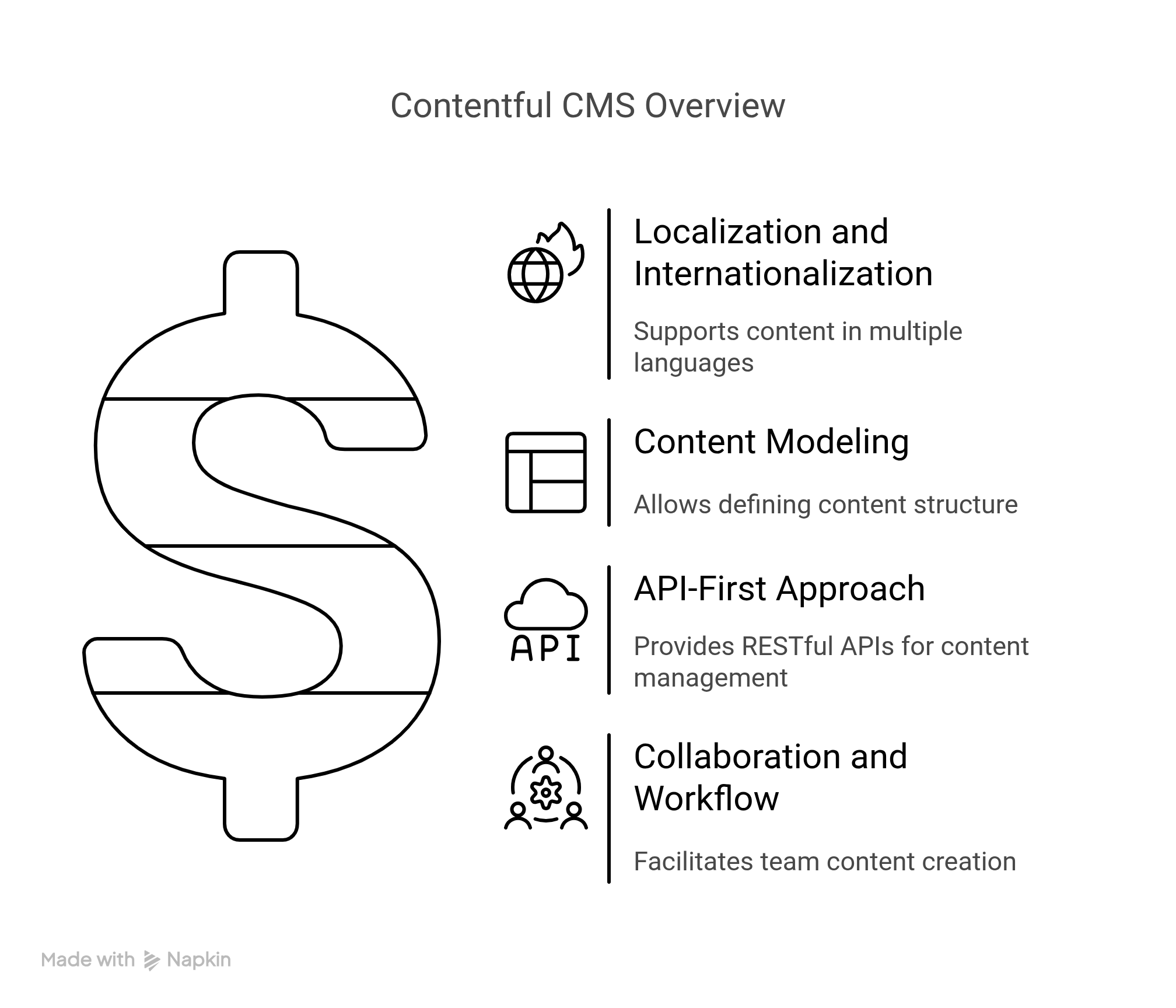
- Localization and Internationalization: Contentful supports localization and internationalization, allowing you to manage content in multiple languages and adapt it for different regional audiences.
- Content Modeling: Contentful provides a flexible content modeling system that allows you to define the structure of your content. You can create content types with various fields to accommodate different types of content, such as articles, products, or landing pages.
- API-First Approach: Contentful is built with an API-first approach, offering a set of RESTful APIs that enable you to retrieve, create, update, and delete content manually.
- Collaboration and Workflow: Contentful offers collaboration tools and workflow features that support content creation and publishing processes. Multiple team members can work on content simultaneously, with roles and permissions to control access.
Pros and Cons of Contentful
Let's look at some of the pros and cons so that you can have a better idea of which one to choose.
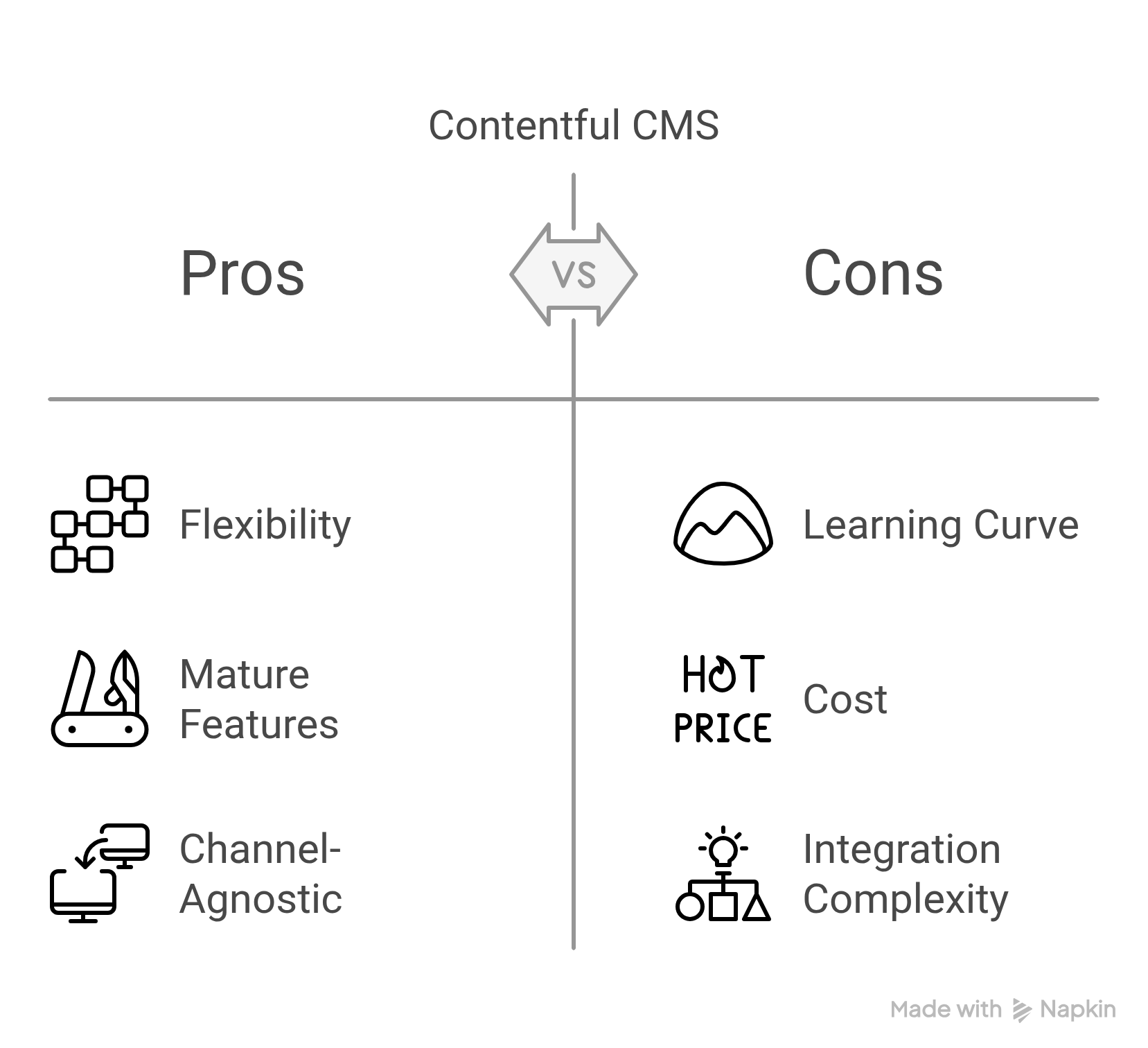
Pros
- Flexibility: Contentful's modular architecture and customizable content types offer a high degree of flexibility, allowing organizations to tailor their content management systems to their specific needs.
- Mature Features: Contentful provides a robust set of features, including powerful APIs, content orchestration, and app integrations, that support complex content management requirements.
- Channel-Agnostic System: Contentful's headless nature makes it channel-agnostic, meaning content can be delivered seamlessly across websites, mobile apps, and other digital platforms without the need for extensive modifications.
Cons
- Learning Curve: The flexibility and breadth of features offered by Contentful may require a learning curve for new users, particularly those with limited technical expertise.
- Cost: While Contentful offers a range of pricing plans, the cost can escalate for larger organizations or more complex projects that require advanced features and higher usage limits.
- Integration Complexity: While the app framework allows for extensive integrations, setting up and maintaining these integrations can be complex and may require additional development resources.
Start Your Strapi Implementation with Proven Experts
Schedule a consultation with our certified Strapi experts to discuss your project requirements and implementation timeline
Contentful Use Cases
- Personalization
Contentful excels in delivering AI-driven personalization capabilities for organizations that require sophisticated audience targeting without the need for extensive custom development.
Key Benefits of Personalization
- Implement AI-native personalization with minimal development.
- Create audience segments with built-in tooling.
- Deploy personalized content across multiple channels simultaneously.
- Access advanced analytics for personalization performance.
- Scale personalization efforts without infrastructure concerns.
2. Website Management
Organizations requiring future-proof website architectures with global reach choose Contentful for its enterprise-grade reliability and built-in distribution capabilities.
Key Benefits for Website Management
- Guaranteed uptime SLAs for mission-critical content.
- Built-in global CDN for consistent performance.
- Simplified workflows for marketing teams.
- Structured content models for maximum reusability.
- Enterprise-grade user management and permissions.
3. Multi-brand Experiences
Contentful provides sophisticated tools for organizations managing multiple brands, enabling consistent experiences while maintaining brand differentiation without technical constraints.
Key Benefits for Multi-brand Experiences:
- Unified content hub for cross-brand management.
- Built-in workflows for brand-specific approvals.
- Advanced reuse of content across brand properties.
- Simplified management of shared brand assets.
- Consistent governance across brand portfolios.
4. Making the Strategic Choice for Your Business
When evaluating Strapi versus Contentful for your specific use case or industry, consider these key decision factors:
Development Resources: Organizations with strong development teams often maximize Strapi's flexibility, while those seeking to minimize development requirements may benefit from Contentful's out-of-box capabilities.
Time-to-Market Priority: For aggressive launch timelines, Contentful's enterprise-ready features accelerate deployment, while Strapi offers greater long-term customization potential.
Budget Considerations: Growing organizations with technical resources typically achieve lower total cost of ownership with Strapi, while enterprises valuing managed services often find Contentful's predictable pricing advantageous.
Integration Requirements: Businesses with unique or legacy systems benefit from Strapi's unlimited customization, while those using standard enterprise tools may find Contentful's pre-built connectors valuable.
Pricing for Contentful
Pricing
| Free | $300 / month | Custom |
|
5 users, 4 standard roles, 2 locales, 1,000,000 API calls per month, 0.1 TB/month bandwidth. |
20 users, 4 standard roles, 4 locales, 2,000,000 API calls per month, 0.75 TB/month bandwidth. |
Thousands of users, no API call limits, and custom bandwidth usage limits with overage. |
|
|
|
Choose and Build the Right Headless CMS Software
So, who wins the crown? It depends on your needs and priorities. Strapi's open-source flexibility and developer-friendly approach are ideal for cost-conscious organizations with technical expertise. Contentful's robust features and channel-agnostic nature cater to larger organizations seeking a feature-rich, easy-to-use solution.
No matter your choice, Third Rock Techkno is your expert guide in the Strapi development. We help you navigate the complexities, choose the right tool, and build a seamless content management experience that empowers your website to conquer its goals.