
To expand their business, organizations are looking for larger customer acquisitions and for that, they are developing complex apps. The larger, complex applications provide a myriad of services to the customers and therefore, Microservices are becoming extremely popular.
Microservices are apps that can be separated and used as a combination of smaller services. Therefore, it is inevitable for businesses to know the best languages for Microservices. Enterprises are increasingly looking to redesign their traditional system into sequences of independent Microservices.
Therefore, in this blog, we will understand the best programming languages for Microservices. In addition, we’ll see how the microservice architecture works and what are the best practices to picking the top languages for microservices
But before getting into the details, let us get a brief idea about microservice architecture.
What is microservice architecture?
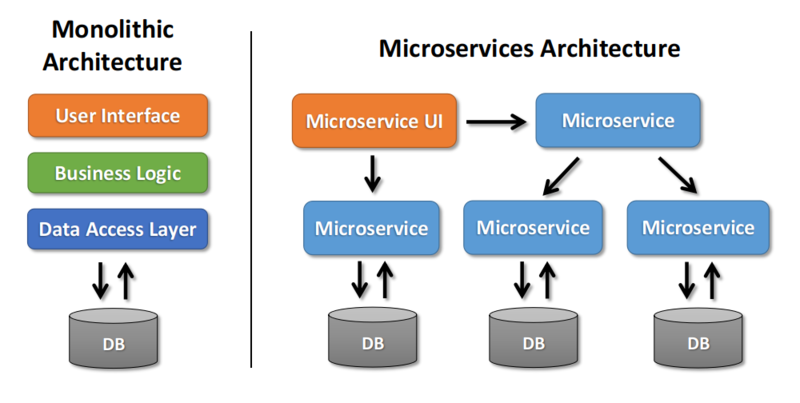
It is a software development approach that is used to disintegrate mobile applications into smaller parts. Microservice architecture is rapidly replacing monolithic architecture that is used in heavier, complex applications.
The basic focus of the microservice architecture is to develop cloud-ready apps and simplify the deployment process. The architecture has several built-in programming languages and also uses different data storage techniques.
What is the process to choose programming languages for microservices?
Business enterprises need to understand that microservices can be implemented with a plethora of frameworks and tools. Therefore, it is necessary to employ the best practices while choosing a programming language for microservices. We have listed a few criterions that will help in evaluating the best programming language for microservices.
- The language must be independent of deployment and must be highly observable.
- It must have a customer-centric approach and according to the changing trends, must support automation.
- The structure of the language should be around the business domain.
- It must have decentralization of components and must support continuous integration.
See More: How to Pick the Best Languages for Microservices Architecture
Top languages to pick for developing a microservices architecture
To build a state-of-the-art microservices architecture, it is necessary to understand what the top languages are for it. Here, we have curated a list of leading languages for microservices that will help you to make an informed decision.
1. Node.js
For start-ups and bootstrapped enterprises, Node.js has become a beneficial platform for both startup enterprises and established business organizations. Because Node.JS is created with the V8 runtime, it is a highly preferred language for I/O bound tasks. In addition, it is known for higher productivity and performance at a lower cost and renders satisfaction to the developers. This is one of the prime reasons why enterprises consider Node.JS as the leading programming language for Microservices.
If there is proper utilization of NodeJS and microservices, the same load of programs can be handled with just 1/10th of the hardware. And because of its increased productivity, NodeJS is preferred by innovative business organizations.
See More: 10 Useful NodeJS Libraries You Should Know in 2022
2. Java
Java is a great programming language for Microservices as it has annotation syntax which makes it easier to read. Moreover, while working with complex systems, Java offers value in code readability. And with annotation syntax, the process of Java Microservices becomes easier when powered by the Microservices framework.
There is a myriad of Java frameworks that are compatible with the Microservices architecture. Some of the leading frameworks are Spark, Spring Boot, Restlet, Dropwizard, and more.
Spark: It supports in creation of web applications in Kotlin and Java 8 with lesser efforts
Spring Boot: Whether it is an inversion of control, aspect-oriented programming, and more, Spring boot works aptly for various languages.
Dropwizard: The main focus of this Java Microservices framework is to assemble mature and stable libraries of Java. The amalgamation of libraries is done into a lightweight and simple package.
Restlet: The developers here can build immaculate website APIs. These web APIs trail the REST architecture model
Besides this, Java renders better connectivity to the back-end resources and model components. It provides a best-in-class user interface (UI) as well. Therefore, for the above reasons, it becomes one of the best languages for Microservices.
See More: Should you use full-stack JavaScript development?
3. Python
Python has easy integration with various technologies and is a high-level programming language. It is one of the best options for developers as it enables fast and easy prototyping. This programming language for Microservices is highly compatible with established languages such as ASP and PHP. Some of the leading Python frameworks that are popular for website development are:
- Flask: This Python micro framework depends on WerkZeug and Jinja2.
- CherryPy: It is an object-oriented website framework from Python that is highly mature.
- NameKo: If the developers wish to concentrate on app logic, they must go for NameKo. This is one of the main reasons why NameKo is considered a Python Microservices framework.
- Falcon: If the aim is to create cloud APIs, smart proxies, and application backends, Falcon is a great choice.
- Bottle: This framework is lightweight, simple, and very fast.
4. .Net
In the realm of web development, .Net is used to build simple APIs that later become Microservices. This programming language for Microservices is ideal for cross-platform development. In addition, the language has a built-in Docker container that assists in developing Microservices.
The .Net Microservices can be easily integrated into the application written in Java, Node.js, etc. Moreover, along with this, it helps in gradually migrating to the core .Net technology and developing cloud services.
In Microsoft, there is a secured platform named Azure that is well-suited for .Net. This platform assists in running modules on the cloud through a hybrid method. .Net is also considered one of the best languages for Microservices as it helps in compiling different technologies for each service.
5. Golang
If the goal of the business organization is to go big on the existing project, Golang would be the best choice. This programming language for Microservices, also known as Go is popular for its API support and concurrency. Its concurrency is the main reason that enterprises can increase the productivity of their existing project.
Since its inception in 2009, Golang is considered the best programming language that offers great support and testing. For developing a great Microservice architecture, Golang has two impressive frameworks.
Go Kit: The Go Kit needs to be imported in a binary package and this is how it differs from GoMicro. It is best suited for domain-driven design, declarative aspect compositions, and explicit dependencies.
GoMicro: GoMicro is basically an RPC framework. It has several benefits such as server packages, PRC client, message encoding, load balancing, and more.
Golang has a simple syntax and that is why it is able to render impeccable testing support. Therefore, it is simpler to write robust tests and inculcate them into the entire workflow.
6. C++
C++ is a rapid, effective, flexible, and very complex programming language. This programming language for Microservices has a wide set of libraries that renders a great service registry. It also plays a vital role in robotics, automotive apps, and database services. In addition, the C++ Microservices is extensively used by the REST SDK cross-platform.
Final thoughts
The selection of the best language for Microservices depends on the knowledge of the team, tools that they’ll employ, etc. Microservices in itself is an extensive concept and are implemented to disintegrate products or solutions to a more granular level. Moreover, it is not recommended to start Microservices architecture from the beginning as it is difficult to define the boundaries at this stage.
Therefore, business houses before selecting the programming language for Microservices must be certain about their requirements. In addition, they must choose a reliable development service provider to leverage the best out of the languages.